
How to Choose an Outdoor Fountain Pump for Year-Round Use
باختصار شديد: An outdoor fountain pump has to survive three things an indoor pump does not: water getting in, sun and weather on everything above the waterline, and ice. Choose the IP rating for where the pump actually sits (IP68 if submerged), pick a housing and cable that tolerate sun, let your climate zone decide whether the fountain runs through winter or gets pulled, and winterize before the first hard freeze. Low-voltage DC pumps add one more decision — adapter, battery, or solar panel — and that choice shapes the whole installation.
What IP rating do I need for an outdoor fountain pump?
IP68 for a fully submerged pump. IP65 or better for a pump mounted outside the water, such as a reservoir-side waterfall pump, and IP67 if it may sit partly underwater. IP ratings describe protection against dust and water entering the housing — not freeze resistance, not UV weathering.
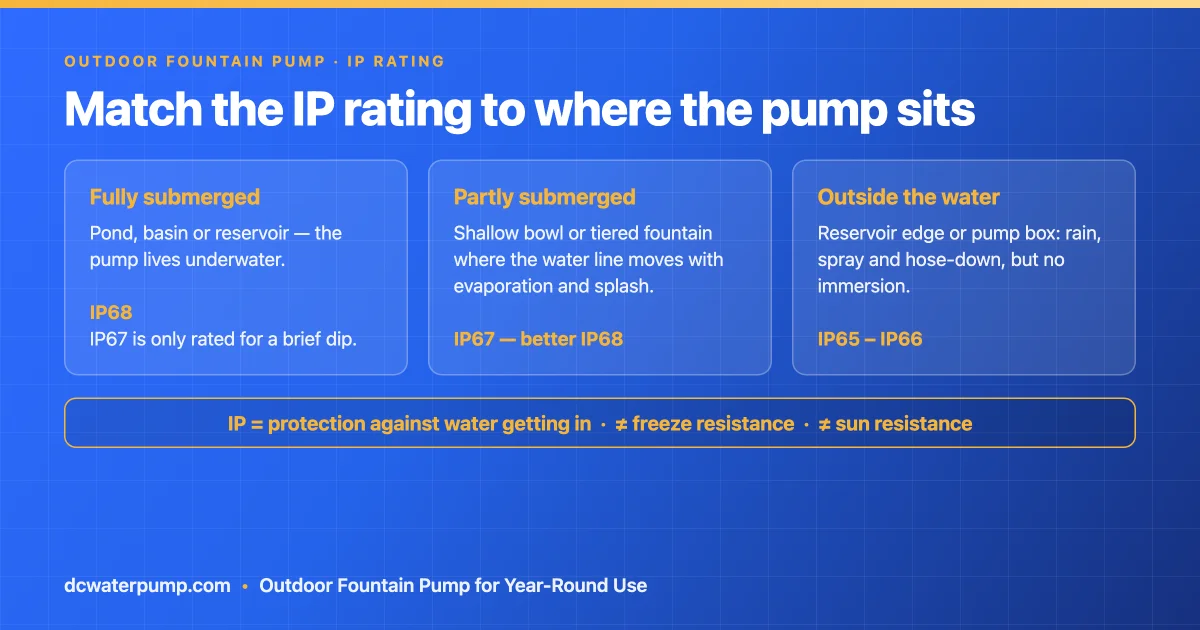
Decision 1 — Match the IP rating to where the pump sits
The two digits of an IP code answer two different questions: the first is dust, the second is water. For an outdoor fountain only the second digit changes your decision, and it maps directly onto how the pump is installed. The general IP reference published by Index Enclosures describes IP65 as protection against water jets, IP66 against powerful jets, IP67 against temporary immersion (up to 1 m for 30 minutes), and IP68 as protection during continuous submersion under conditions the manufacturer specifies.
| Where the pump sits | Minimum rating | لماذا |
|---|---|---|
| Fully submerged in a pond, basin or reservoir | IP68 | The pump lives underwater; IP67 is only rated for a brief dip |
| Partly submerged (shallow bowl, tiered fountain where the level drops) | IP67, better IP68 | The water line moves with evaporation and splash |
| Mounted outside the water, at the reservoir edge or in a pump box | IP65–IP66 | Rain, spray and hose-down, but no immersion |
Three things the table cannot tell you, and where outdoor buyers get caught:
- IP68 is an ingress rating, nothing more. It says water does not get into the housing under continuous submersion — nothing about ice pressure, sun, or running dry. Pond keepers regularly report IP68 pumps left in shallow pools that froze solid being crushed by ice; the lesson they draw is the right one — an IP rating is about water ingress, not freeze resistance.
- The rating has to cover the whole electrical path. A submersible pump with an IP68 body and an unsealed connector sitting in wet mulch is not an IP68 installation. On our pumps the coil and control board are potted in epoxy, which is what makes the IP68 rating possible; where a model uses an external controller box, that box carries the same IP68 rating and can be submerged, and a waterproof connector between pump and controller is an available option.
- Submerged is often the easier case. Water absorbs motor noise, keeps the pump flooded, and shields the housing from sun. The exposed items become the cable jacket, the connector and the adapter — which is why the next decision is about materials.
Decision 2 — Housing, cable and connectors that tolerate the outdoors
For a submerged pump, the housing spends its life in shade. For a pump mounted in the open, and for every cable, connector and controller box regardless of mounting, sun is the slow killer. Pond keepers commonly report replacing an outdoor pump every couple of seasons for the same reason: a plastic housing degraded in sunlight until it cracked. The fix they arrive at is the general rule — pay for a housing that is built for sun, or keep the pump out of it.
| عنصر | What to look for | What to avoid |
|---|---|---|
| Pump housing (exposed mounting) | Glass-fiber reinforced engineering plastics (PP+GF, PA+GF), or a metal body; or simply mount it submerged or in a shaded pump box | Thin, unfilled plastic housings marketed for indoor use |
| Pump housing (submerged) | Any properly rated IP68 housing; sun exposure is minimal | — |
| Cable | Outdoor-rated jacket, run in conduit or buried where it crosses soil; length chosen for the run so voltage drop stays small | Indoor-grade cable spliced outdoors |
| Connectors | Sealed, waterproof connectors above the water line or rated for submersion | Twist-and-tape joints in damp ground |
| Adapter / transformer | Indoors or in a weatherproof enclosure at the outlet, not in the basin | An adapter left on wet paving |
| Controller box (if external) | Same IP rating as the pump, mounted where it can be reached for service | — |
Our DC60, DC80 and DC85 series use PP+30%GF housings and the compact DC40 series PA66+30%GF — glass-fiber reinforced polypropylene and polyamide — with epoxy-potted electronics, and cable length, connector type and plug are customizable at the order stage, which matters more outdoors than anywhere else: a cable cut to the run is a cable with no splice in the ground.
Decision 3 — Your climate zone decides the winter plan
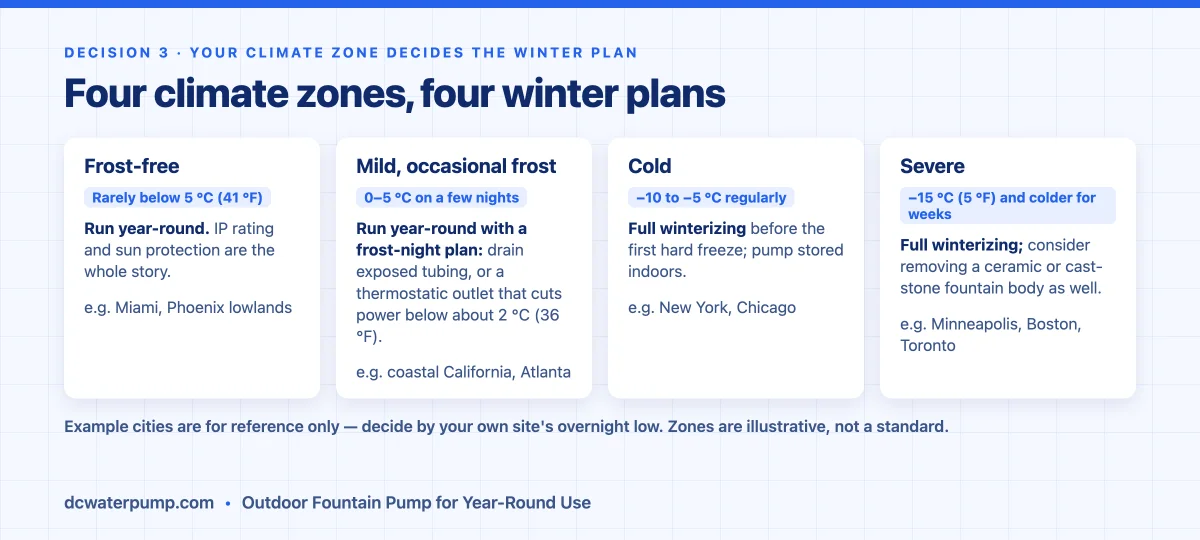
Water expands as it freezes. Anything that holds water — a ceramic bowl, a pump chamber, a low loop of vinyl tubing — is at risk once temperatures stay below freezing. دليل تجهيز سيارات هايلين لفصل الشتاء describes the damage plainly: freezing water cracks stone, resin or concrete, and water left inside a fountain can freeze and break the motor or tubing. There is no universal temperature threshold; the number that matters is your own site’s overnight low, and the zones below are illustrative.
| Zone (illustrative examples) | Typical winter lows | Recommendation |
|---|---|---|
| Frost-free (Miami, Phoenix lowlands) | Rarely below 5 °C (41 °F) | Run year-round; IP rating and sun protection are the whole story |
| Mild with occasional frost (coastal California, Atlanta) | 0–5 °C on a few nights | Run year-round with a plan for frost nights: shut down and drain the exposed tubing, or use a thermostatic outlet that cuts power below about 2 °C (36 °F) |
| Cold (New York, Chicago) | −10 to −5 °C regularly | Full winterizing before the first hard freeze; pump stored indoors |
| Severe (Minneapolis, Boston, Toronto) | −15 °C (5 °F) and colder for weeks | Full winterizing; consider removing the fountain body as well if it is ceramic or cast stone |
The thermostatic-outlet trick is field practice, not a standard: a DIY owner on Reddit runs an outdoor fountain through a smart plug that cuts power when the air temperature nears freezing, so the pump stops pushing water into tubing about to freeze. It is a convenience for the mild zone, not a substitute for winterizing in the cold ones.
Decision 4 — Winterizing: the 10-step routine
For the cold and severe zones, do this once a year, a week before the first forecast overnight low near 0 °C (32 °F). AC or DC, the sequence is the same; the one DC-specific note is that “power off” means unplugging the adapter or transformer at the outlet, not just lifting the low-voltage lead out of the water.
- Pick the date. One week before the first forecast frost. Waiting for the first ice is too late for stone bowls.
- Power off at the outlet. Unplug the adapter or transformer. If the circuit has a switch or protective device, use it; what protection an outdoor water-feature circuit needs is a matter of local code — in the US, NEC Article 680.
- Drain the fountain. Drain plug, siphon or tip. Every tier and bowl, not just the reservoir.
- Lift the pump and disconnect the tubing. Drain the tubing completely; water trapped in a low loop is what splits vinyl.
- Clean the pump. Remove the pre-filter sleeve, open the pump head, and clear algae and scale from the impeller cavity. On a magnetic-drive pump the rotor lifts out for cleaning; impurities left in the cavity over winter harden and are the most common cause of a rough spring start.
- Dry it. 24 hours indoors. Dry the connector pins — our usage precautions call for drying the pins before use — and inspect the cable jacket for cracks.
- Store the pump indoors, dry and frost-free, in a closed container so nothing gets into the intake. (Some AC pumps with shaft seals are stored submerged to keep the seal wet; a magnetic-drive DC pump has no shaft seal, so dry storage is fine.)
- Protect the fountain body. Once dry, seal porous stone if the maker recommends it, then cover and secure the cover so it does not collect a bowl of rainwater on top.
- Bring the electronics in. Adapter, timer, and an external controller box if you have one; cap any buried connectors.
- Spring restart, in order. Refill the basin, place the pump, and let it flood before you connect power: the pump chamber must be full of water and the air worked out before the first start — the two installation points our engineers stress are bleeding the air before installation and keeping positive pressure on the inlet if the pump is not submerged. Then reconnect at the adapter, watch the flow, and check the tubing for leaks. Dry-run protection on a quality DC pump will pulse the pump on and off if it starts dry, but that is a backstop, not a procedure.
If Mistake 7 in our fountain pump buying mistakes guide was news to you, this list is the long version.
Should I run my outdoor fountain in winter?
Only if the water cannot freeze around the pump: either a de-icer or heater keeps the water a few degrees above freezing, or the feature is deep and moves enough water that ice stays at the margins. Wherever overnight lows stay below freezing for consecutive nights, drain, pull the pump and cover instead.
That is also the consensus of the pond-keeping community; an r/ponds thread on running fountains in sub-freezing weather lands on the same two conditions — a heater, or enough flow — and otherwise recommends shutting down and pulling the pump. The physics behind it: ice forms first where water is still and shallow, at the edges and in tubing above the waterline. A running pump keeps its own patch open for a while, but as the ice sheet grows inward the basin’s usable volume shrinks until the intake starves or the rotor is locked by ice. A pump rated for a wide ambient range does not change that — one of our engineers put it to a customer this way: “For your application the pump will work if the fluid is not frozen.” Our pumps are rated for operation from −30 °C to 100 °C; the water is the limit, not the pump.
Decision 5 — Power: adapter, battery or solar
Outdoor is where a low-voltage DC fountain pump earns its keep, because the supply is a real design choice rather than “find an outlet.” Our DC fountain pump introduction covers the DC-versus-AC differences; here is what changes outdoors.
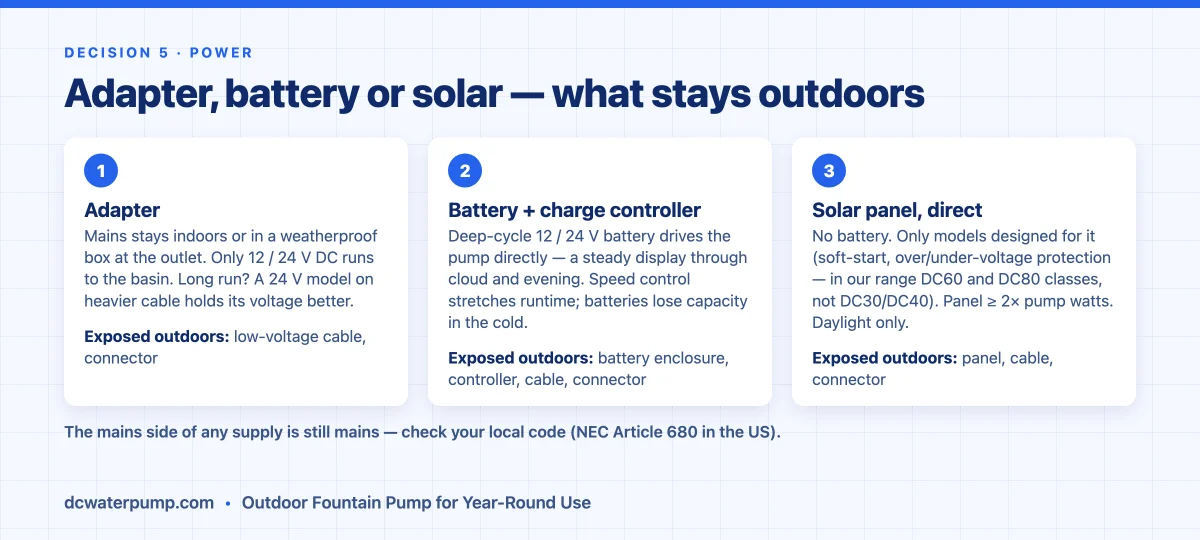
Adapter. The mains stays at the outlet, indoors or in a weatherproof box, and only 12 or 24 V DC runs to the basin. The outdoor issue is voltage drop over a long low-voltage run: the current is higher at 12 V than at 24 V for the same watts, so once the pump is more than a few meters from the supply, a 24 V model on a heavier cable holds its voltage better. Quality DC pumps protect themselves against a supply that is wrong — ours protect themselves outside the model’s input window (our 24 V models typically operate across about 10–30 V, model-dependent) — but a starved pump still runs weak.
بطارية. Deep-cycle 12 or 24 V batteries drive DC pumps directly, which is why balcony and remote-garden fountains are almost always DC. Two winter notes: many lithium iron phosphate batteries should not be charged below 0 °C according to their makers’ datasheets, and any battery loses usable capacity in the cold. Speed control (PWM, 0–5 V or a potentiometer) is the lever that stretches runtime.
Solar, direct. A panel can drive a DC pump with no battery at all, but only if the pump is designed for it: the panel’s output rises and collapses with every cloud, and the pump’s controller has to start softly and tolerate the swings. Ours are built for this — the controller carries a soft-start algorithm, and direct-panel operation has been a design requirement of our solar pump line from the start — but not every model in a lineup is: in our range the DC60 and DC80 classes run submerged and connected directly to a panel, while the small DC30 and DC40 do not. Size the panel generously; the rule our engineers give customers is that panel wattage should be at least twice the pump’s rated wattage. And when the buyer asks for a panel-only system, our honest advice is on record: “But frankly speaking, you have a controller and batteries, it’s easier to control the output of the water, more reliable.” Direct-solar is fine for a daytime garden fountain that may stutter under cloud; if you want a steady display, put a battery and charge controller between the panel and the pump. The solar-ready models in our range are listed with the head and flow figures you need to size the panel.
The general electrical background for all three supplies is in our دليل شامل لمضخات المياه التي تعمل بالتيار المستمر.
One objection we hear from outdoor-feature builders: “your standard cable is too short and the plug is wrong for our enclosure.” Cable length, connector type and plug are order-stage customizations on our pumps, as is rated voltage, so a pump for an outdoor product can ship with a cable cut to the run and a sealed connector rather than a field splice; the trade-off is that a custom connector carries its own, higher minimum order quantity, while standard leads ship at the normal order MOQ.
Where the pump lives: submerged, or in a pump box
Most outdoor fountains are best served by a submerged pump: flooded by default, quiet, shaded from sun, and with only the cable exposed. The exception is a large pond or a cold-climate feature you want to service without wading — an external pump in an insulated, ventilated pump box can be serviced in winter without wading. An external installation brings its own rules: the pump is not self-priming, so the chamber must be flooded before start and the inlet kept below the water line with positive pressure on the suction side. The head the pump sees is the same in either case — measured from the water surface, not from the pump — which our guide to head pressure and spray height explains.
الأسئلة الشائعة
Can outdoor fountain pumps freeze?
Yes. Water inside the pump chamber and tubing expands as it freezes, cracking housings and snapping impellers. An IP68 rating does not prevent this — it only keeps water out of the electronics. Wherever hard freezes occur, remove the pump before the first one.
What IP rating do I need for an outdoor fountain pump?
IP68 for anything submerged; IP65 or IP66 for a pump mounted outside the water; IP67 where the water line may fall below the pump. Make sure connectors and any external controller box carry the same rating as the pump.
Are solar outdoor fountain pumps reliable?
Direct-panel operation is reliable when the pump is designed for it (soft-start, over- and under-voltage protection) and the panel is at least twice the pump’s rated wattage. For steady flow through cloud and evening, add a battery and charge controller; panel-only systems stutter with the sky.
Do outdoor fountain pumps need GFCI protection?
That depends on your local electrical code. In the US, NEC Article 680 covers fountains and their circuits. A DC pump moves the mains to the adapter or transformer, but the mains side is still mains and the code still applies; check before you install.
How long do outdoor fountain pumps last?
Design life is a per-model spec — quality brushless DC units, ours included, publish figures on the order of tens of thousands of hours (ours around 30,000 hours, model-dependent). Outdoors, the pump usually outlives its accessories: cracked cable jackets, corroded connectors, and freeze damage end more pumps than motor wear.
Can I leave my pump submerged over winter?
Only where the water will not freeze solid around it. Elsewhere, a submerged pump is the first casualty of ice: drain, clean, dry and store it indoors, and refit it in spring with the chamber flooded and the air bled before power.
إلى أين نذهب بعد ذلك؟
You now have the decisions in order: IP rating for the mounting, materials for the sun, a climate-zone plan for the ice, and a supply choice for the site. If you skipped the fundamentals, ما هي مضخة نافورة التيار المستمر and the seven buying mistakes fill them in; if your jet is shorter than the spec promised, that is a head problem, not a weather problem — see why spray height is not max head.