
Ratgeber zum Kauf von Whirlpoolpumpen: Austausch, Dimensionierung & Kompatibilität
TL;DR: Der Austausch einer Whirlpoolpumpe beginnt mit der Überprüfung von vier wichtigen Spezifikationen für Passform und Verkabelung: Pumpentyp (Jet- oder Umwälzpumpe – die Stromaufnahme gibt Aufschluss), Baugröße (48 oder 56), Anschlussgröße (1,5″, 2″ oder 2,5″) und Spannung (115 V oder 230 V). Anschließend muss sichergestellt werden, dass Leistung und Performance den Spezifikationen Ihres Whirlpools entsprechen. Wird eine der Spezifikationen nicht beachtet, lässt sich die Pumpe nicht montieren oder anschließen; wird die Leistungsprüfung ausgelassen, kann die falsche Pumpe trotzdem eingebaut werden. Diese Anleitung führt Sie Schritt für Schritt durch die Prüfungen und behandelt anschließend Marken, Energieverbrauch und wann eine leise Niederspannungs-Umwälzpumpe die sinnvollere Systemaufrüstung darstellt.
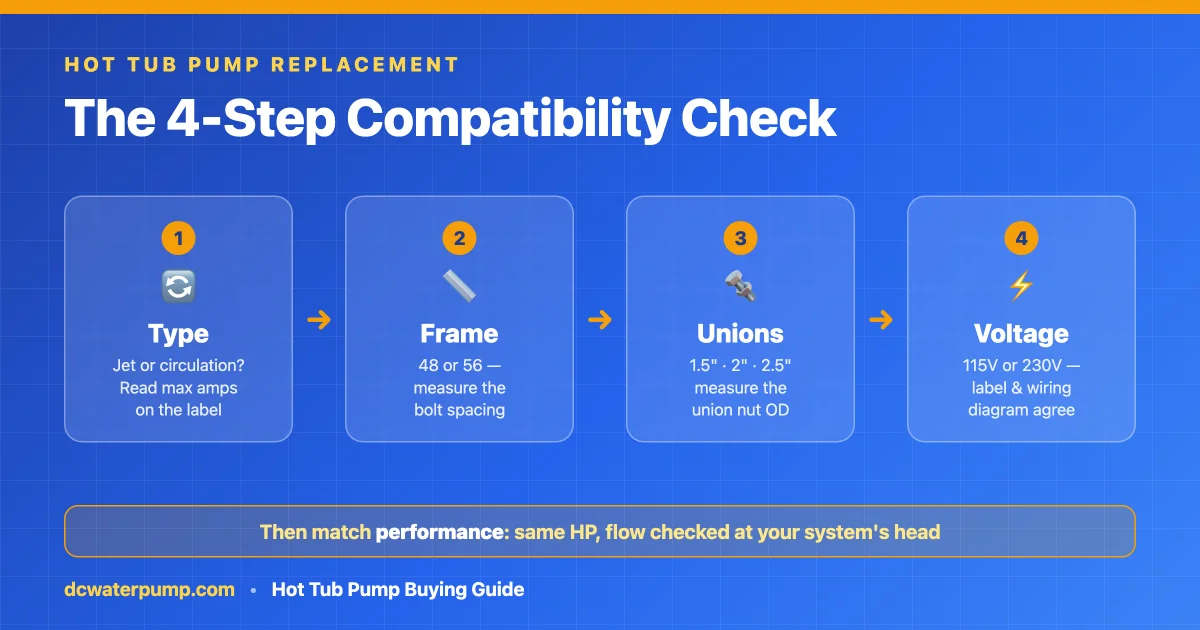
Zunächst sollten Sie verstehen, was sich tatsächlich in Ihrem Spa befindet.
Whirlpools werden auf zwei verschiedene Arten verrohrt, und die Hälfte aller Fehler beim Austausch entsteht dadurch, dass man nicht weiß, welche Verrohrung man hat:
- Whirlpools mit einer Pumpe Lauf eins Zwei-Gang-Jetpumpe Für alle Funktionen: Niedrige Drehzahl versorgt Filter und Heizung, hohe Drehzahl treibt die Massagedüsen an. Üblich bei Einsteiger- und Mittelklasse-Badewannen.
- Whirlpools mit zwei Pumpen die Aufgaben aufteilen: ein kleiner separate Umwälzpumpe — geringer Durchfluss, Betrieb bis zu 24/7, um das Wasser durch Filter und Heizung zu zirkulieren zu lassen (unterstützt das Desinfektionsmittel, ersetzt es nicht) — plus ein oder mehrere Strahlpumpen die nur während der Einweichzeit laufen.
Ein konkretes Beispiel für die Doppelpumpenkonstruktion aus dem Jacuzzi-Sortiment: Der J-225 kombiniert eine 2,5 PS starke Zweigang-Jetpumpe mit einer kleineren, separaten Umwälzpumpe, die “kontinuierlich läuft, um eine gleichmäßige Wasserzirkulation für Filtration und Heizung unabhängig von der Haupt-Jetpumpe zu gewährleisten”.”
Welche Pumpe ist wichtiger? Die für die Filterung zuständige. In einem Whirlpool mit zwei Pumpen führt eine defekte Jetpumpe zum Ausfall einiger Düsen; eine defekte Umwälzpumpe bedeutet keine Filterung und keine Heizung – Besitzer im r/hottub-Forum bringen es auf den Punkt: Der Whirlpool ist “tot im Wasser” und zeigt Fehlermeldungen wie FLO oder OH an, bis die Pumpe ausgetauscht ist. In einem Whirlpool mit nur einer Pumpe gilt dasselbe für die Niedrigdrehzahl-Wicklung: Fällt sie aus, funktionieren Filterung und Heizung nicht mehr, selbst wenn die Hochdrehzahl-Wicklung noch läuft. Planen Sie entsprechend: Die weniger effektive Reparatur ist die kritischste.
Schritt 1 – Ermitteln Sie, welche Pumpe Sie ersetzen (die Ampere-Regel).
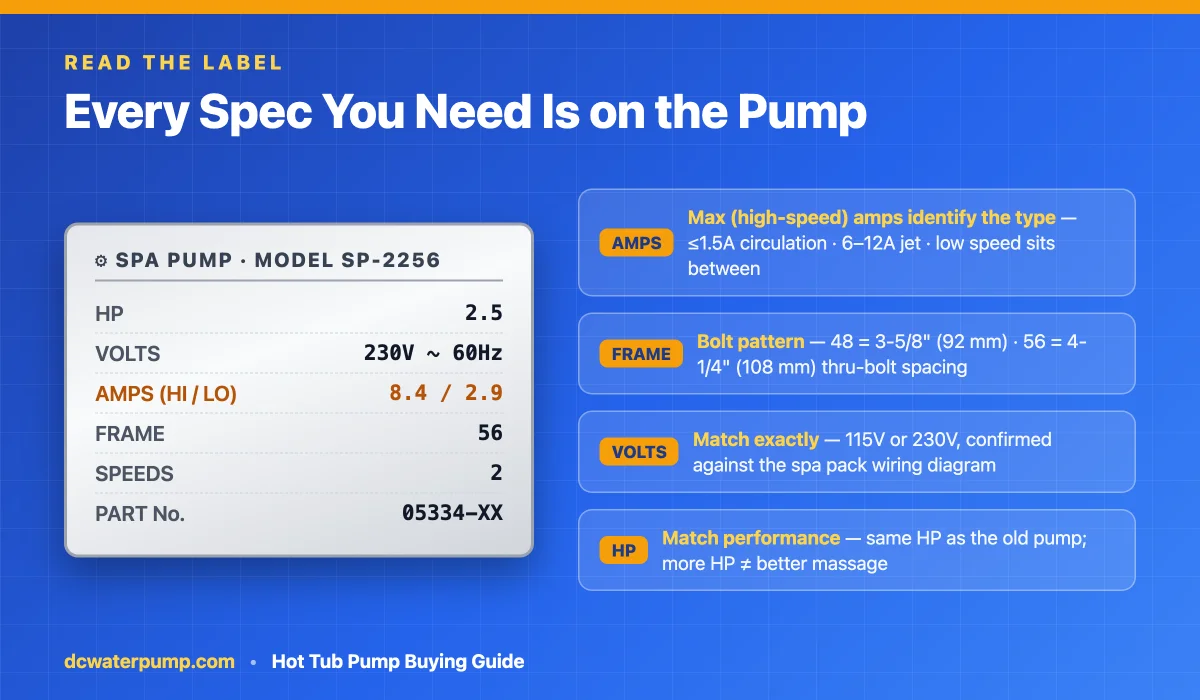
Am schnellsten lässt sich der Pumpentyp auf dem Etikett erkennen: Stromaufnahme. Eine Pumpenzeichnung Bei etwa 1,5 Ampere oder weniger handelt es sich mit ziemlicher Sicherheit um eine separate Umwälzpumpe.; Eine Strahlpumpe saugt typischerweise an 6–12 Ampere bei hoher Geschwindigkeit. Der Zwischenbereich ist jedoch nicht leer – die Wicklung einer zweistufigen Strahlpumpe im Niedrigdrehzahlbereich liegt üblicherweise im Bereich von 2–4 A, abhängig von Spannung und Leistung. Lesen Sie also weiter. Hochgeschwindigkeits- (maximale) Ampere auf dem Etikett: Das ist die Nummer, die die Pumpe identifiziert.
Die Stufen, wie dokumentiert in Pumpenleitfaden von Hot Tub Geek:
| Pumpenrolle | Typischer Stromverbrauch |
|---|---|
| Spezielle Umwälzpumpe | 0,5–1,5 A |
| Zweistufige Jetpumpe, niedrige Drehzahl | 2–3 A |
| Zweistufige Jetpumpe, hohe Geschwindigkeit | 8–12 A |
Die Durchflussraten teilen sich auf die gleiche Weise auf, wobei der Durchfluss der Zirkulationsklasse ein breites Spektrum abdeckt: Bauanleitung für eine Whirlpoolpumpe setzt Spa-Umwälzpumpen auf 25–35 GPM (95–130 L/min), Kompakte, speziell für den Umwälzpumpenbetrieb entwickelte Geräte arbeiten sogar noch sparsamer – der E10 von Laing, ein Referenzgerät in dieser Klasse, erreicht einen Höchstwert von 16 GPM (~3.500 l/h) pro offizielles Handbuch von Xylem. Strahlpumpen mit hohem Schub 100–260 GPM (380–980 L/min). In beiden Fällen ist der Unterschied groß – der Durchfluss und die Stromaufnahme sind um ein Vielfaches höher – weshalb das Filtern durch eine Jetpumpe (wie es bei Whirlpools mit nur einer Pumpe der Fall sein muss) mehr Energie verbraucht als eine speziell dafür gebaute Umwälzpumpe, die die gleiche Aufgabe erfüllt.
Schritt 2 – Passen Sie die Rahmengröße an (48 vs. 56).
Die Rahmengröße ist die mit Abstand unnachgiebigste Spezifikation bei einem Ersatzteil: Sie bestimmt das Befestigungsschraubenmuster des Motors, und eine Abweichung von nur einem halben Zoll bedeutet, dass die neue Pumpe einfach nicht angeschraubt werden kann.
Pro Spa Care's Passformleitfaden:
- 48er Rahmen — Durchgangsbolzen etwa 3-5/8″ (92 mm) Abstand. Typisch für Umwälzpumpen und kleinere Strahlpumpen.
- 56er Rahmen — Durchgangsbolzen etwa 4-1/4″ (108 mm) abgesehen davon. Das Gebiet der größeren Strahlpumpen.
Nicht anhand der PS-Zahl raten – den Bolzenabstand messen oder das Typenschild ablesen. (Einige spezielle Umwälzpumpen, insbesondere solche vom Typ Laing, verwenden eine eigene kompakte Bauform ohne Standardrahmen; in diesem Fall das genaue Modell oder die angegebene Querverweisnummer auswählen.)
Schritt 3 – Die Rohrverschraubungen zusammenfügen
Whirlpoolpumpen werden über Verschraubungen angeschlossen, und die Nennweite bezieht sich auf das Rohr – nicht auf die Verschraubung, die Sie messen. Leitfaden für den Austausch von Poolzubehör in Kanada:
| Namensunion | Gemessener Außendurchmesser der Überwurfmutter | Typischerweise zu finden auf |
|---|---|---|
| 1,5″ | ≈2-3/8″ (60 mm) | Umwälzpumpen |
| 2″ | ≈3″ (76 mm) | Strahlpumpen |
| 2,5″ | ≈3-5/8″ (92 mm) | Großraum-Jetpumpen |
Messen Sie vor der Bestellung den Außendurchmesser der Überwurfmutter der alten Pumpe. Adapter sind zwar erhältlich, aber jeder Adapter stellt eine zusätzliche potenzielle Leckstelle und eine weitere Durchflussverengung dar – warum Durchflussverengungen wichtig sind, erfahren Sie in unserer Erklärung dazu. wie wichtig die maximale Förderhöhe einer Pumpe wirklich ist behandelt die Physik.
Schritt 4 – Elektrische Anschlüsse anpassen
Drei Prüfungen, der Reihe nach:
- Stromspannung. Nordamerikanische Whirlpools werden entweder mit 115-V- oder 230-V-Pumpen betrieben. Das steht auf dem Typenschild und im Schaltplan Ihres Whirlpool-Steuergeräts. Verlassen Sie sich niemals allein auf die Steckerform.
- Geschwindigkeiten. Die Verkabelung von ein- und zweistufigen Pumpen ist unterschiedlich. Besitzer, die von ein- auf zweistufige Pumpen umgerüstet haben, berichten, dass dies oft von der Steuereinheit unterstützt wird – manchmal genügt ein einfacher DIP-Schalterwechsel –, aber überprüfen Sie dies bitte vor dem Kauf anhand Ihres spezifischen Modells.
- Elektrische Kapazitätsreserve. Die Stromaufnahme der neuen Pumpe muss innerhalb der Nennstromstärke liegen, für die der Pumpenstromkreis Ihres Spa-Systems ausgelegt ist. Und Innerhalb der Nennleistung des Schutzschalters – das Relais des Steuergeräts stellt oft die engere Grenze dar. Kabelquerschnitt, Erdung/Potenzialausgleich und die örtlichen Elektrovorschriften gehören in den Aufgabenbereich des Technikers und lassen sich nicht durch einen Blick auf das Typenschild überprüfen. Eine Leistungssteigerung ohne diese Prüfungen führt klassischerweise zu selbstverschuldeten Ausfällen.
Sollte Ihnen irgendetwas davon unbekannt vorkommen, überlassen Sie die Verkabelung einem Techniker – die oben beschriebenen Kompatibilitätsprüfungen sind reine Theorie. Führen Sie alle Arbeiten nur bei abgeschalteter Stromversorgung und Sicherung durch.
Bevor Sie bestellen – vergleichen Sie die Leistung, nicht nur die Passform.
Rahmen, Anschlüsse und Spannung dienen der Montage und Verkabelung der Pumpe; sie sagen jedoch nichts darüber aus, welches Medium sie fördert. Pumpen mit gleichem Rahmen und gleichen Anschlüssen sind in verschiedenen Leistungsstufen, Fördermengen und Stromstärken erhältlich. Vergleichen Sie daher die Leistungszahl (PS) Ihrer alten Pumpe mit der auf dem Typenschild angegebenen und, falls im Datenblatt vorhanden, die Leistungskurve bei der Betriebshöhe Ihres Systems. Ihr Whirlpool wurde für eine bestimmte Fördermenge entwickelt – eine höhere Fördermenge ist nicht besser, sondern führt lediglich zu mehr Lärm und höherem Wasserverbrauch.
Die Markenlandschaft (und wie man sie nutzt)
Fünf Namen dominieren den Ersatzteilmarkt. Betrachten Sie diese Tabelle als Orientierungshilfe, nicht als unumstößliche Wahrheit. Beachten Sie immer die Angaben auf dem Etikett Ihrer vorhandenen Pumpe., Denn jede Marke baut mehrere Rahmen, Verbindungen und Spannungen:
| Marke | Bekannt für | Typische Rolle |
|---|---|---|
| Wasserweg | Breites Sortiment an Strahlpumpen (Die Executive-Serie ist überall erhältlich) | Jetpumpen, Rahmengröße 48 & 56 |
| Aqua-Flo (Gecko) | Flo-Master Jetpumpen + kompakte Umwälzeinheiten | Beide Rollen |
| LX Pumpen | Preisgünstige Pumpen sind in europäischen/asiatischen Whirlpools üblich. | Beide Rollen |
| Balboa | Pumpen werden zusammen mit ihren Spa-Steuerungssystemen verkauft. | Strahlpumpen |
| Laing (Xylem) | Kompakte, dedizierte Umwälzpumpen (E-Serie) | Nur für den Umlauf |
| BLDC-Pumpe (OEM) | Bürstenlose Gleichstrom-Umwälzpumpen für Anlagenbauer | Nur Umlauf, 12/24 V Gleichstrom |
Zwei praktische Hinweise aus der Praxis: Käufer von Ersatzpumpen berichten, dass Umwälzpumpen der Laing-Klasse zwar zuverlässig, aber “teuer und am Ende ihrer Lebensdauer oft unerwartet ausfallen” – daher ist es wichtig, die passende Vergleichsnummer zu finden. vor Ein Fehler kann eine kalte, grüne Woche ersparen. Beim Vergleich verschiedener Marken sind Anschlussgröße und Gehäuse wichtiger als der Markenname – die Passformangaben garantieren jedoch nur die Montage und Verkabelung der Pumpe; sie gewährleisten nicht die gleiche Leistung wie die ersetzte Pumpe. Prüfen Sie vor der Bestellung daher unbedingt die Leistung (in PS), die Ausrichtung des Auslasses, die Abmessungen und die Drehzahlkonfiguration Ihrer alten Pumpe und nutzen Sie, falls vorhanden, die Vergleichsliste des Herstellers. Der Austausch von Pumpen gleicher Spezifikationen zwischen verschiedenen Marken ist üblich; unüberprüfte Modelle führen jedoch dazu, dass der Auslass in die falsche Richtung zeigt.
Wo bürstenloser Gleichstrom in dieses Bild passt
Eine ehrliche Einschätzung eines Pumpenherstellers: Bürstenlose Gleichstrompumpen (BLDC) konkurrieren im Bereich der Zirkulationspumpen, nicht im Bereich der Strahlpumpen. In der 12/24V-Gleichstromwelt gibt es nichts, was eine 2 PS starke Massagepumpe ersetzen könnte – dafür sind netzbetriebene Jetpumpen die erste Wahl.
Doch für eine Pumpe, die rund um die Uhr läuft, gelten andere Anforderungen: Dauerbetrieb, minimale Geräuschentwicklung neben einer Badewanne und geringer Energieverbrauch. Genau dafür wurden BLDC-Umwälzpumpen entwickelt – keine verschleißanfälligen Kohlebürsten, magnetische Antriebsisolierung und hochwertige Geräte. unter 35 dB mit Design lebt um 30.000 Stunden, Sie werden mit 12/24 V Gleichstrom betrieben. Dank der Niederspannung eignen sie sich ideal für Solaranlagen und netzunabhängige Systeme, da die Umwandlung von Batteriestrom auf 230 V, nur um eine kleine Wechselstrompumpe anzutreiben, doppelte Energieverschwendung bedeutet. (Wie sich “unter 35 dB” neben einer Badewanne tatsächlich anhört – und wie man die Angabe im Datenblatt überprüft – wird in unserem Artikel behandelt.) Anleitung für geräuschlose Kaltwasserpumpen.)
Zwei praktische Einschränkungen. Erstens, Passform: Eine 12/24V BLDC-Pumpe ist kein direkter Austausch Für die 115/230-V-Umwälzpumpe, die in ein bestehendes Spa-System integriert ist, wird ein eigenes Gleichstromnetzteil und eine eigene Steuerung benötigt. Daher eignet sie sich besonders für OEM-Anlagen, Kaltwasser- und Rückgewinnungsanlagen sowie netzunabhängige Projekte, die von Anfang an auf Gleichstrom ausgelegt sind, und nicht für Nachrüstungen. Zweitens: Ansaugung: Wie Wechselstrom-Umwälzpumpen arbeiten auch diese Pumpen mit geflutetem Ansaugstutzen und nicht mit trockener Selbstansaugung. Sie müssen unterhalb der Wasserlinie montiert werden, und der Ansaugstutzen muss stets geflutet sein.
Detaillierte Informationen zu den Unterschieden zwischen BLDC- und AC-Motoren auf Motorebene finden Sie in unserer [Link einfügen]. Umfassender Leitfaden für Gleichstrom-Wasserpumpen. Gewerblicher Bau von Wannen oder Rückgewinnungsanlagen? BLDC PUMP Umwälzpumpen-Sortiment deckt OEM-Spezifikationen ab – das Unternehmen baut seit 2009 bürstenlose Gleichstrompumpen, Standardmuster sind in 3–7 Werktagen verfügbar.
Woran erkenne ich, ob ich eine neue Whirlpoolpumpe benötige?
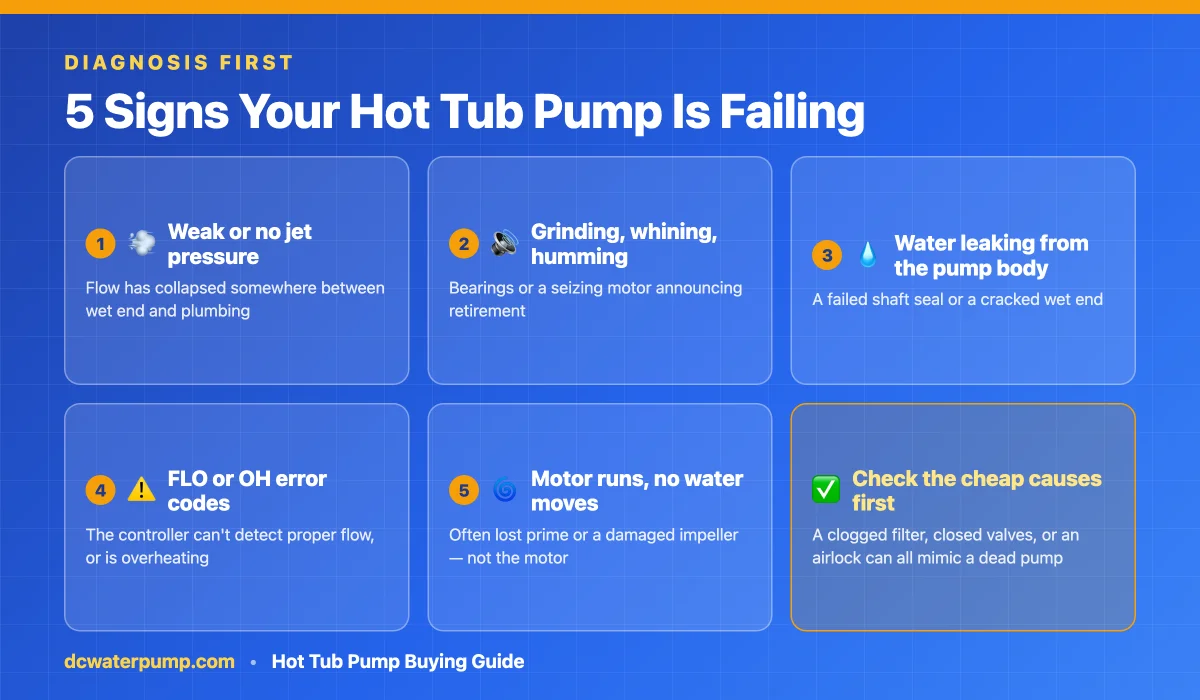
Fünf Anzeichen decken die meisten Misserfolge ab:
- Schwacher oder kein Strahldruck — Der Durchfluss ist irgendwo zwischen dem Nassbereich und der Rohrleitung zusammengebrochen.
- Knirschen, Jaulen oder lautes Summen — Lager oder ein blockierender Motor, der den Ausfall ankündigt.
- Wasser tritt aus dem Pumpengehäuse aus — eine defekte Wellendichtung oder ein gerissener Nassbereich.
- FLO- oder OH-Fehlercodes — Das Steuerungssystem kann den korrekten Durchfluss nicht erkennen oder überhitzt.
- Der Motor läuft, aber das Wasser bewegt sich nicht. — oft fehlte die Kraftstoffzufuhr oder das Laufrad war beschädigt, nicht aber der Motor selbst.
Bevor Sie wegen Symptom 5 eine Pumpe bestellen, prüfen Sie zuerst die einfachen Ursachen: Ein verstopfter Filter, geschlossene Ventile oder eine Luftblase nach dem Nachfüllen können alle den Eindruck einer defekten Pumpe erwecken.
Häufig gestellte Fragen
Worin besteht der Unterschied zwischen einer Umwälzpumpe und einer Strahlpumpe?
Umwälzpumpen laufen bis zu 24 Stunden am Tag mit geringer Fördermenge (ca. 15–35 GPM, je nach Ausführung, Stromaufnahme 0,5–1,5 A), um Filter und Heizung zu versorgen. Strahlpumpen laufen nur während der Nutzung mit 100–260 GPM und einer Stromaufnahme von 6–12 A bei hoher Drehzahl, um die Massagedüsen anzutreiben. Sie sind nicht austauschbar. In Whirlpools mit nur einer Pumpe übernimmt eine zweistufige Strahlpumpe beide Aufgaben – niedrige Drehzahl für die Filtration, hohe Drehzahl für die Düsen.
Wie lange hält eine Whirlpoolpumpe?
Branchenrichtlinien geben üblicherweise eine Lebensdauer von 5–10 Jahren an, wobei die tatsächliche Lebensdauer von Betriebszyklus, Wasserzusammensetzung und Trockenlauf abhängt. Umwälzpumpen erreichen deutlich schneller Betriebsstunden als Strahlpumpen, da sie kontinuierlich laufen.
Kann ich die Pumpe eines Whirlpools selbst austauschen?
Die Recherche – Pumpentyp, Baugröße, Verschraubungen, Spannung, Leistung – ist reine Büroarbeit und kann von jedem erledigt werden. Der eigentliche Austausch ist jedoch eine andere Sache: Pumpenhersteller verlangen, dass die Stromzufuhr vor jeglichen Wartungsarbeiten unterbrochen und die Anlage gesperrt wird (das steht wörtlich im Handbuch von Xylem Laing), und elektrische Anschlüsse dürfen gemäß den meisten örtlichen Vorschriften nur von zertifizierten Elektrikern durchgeführt werden. Ist der Strom am Sicherungskasten abgeschaltet, ist der Sanitärteil unkompliziert, sofern man mit Verschraubungen vertraut ist. Sollten Sie sich dabei unsicher fühlen, lassen Sie die gesamte Arbeit von einem Fachmann durchführen.
48er oder 56er Rahmen – welchen habe ich?
Messen Sie den Abstand zwischen den Durchgangsbolzen des Motors: Etwa 92 mm (3-5/8″) entsprechen einem 48er Rahmen; etwa 108 mm (4-1/4″) entsprechen einem 56er Rahmen. Dies ist üblicherweise auch auf dem Typenschild angegeben.
Welche PS-Zahl benötige ich?
Halten Sie sich an die Spezifikationen Ihres Whirlpools – diese finden Sie auf dem Typenschild der alten Pumpe. Eine Leistungssteigerung ohne Überprüfung der Rohrleitungsgröße, der Nennleistung des Whirlpool-Steuergeräts und des Sicherungsautomaten verursacht mehr Probleme als sie löst; mehr PS durch die gleichen 1,5-Zoll-Rohrleitungen führen meist zu mehr Lärm und höherer Stromaufnahme, nicht aber zu einer besseren Massageleistung.
115 V oder 230 V – wie kann ich das feststellen?
Lesen Sie das Etikett der alten Pumpe und den Schaltplan Ihres Whirlpool-Systems. Tragbare Plug-and-Play-Whirlpools benötigen in der Regel 115 V; die meisten fest installierten Whirlpools in Standardgröße werden mit 230-V-Pumpen betrieben. Lassen Sie sich niemals von der physischen Größe der Pumpe leiten.
Müssen Whirlpoolpumpen entlüftet werden?
Ja – sowohl Wechselstrom- als auch Gleichstrom-Umwälzpumpen sind Nassansaugpumpen, die Wasser drücken, anstatt es aus dem Trockenen anzusaugen. Nach dem Nachfüllen oder Filterwechsel muss die eingeschlossene Luft abgelassen und sichergestellt werden, dass das Pumpengehäuse vollständig gefüllt ist, bevor die Pumpe in Betrieb genommen wird; Trockenlauf ist der schnellste Weg, eine neue Pumpe zu zerstören.
Wohin als Nächstes?
Wenn Sie die leise Hälfte des Systems spezifizieren – oder Kalttauch- und Rückgewinnungsanlagen bauen, bei denen die Umwälzpumpe Ist das System – beginnen Sie mit unserer Einführung zu Was eine Kaltwasserpumpe bewirkt, Dann gehen Sie tiefer auf die Motortechnologie ein im Umfassender Leitfaden für Gleichstrom-Wasserpumpen.