
Fountain Pump Head Pressure Explained: Why Max Head Isn’t Your Spray Height
TL;DR: The “max head” printed on a fountain pump is the height of a water column the pump can hold up at zero flow — not how high your jet will go. Spray height is set by how fast water leaves the nozzle, and by the time you subtract static lift, hose friction, fittings and the nozzle itself, a pump with “15 m max head” is doing well to throw a jet a fraction of that. This guide explains what max head actually means, how to add up the head your fountain really demands, how to read the pump curve at that point, and why a speed-adjustable pump saves you from buying twice.
What does max head mean on a fountain pump?
Max head (often labeled max static head) is the maximum vertical height of water a pump can support when the outlet is closed off — the point on the pump curve where flow is zero. It is a pressure rating expressed as a column of water: 1 m of head ≈ 0.1 bar ≈ 1.42 psi. It is not a spray height.
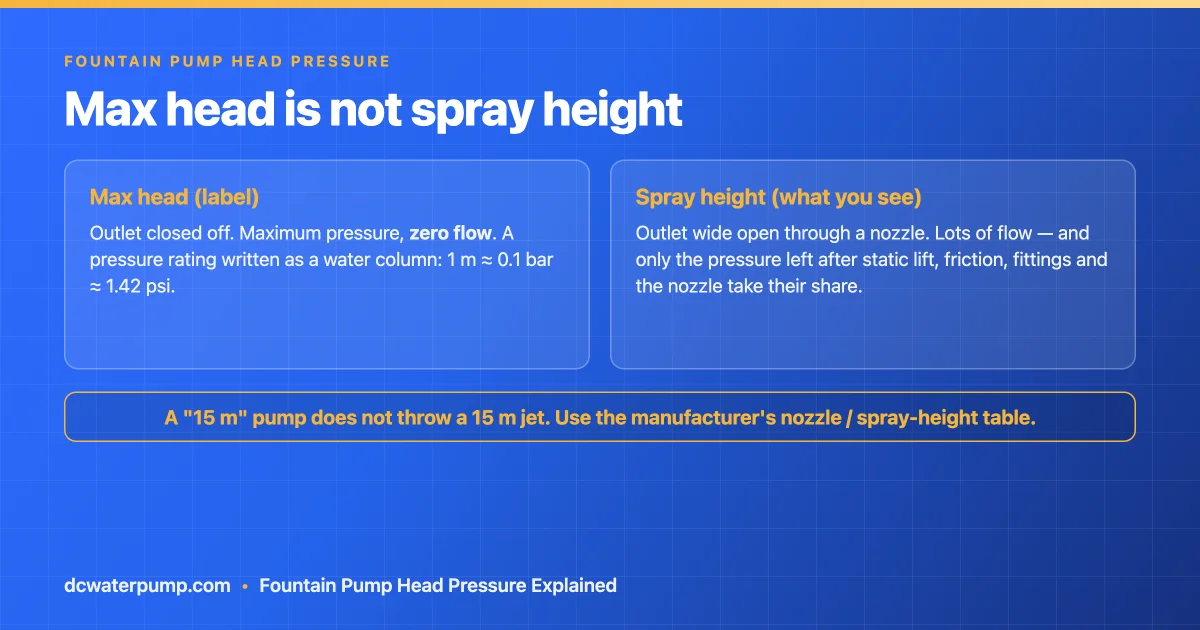
Two ideas hide in that sentence. Head is pressure, converted into meters or feet so pumps can be compared without a gauge; and “max” means the rating is taken at the one operating point where the pump moves no water. As our sales engineer puts it to customers who ask why a “15 m” pump won’t lift a jet 15 m: “the 15 meters of the models are static head, in other words, the pressure at the outlet of the pump. At the 15 meters, there will be no water flow, you can check the performance curve.”
If you want the general “why max head beats max flow as your first spec” argument, it’s in our earlier explainer on ¿Qué tan importante es realmente la altura máxima de elevación de una bomba?. This article is about the fountain-specific trap: reading max head as spray height.
The problem: buyers shop for a jet height and get a pressure rating
A recurring fountain-pump inquiry we receive goes something like “I want a 2 m spray — which pump has 2 m of head?” The honest answer is “none of them, not directly,” because the two numbers describe different things:
- Max head is measured with the outlet blocked: maximum pressure, zero flow.
- Spray height is produced with the outlet wide open through a nozzle: lots of flow, and only the pressure left over after everything upstream of the nozzle has taken its share.
Manufacturers publish a curve linking the two, because neither number alone tells you what the fountain will do — as Fountain Tech Pumps puts it, the flow curve “is a measure of the flow rate of a particular pump and different heights.” The listing headline prints only the two maxima, so people buy on max head, plumb the fountain, and get a jet shorter than the spec sheet seemed to promise. Our seven fountain pump buying mistakes puts this one first because it is the most expensive to discover after the fact.
Why the gap is so large: four deductions before the water leaves the nozzle
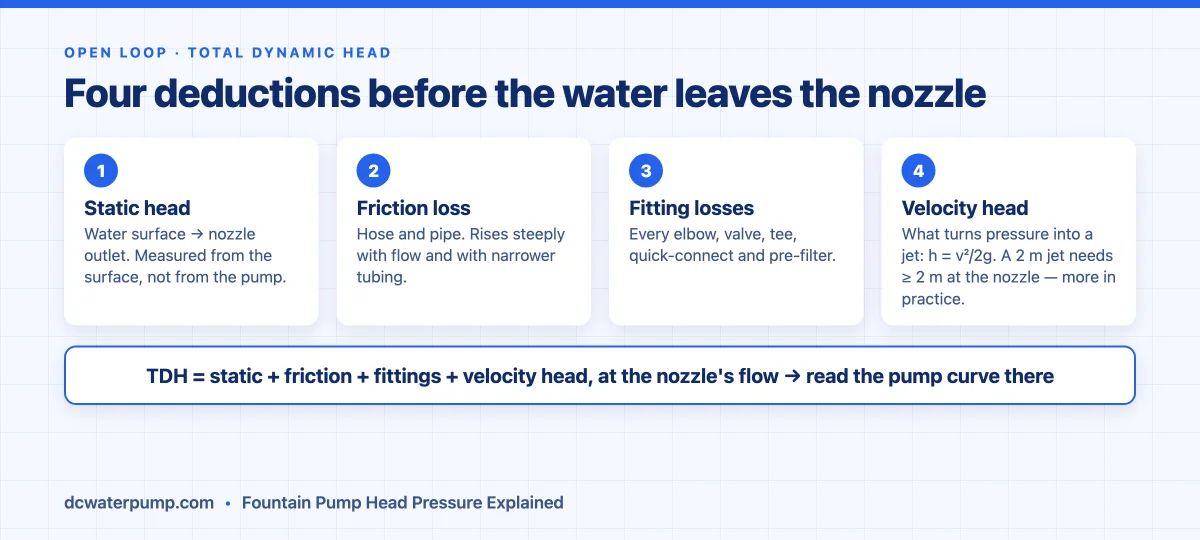
Between the pump outlet and the top of the jet, head is consumed four times. A fountain is an open loop — water leaves the reservoir, goes up through the nozzle and falls back — so unlike a closed circulation loop, the vertical lift counts in full.
- Static head. The vertical distance from the water surface to the nozzle outlet. If the nozzle sits 1.2 m above the pond surface, 1.2 m of head is spent before any spray exists. (Measure from the surface, not from the pump: a submersible pump sitting deeper does not add lift, because the water above it pushes on the inlet just as hard.)
- Friction loss. Water rubbing along hose and pipe. It rises steeply with flow rate and with smaller hose diameter; long runs and narrow tubing are the usual culprits behind “the pump is strong but the jet is weak.”
- Fitting losses. Every elbow, valve, tee, quick-connect and pre-filter is a local restriction — individually small, and the part of the system people forget to count.
- Velocity head at the nozzle. This is the deduction that turns pressure into spray. A jet reaches, in theory, the height
h = v² / 2g— the height a water column would need to fall to reach the nozzle exit velocity v. A 2 m jet therefore needs the water to leave the nozzle at about 6.3 m/s, which means at least 2 m of pressure head must be converted at the nozzle itself. The real jet is lower still: air drag, nozzle losses and the column breaking into droplets shave height off, and different nozzle geometries (single jet, foam, bell, spray ring) trade height for spread very differently.
Add the four together and you have the total dynamic head (TDH) your pump must supply at the flow rate the nozzle needs. Compare that to the pump’s max head — a zero-flow number — and the mystery of the short jet disappears.
This is why there is no fixed ratio between max head and spray height: the nozzle, the hose and the fitting count each change it. The only trustworthy source is a manufacturer’s nozzle / spray-height table built from tests on that pump family. For our own fountain range, practical spray heights top out at roughly 6 m with matched nozzles; as one illustrative data point from a quotation, a DC85E-24100S with a DN40 nozzle (16 mm outlet) sprays around 4 m — from a pump whose max static head is 10 m.
Reading the pump curve: where your fountain actually operates
A pump’s performance curve plots flow against head, and the two printed maxima are only its endpoints. Your fountain sits in the middle, where the pump curve crosses the system curve — the head your plumbing and nozzle demand as flow increases.
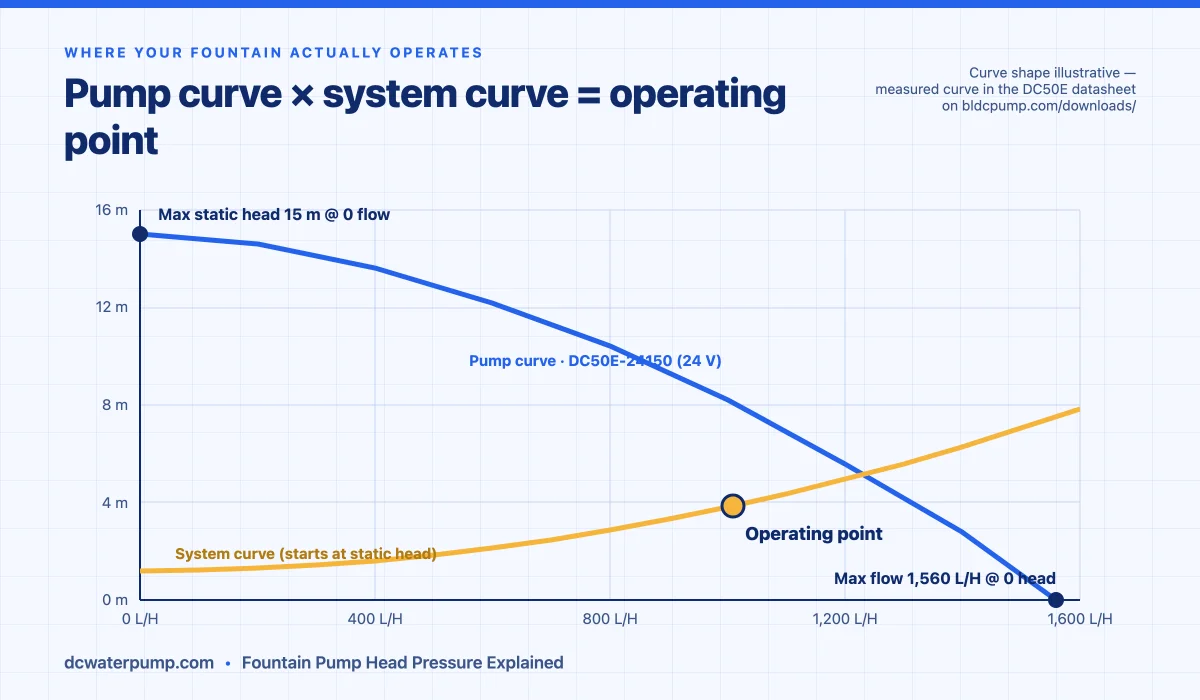
Take our DC50E-24150 as an illustration: 24 V, max flow 1,560 L/H (26 L/min, ≈412 GPH), max static head 15 m (≈49 ft). Nobody runs it at either endpoint; the flow you get depends on the head your fountain demands. An illustrative fountain, stated as assumptions rather than measurements:
| Item (illustrative — replace with your own measurements) | Cabeza |
|---|---|
| Static lift, pond surface to nozzle outlet | 1.2 m (3.9 ft) |
| Friction, 3 m of 1/2″ hose at fountain flow | roughly 0.4–0.8 m, from a hose friction-loss table for your hose ID |
| Two elbows and an inlet pre-filter | a few tenths of a meter, from fitting-loss tables |
| Velocity head for a 1.5 m single jet | at least 1.5 m at the nozzle, more after nozzle losses |
| TDH the pump must supply at that flow | roughly 3.5–4 m, at whatever flow the nozzle passes |
Read the DC50E-24150 curve at 3.5–4 m and you find the flow it delivers there. If that meets what the nozzle needs, the fountain works; if not, accept a shorter jet, remove restriction (bigger hose, fewer fittings) or move to a model whose curve is higher at that head. Note what this example does no say: it does not turn “15 m max head” into “spray height X,” and it does not conclude that you need a 10 m pump. Get the real numbers, then read the real curve — the measured datasheet curve is the authority.
Two pumps of identical rated power can cross over on the curve. Take the DC50A-2450 (5 m max head, 3,600 L/H max flow) and the DC50E-24150 (15 m, 1,560 L/H) — same rated voltage and current: read from the two datasheet curves, they cross near 4 m of head at roughly 20 L/min; above that the DC50E pulls ahead, below it the DC50A does (at 3 m the DC50A is already delivering about 30 L/min against roughly 20 for the DC50E). The pump that wins at su operating head is the right pump, whichever prints the bigger maximum. Our max head vs flow rate guide walks through curve reading for a closed loop; the mechanics are the same, only the static-head term differs.
How do you calculate total head for a fountain?
Add the vertical distance from water surface to nozzle outlet, the friction loss of your hose and pipe at fountain flow, the local losses of every fitting and filter, and the velocity head the nozzle needs for the jet height you want. That sum, at the nozzle’s flow, is the head to read on the pump curve.
The fix: a three-step method that starts with the nozzle, not the pump
Working from the jet backward removes the guesswork.
Step 1 — Choose the nozzle and target spray height from the manufacturer’s table. Pump makers publish spray height against nozzle type and flow for a given pump family. Start there, because the nozzle decides both the flow you need and the pressure it consumes; there is no honest constant for back-calculating spray height from max head.
Step 2 — Add up the total head at that flow. Static lift from the water surface, friction for the actual hose size and length, fitting and pre-filter losses, plus the nozzle’s requirement. Fountain Tech Pumps’ field rule for the static part is a useful floor: “Measure from the pump to the highest water point and add 1 foot for a safety margin. Choose a pump that can handle this height, and remember that higher pumping needs more power. Check out the flow curve of the model…” (Fountain Tech Pumps). Treat calculator rules such as SimplifyCalc’s “Every 5 ft of head reduces pump output by roughly 10%” (SimplificarCalc) as a rough first pass only — the derate differs from pump to pump, and the curve settles it.
Step 3 — Pick the operating point on the curve and keep margin. Find the Step 2 head on the pump curve, read off the flow, and check it against the nozzle’s requirement. Leave 20–30% in hand: pre-filters clog, hoses kink and water levels drop in summer, all of which push the system curve up and shrink the jet over the season.
Why a speed-adjustable pump beats buying twice
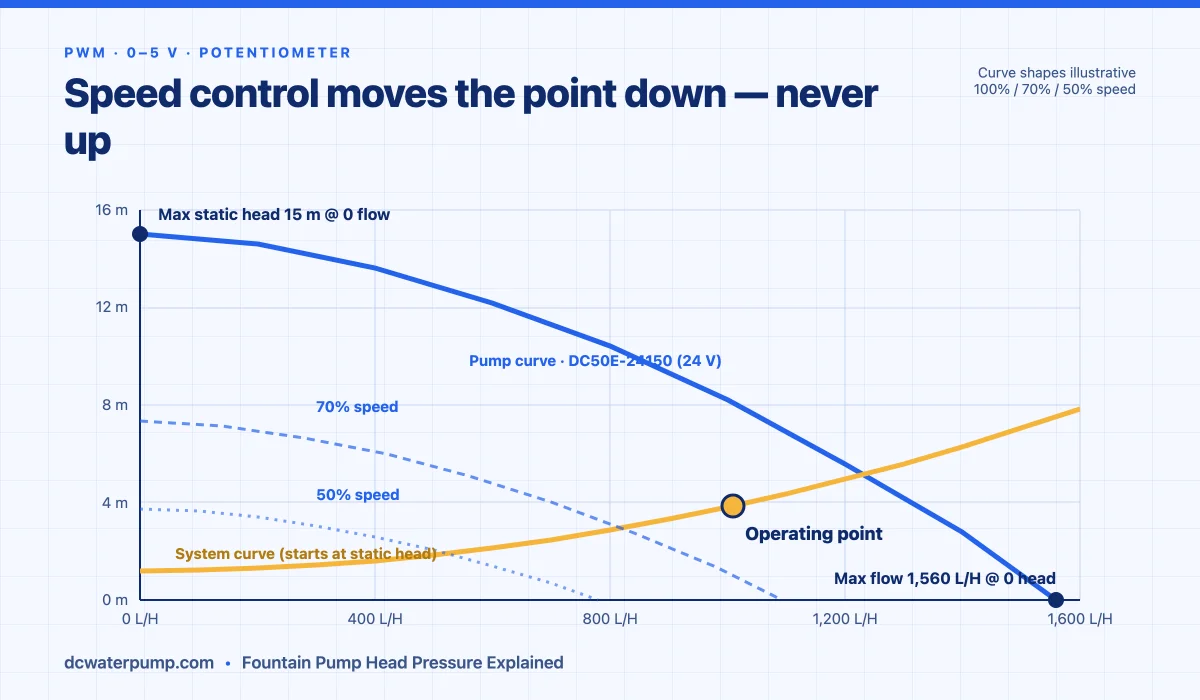
Because the head your fountain demands is uncertain until it is built, the most forgiving approach is to buy a pump whose curve sits comfortably above the estimate and turn it down to the jet you want. Our speed-control versions accept a PWM signal (50–800 Hz, 0–100% duty), a 0–5 V analog signal or a potentiometer knob — other quality BLDC pumps offer comparable interfaces; check the datasheet — and reducing speed lowers flow and pressure along a family of curves instead of throttling with a valve.
The way our engineers use this with OEM customers is worth copying at home: fit the potentiometer version first, rotate the knob until the spray looks right in the real installation, then note the current the pump draws at that setting — a production batch can be built to run at that current with the adjustment removed. For a DIY fountain the knob simply becomes your spray-height control, and it avoids the other common mistake: slowing a pump by cutting supply voltage, which pushes it off its design point and is not a control method we recommend.
Speed control can only take head away: if the curve does not reach your TDH at full speed, no signal will add pressure, and the answer is a higher-head model or, for tall jets, two pumps in series. It also does not replace clean intake water — a fouled impeller drops the whole curve.
Preguntas frecuentes
What is max head on a water pump?
Max head is the height of water column the pump can hold at zero flow — its maximum pressure expressed in meters or feet (1 m ≈ 0.1 bar ≈ 1.42 psi). Real delivery happens well below it, where the pump still moves water.
Is max head the same as spray height?
No. Spray height depends on the nozzle exit velocity after static lift, hose friction, fittings and nozzle losses are subtracted. It is far lower than max head, and the ratio changes with every nozzle and plumbing layout, so use the manufacturer’s nozzle table.
Does putting a submersible pump deeper reduce its lift?
No. Static head is measured from the water surface to the outlet, not from the pump. The water above a submerged pump pushes on its inlet, so depth neither helps nor hurts the jet.
Why is my fountain jet weaker than the pump rating suggests?
Usually the plumbing: undersized hose, a long run, several elbows, a clogged pre-filter or a nozzle that needs more flow than the pump delivers at your head. Check the intake first — a fouled impeller drops the entire curve — then work through the head deductions above.
How much head does a fountain nozzle need?
It depends on the nozzle type and the jet height you want; the theoretical minimum is the height itself (from h = v²/2g), and real nozzles need more. Manufacturers publish spray height against nozzle and flow for their pumps — that table is the answer, not a formula.
Can I increase spray height by raising the voltage?
Don’t. Running above rated voltage is outside the pump’s specification and shortens its life; on our pumps the over-voltage protection trips outside the model’s input window in any case (our 24 V models typically operate across about 10–30 V, model-dependent). Use the pump’s speed control to trim down from a larger curve, or choose a higher-head model.
What if my fountain needs more head than any single pump has?
Two identical pumps in series roughly double the available head at the same flow; two in parallel roughly double flow at the same head. Series is the tool for a tall single jet, parallel for a wide, low display.
¿Adónde ir después?
You now know why max head is a pressure rating, why spray height comes out far lower, and how to size from the nozzle backward. The general case for putting head before flow is in ¿Qué tan importante es realmente la altura máxima de elevación de una bomba?; if you are still deciding whether a DC fountain pump is the right category at all, start with what a DC fountain pump is.
If you are specifying pumps for a fountain product and want the nozzle and spray-height tables that make Step 1 possible, they are in the catalog on our DC fountain pumps page, alongside the measured curves for each model.