
What Is a DC Fountain Pump? A 5-Minute Introduction
TL;DR: A DC fountain pump is a small submersible centrifugal pump that runs on low-voltage direct current — typically 12 V or 24 V from a power adapter, a battery, or a solar panel — instead of mains AC. It does the same three jobs as any fountain pump (lift water, pressurize the nozzle, keep the basin circulating), but the low-voltage supply, brushless motor, and built-in controller change what you can do with it: quieter running, adjustable flow, and on some models direct control from lighting systems. Sizing still comes down to two numbers, flow rate and head — and the spray height you see is not the max head printed on the label.
What is a DC fountain pump?
A DC fountain pump is a submersible water pump powered by low-voltage direct current (usually 12 V or 24 V) that lifts water from a basin to a nozzle or spillway and lets it fall back. Unlike mains-powered AC pumps, it runs from a power adapter, a battery, or a solar panel.
Three design choices define almost every pump in this class. It is centrifugal, because a spinning impeller tolerates the small amount of debris that ends up in fountain water far better than diaphragm, gear, or piston designs (a pre-filter on the intake is still the rule, not the exception). It is submersible, because sitting in the basin keeps the pump flooded, hides it from view, and lets the water absorb motor noise. And it is electric and low-voltage, which is the part that changes the engineering — the power supply sits outside the water and only 12 or 24 V DC reaches the pump.
The category is bigger than most people assume. The global water features market was valued at about USD 1.92 billion in 2025, according to Global Market Statistics (a secondary market estimate), and a large share of those features run on exactly this kind of pump: something between the size of an egg and the size of a hand, moving anywhere from a few hundred to several thousand liters per hour.
What a fountain pump actually does (three jobs, one impeller)
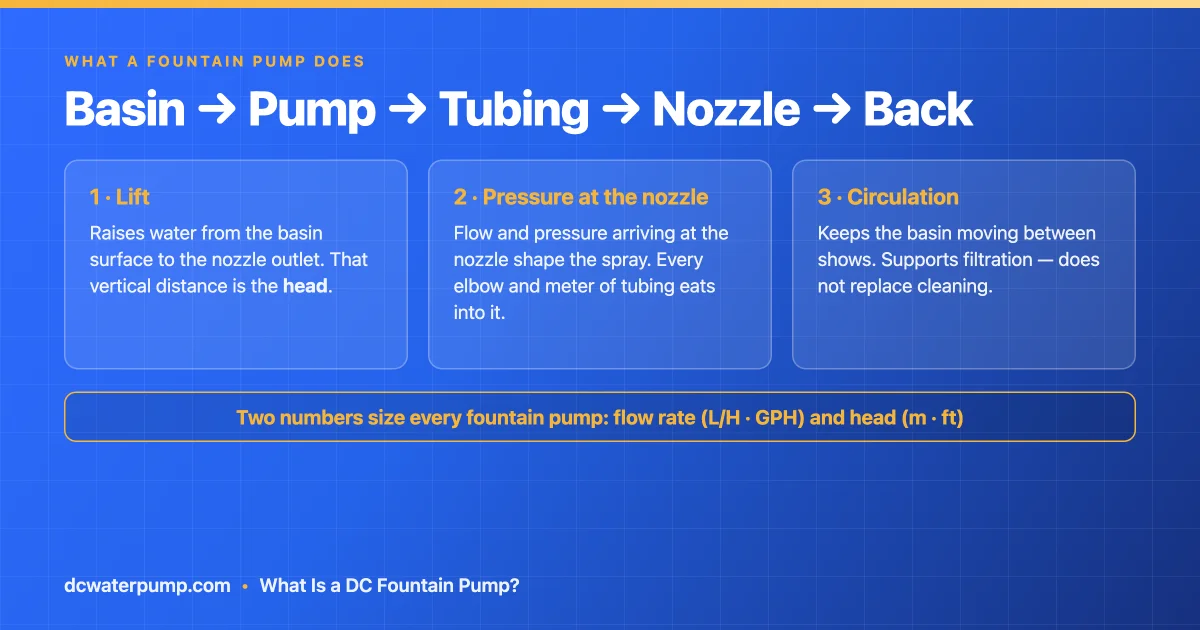
A fountain pump does three things at once, and the pump you choose has to be sized for all three, not just the one you can see.
- Lift. The pump raises water from the basin surface to the nozzle outlet. That vertical distance is the head the pump must overcome, and it is the first number that decides whether a given model will work at all.
- Pressure at the nozzle. A spray pattern — a jet, a bell, a foam column — is shaped by how much flow arrives at the nozzle and at what pressure. Every elbow, fitting, and meter of tubing between the pump and the nozzle eats into that.
- Circulation. Between shows, the pump keeps the basin water moving. Moving water supports filtration and helps distribute whatever treatment you use, but it does not replace cleaning, water changes, or proper water treatment.
One physical fact sits underneath all three jobs and explains most “my pump stopped working” complaints: pumps in this class push water; they do not draw it up from dry. As one of our engineers routinely tells customers who ask about mounting the pump above the basin: “The pump cannot suck water; it must sit below the liquid level. The 13m is the ideal maximum head without pipe resistance, so the real lift will be lower and depends on the piping complexity.” A submersible installation sidesteps the priming problem entirely — the pump stays flooded — which is why it is the default for fountains.
DC vs. AC fountain pumps: the three differences that matter
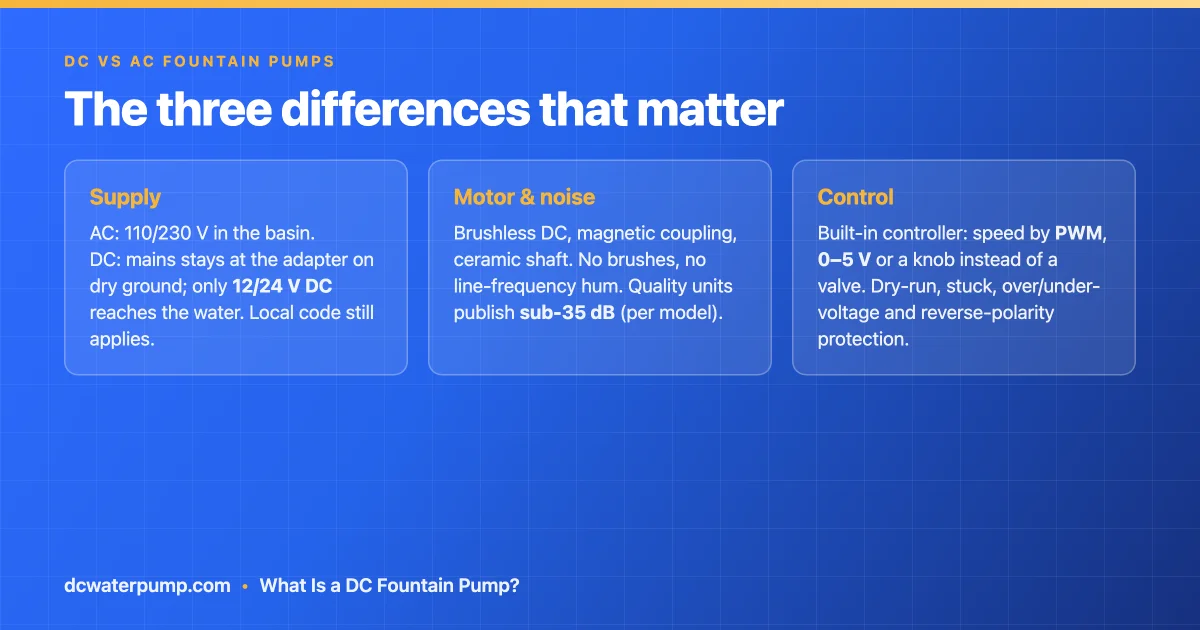
DC and AC fountain pumps move water the same way. The differences are in what surrounds the impeller: the supply, the motor, and the controller.
1. Only low voltage reaches the water
A mains AC pump puts a 110 V or 230 V cable into the basin. A DC fountain pump keeps the mains at the adapter (power supply) on dry ground and sends 12 V or 24 V DC to the pump. That places the pump’s supply in the extra-low-voltage range defined by IEC 61140 and IEC 60364-4-41, where the electrical hazard mechanism is fundamentally different from mains voltage. Two honest caveats belong next to that fact: the mains side of the adapter is still mains, and pool and fountain wiring is regulated — check your local code (NEC Article 680 in the US) before you decide what protection your circuit needs.
A practical consequence of low voltage: the cable to the pump is a thin two-conductor lead rather than conduit-grade wiring, but voltage drop over long runs is real. This is one reason 24 V models are preferred once the pump is more than a few meters from the supply — half the current for the same power.
2. A brushless motor, and what that does to noise
Quality DC fountain pumps use a brushless DC (BLDC) motor driving the impeller through a magnetic coupling: the stator is sealed in epoxy, the rotor spins on a ceramic shaft in a graphite sleeve, and there is no shaft seal between motor and water. There are no brushes to wear; bearings remain the wear item. The design lets manufacturers rate these pumps for continuous duty — our own published design life is around 30,000 hours, model-dependent — and for submersion, since the electronics are fully encapsulated (the IP68 rating on such units describes ingress protection, nothing more).
Is a DC fountain pump quieter than an AC pump? Usually, yes. A brushless magnetic-drive pump has no brushes and no line-frequency hum, and well-built units, ours included, publish noise figures below 35 dB measured at 1 m; submerging the pump lowers what you hear further. Treat the number as a per-model spec to verify, not a property of “DC” as a category.
3. Speed you can control from a wire, not a valve
A fixed-speed AC fountain pump has one output. To reduce the spray you throttle it with a valve, which wastes the energy you just paid for and still leaves the motor at full speed. A DC fountain pump has a controller built into the pump, so the same model can be ordered with speed control by a PWM signal (typically 50–800 Hz, 0–100% duty cycle), a 0–5 V analog signal, or a simple potentiometer knob. The controller also carries the protections that matter most in a fountain basin: dry-run protection, stuck-impeller protection, over-voltage and low-voltage cutoffs, and reverse-polarity protection.
Speed control changes how you run a show. Our sales engineers put it this way to a fountain builder who was switching the pump on and off between effects: “For the fountain application, there is no need to power off the pump when you don’t want the high flow rate, just keep the pump at 10% power for example, then it will take about 1 second to reach the max flow rate.” The same controller architecture is what allows a DMX512-controllable version — a pump that takes its speed command straight from a lighting console — which is a separate topic with its own guide on the manufacturer side.
| Typical AC fountain pump | Quality DC (BLDC) fountain pump | |
|---|---|---|
| Supply at the pump | 110/230 V AC | 12/24 V DC (5/36/48 V on select models) |
| Speed | Fixed; throttle with a valve | Adjustable: PWM, 0–5 V, or potentiometer |
| Noise | Line-frequency hum, tends to grow with age | No brushes, no hum; sub-35 dB published on well-built models |
| Protections | Usually thermal cutoff only | Dry-run, stuck, over/under-voltage, reverse polarity (model-dependent) |
| Off-grid | Needs an inverter | Runs from battery or solar panel directly (model-dependent) |
| Continuous duty | Yes, with shaft-seal wear on some designs | Designed for 24/7; bearings are the wear item |
The two numbers that size every fountain pump
Virtually every fountain pump worth buying is specified by the same two figures, and you need both.
- Flow rate — how much water the pump moves, in liters per hour (L/H) or gallons per hour (GPH; 1 GPH ≈ 3.8 L/h). The label shows the maximum flow, which the pump only delivers at zero head.
- Head — how high the pump can push water, in meters or feet. The label shows the maximum head, at which the pump delivers zero flow.
Real fountains live between those two extremes. At your actual head, the pump delivers some fraction of its max flow, and that fraction comes from the pump’s performance curve — not from the two headline numbers. Our explainer on why max head matters more than max flow shows two pumps with identical power delivering very different flow at 4 m, and the curve-reading walkthrough applies just as well to a fountain loop as to a cold plunge.
Then there is spray height, the number fountain buyers actually care about — and the one the label does not give you. Spray height depends on the flow and pressure arriving at the nozzle, so it is well below the max head figure. Our own fountain pump range illustrates the gap: max heads up to 16 m (about 52 ft), yet spray heights of up to about 6 m (about 20 ft) with the matching nozzle. Use the manufacturer’s nozzle-to-spray-height table for the specific pump, not a conversion factor.
Three ways to power a DC fountain pump
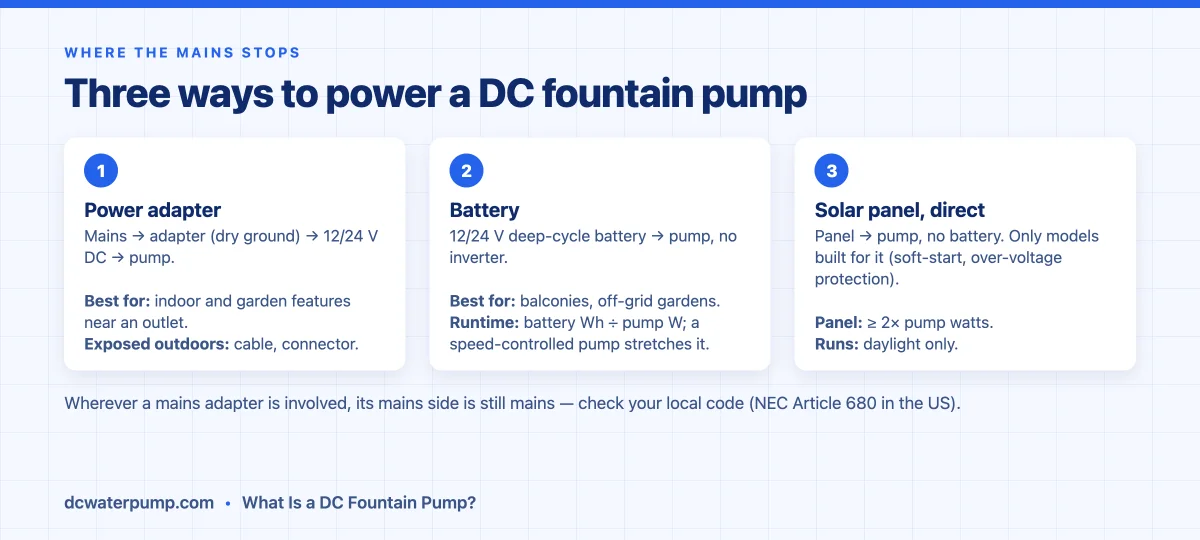
Because only DC reaches the pump, the supply is a separate choice, and it shapes the whole installation.
- Power adapter (mains to DC). The most common indoor and garden setup. The adapter converts 110/230 V AC to the pump’s rated voltage; the mains stays at the outlet. Match the adapter’s voltage and current to the pump’s rating — our models protect themselves outside their input window (our 24 V models typically operate across about 10–30 V, model-dependent), but an undersized adapter still starves the pump.
- Battery. Deep-cycle 12 V or 24 V batteries run DC pumps directly, which is why off-grid and balcony fountains are almost always DC. Runtime is battery capacity divided by pump draw; a speed-controlled pump stretches it.
- Solar panel, direct. Some DC pumps are designed to hang directly off a panel with no battery: a soft-start circuit and over-voltage protection handle the sun coming and going. Not every DC pump is built for this — in our lineup the DC60 and DC80 classes are, the small DC30 and DC40 are not — and the panel is typically sized at twice the pump’s rated wattage or more.
Our DC water pump comprehensive guide goes deeper on all three supply types and the electrical details that separate them.
Three things beginners get wrong about DC fountain pumps
“DC means small and weak.” Low voltage does not mean low output. DC fountain pumps in our range reach 13,000 L/H (about 3,430 GPH) and 16 m of head, and multi-pump shows are exactly how our DMX512-controllable fountain pumps are used — many small DC pumps, each individually addressed, instead of one large AC pump.
“IP68 means it can run dry.” An IP rating describes protection against dust and water getting in. It says nothing about running without water. A submersible fountain pump uses the water it moves to carry away motor heat, so a basin that evaporates below the intake kills the pump quickly — Fountain Tech Pumps’ maintenance guidance lists running dry and debris clogging as the two failures to design against, and Design Cast’s fountain maintenance packet adds that fountains placed around plants or under trees collect exactly the organic debris that clogs the pump. Built-in dry-run protection on a DC pump buys you a margin; it does not replace keeping the water level up.
“Low voltage means the wiring doesn’t matter.” It matters differently. Reverse polarity protection on a good DC pump means a swapped pair does no damage, but the supply voltage still has to be right, cable length still causes voltage drop, and outdoor connectors still need to be sealed. Read the wiring diagram before you read the spec sheet.
Frequently asked questions
What is the difference between a DC fountain pump and an AC fountain pump?
The supply and the motor. An AC pump takes mains voltage into the basin and runs at one fixed speed; a DC pump takes 12 or 24 V from an adapter, battery, or solar panel, uses a brushless motor, and can be speed-controlled by a signal instead of a valve.
Is a 12 V fountain pump safe to use in a garden pond?
Its supply sits in the extra-low-voltage range, which changes the electrical hazard mechanism compared with mains, and the pump’s electronics are sealed for submersion (IP68 on quality units describes ingress protection only, not personal safety). Your local electrical code still governs the circuit and the adapter — check it before installing anything near water.
Can a DC fountain pump run 24/7?
Quality brushless DC fountain pumps are designed for continuous duty — ours are rated for a design life of around 30,000 hours, model-dependent — provided the pump stays submerged and the intake stays clear. Continuous running is the normal case for a fountain, not the exception.
What size DC fountain pump do I need?
Start from the head (basin surface to nozzle outlet, plus a margin for tubing and fittings), then read the flow your candidate pump delivers at that head from its curve, and check it against the nozzle’s requirement. Small tabletop features need tens of GPH; garden features need hundreds; display fountains need thousands.
Why does my fountain pump hum but not pump?
On a submersible pump the usual causes are a clogged intake, an impeller fouled with algae, or air trapped in the pump after a refill. On an externally mounted pump, the pump has lost prime — it must be below the water level with a flooded chamber.
Can I run a DC fountain pump from a solar panel without a battery?
Only if the pump is designed for direct solar connection — it needs a soft-start circuit and over-voltage protection to cope with fluctuating panel output. Check the manufacturer’s statement for the specific model, and size the panel at roughly twice the pump’s rated wattage or more.
Where to go next
You now know what a DC fountain pump is, what it does, how it differs from an AC pump, and which two numbers decide whether a given model will work. The next step for most people is understanding why the spray height they get is lower than they expected — which starts with reading a pump curve. Our max head explainer is the five-minute version.
If you build fountains or water features as a product rather than a weekend project, BLDC PUMP has manufactured brushless DC fountain pumps since 2009 — 12/24 V, IP68-sealed, speed-controllable, with matching nozzles and spray-height tables, and standard samples ready in 3–7 working days. The DC fountain pump range is the place to start.