
Max Head vs Flow Rate: Why Cold Plunge Needs Both Right
TL;DR: Max head is the height at which a pump’s flow drops to zero — it’s a limit, not a promise. A cold plunge pump chosen by its max-head number will disappoint, because the chiller coil, the filter, and every fitting eat into what the pump actually delivers. The working method: total up your loop’s real losses — in a closed loop returning to the same tub, that’s almost entirely friction and equipment, since net elevation is roughly zero — then pick a pump whose rated performance, read off its published curve, delivers your target flow at that head. For an illustrative 100-gallon plunge with chiller and filter, that’s on the order of 8–10 GPM against 14–18 ft of head, with the real figures coming from your own equipment’s documentation.
What does max head mean on a pump?
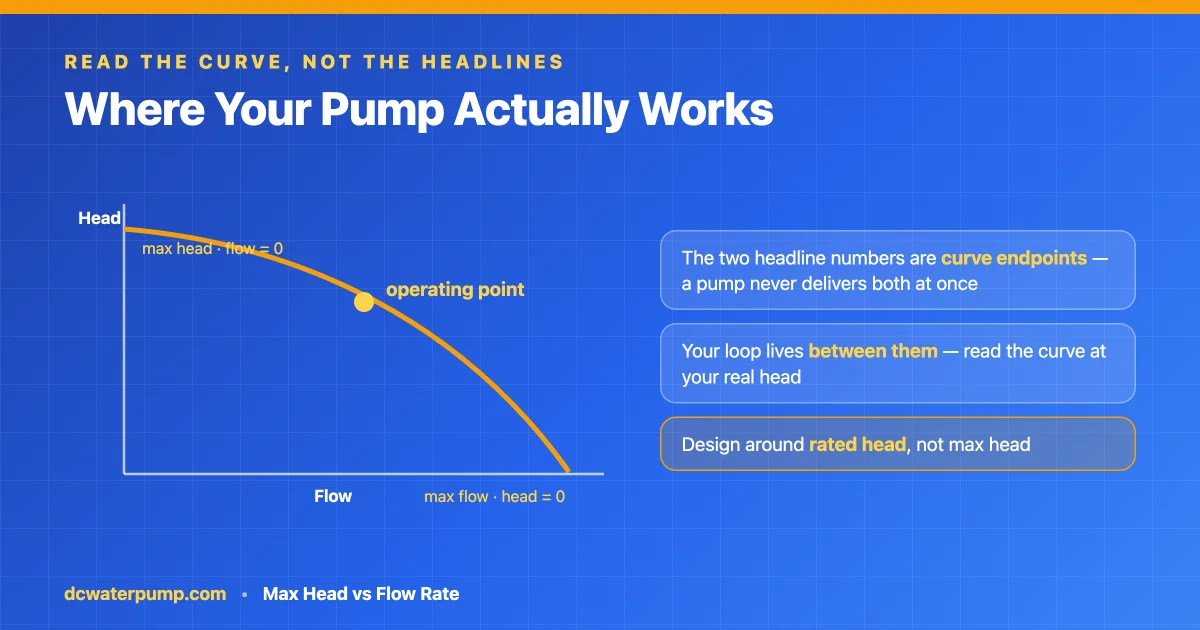
Max head is the maximum vertical height a pump can push water at zero flow — also called shut-off head. At that height the pump generates just enough pressure to hold the water column, with nothing left to move it. Useful flow exists only below max head, so size pumps by rated head, not the max number on the box.
The spec that sells pumps — and sinks cold plunge builds
Pump listings lead with two numbers: max flow and max head. Both are real measurements, and reading them together is where buyers go wrong, because a pump never delivers both at once. Max flow happens at zero height with nothing restricting the outlet; max head happens at zero flow. Real systems live somewhere on the curve between those endpoints — and a cold plunge loop, with its chiller coil, filter, and fittings, lives further from the “max flow” end than almost any other small-pump application.
This is not fine print. The confusion shows up verbatim in the field — a hydroponics builder on Reddit summarized the discovery most buyers make after purchase: every pump has a curve relating pressure and flow, and once you’re pushing water through anything restrictive, “it will be at a significantly lower rate.” The curve was always on the datasheet. The listing just didn’t lead with it.
The trap: flow is zero at max head
Water Garden’s FAQ gives the cleanest illustration in the SERP, from their own catalog: a pump listing 12,000 L/h max flow with a 7 m max head delivering about 6,000 L/h at 3.5 m of lift — half the flow at half the head. That’s one pump’s curve, not a law: centrifugal head-flow curves are generally non-linear, and their shape varies with impeller design. But the example makes the point every curve makes, whatever its exact shape:
- The 7 m number tells you where flow stops, not where the pump works.
- At any height you’d actually install a cold plunge pump, you’re harvesting a fraction of the advertised flow.
- Two pumps with identical max head can deliver very different flow at your operating point — the curve between the endpoints is the real product.
Manufacturers separate these ideas as max head vs. rated head. Water Pumps Direct’s spec guide puts numbers on it: a pump with a 40 m max head “can technically push water that high, but it won’t deliver usable flow at that height” — its rated head, where it performs strongly, may be 25 m. Rated head is where the pump is designed to live; max head is where it dies.
How to calculate TDH for a cold plunge (worked example)
Total dynamic head is the honest version of “how high”: the net elevation change the pump must overcome, plus every friction and equipment loss in the path. For open systems — a well to a tank — the elevation term dominates; CSI Designs’ pump-curve guide walks that general case. A cold plunge has a friendlier geometry: it’s a closed loop returning water to the same tub, so the water column on the suction side offsets the lift on the discharge side and the net elevation term is approximately zero (plus, at most, the height of a return fitting spraying in above the waterline). What’s left — and what actually sizes the pump — is friction and equipment.
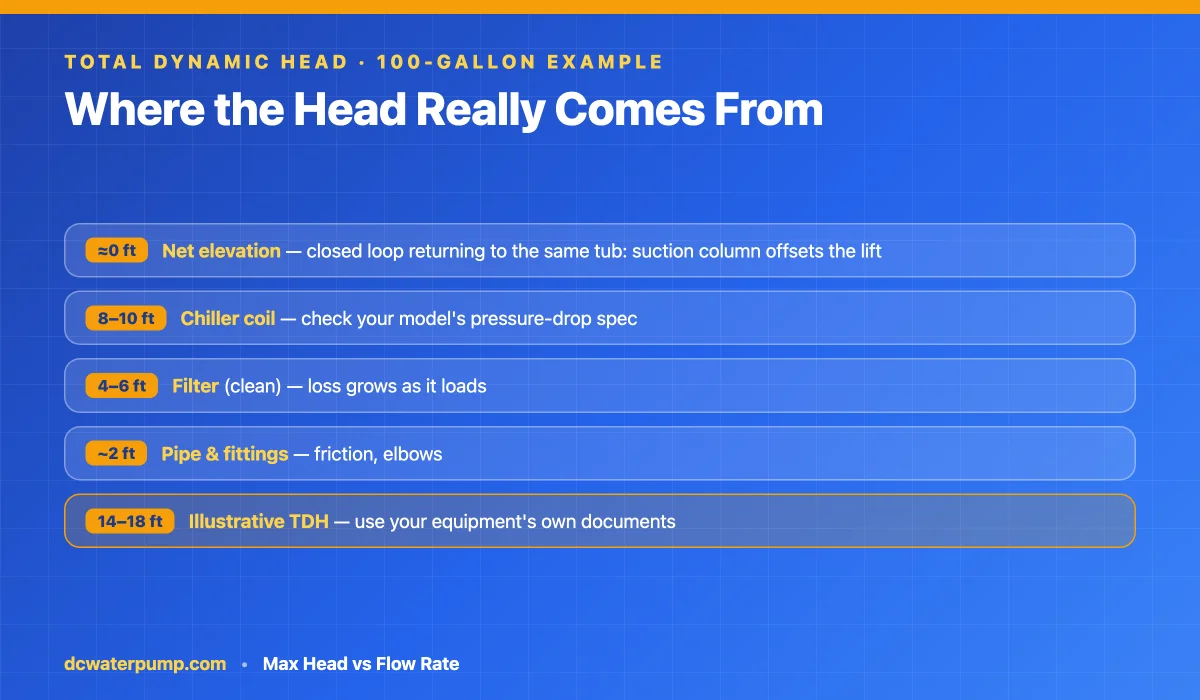
Walk an illustrative build — 100-gallon tub, pump below the waterline, chiller and filter inline. The loss figures below are stand-in assumptions to show the method; your chiller and filter publish their own pressure-drop numbers at a given flow, and those are the ones to use:
| Component | Head contribution (illustrative) | Running total |
|---|---|---|
| Net elevation (closed loop, return below surface) | ~0 ft | 0 ft |
| Chiller coil (check your model’s ΔP) | ~8–10 ft | 8–10 ft |
| Filter (clean; loss grows as it loads) | ~4–6 ft | 12–16 ft |
| Fittings, elbows, tubing friction | ~2 ft | 14–18 ft TDH |
Target flow for this tub is 8–10 GPM of circulation (our cold plunge mistake guide walks the turnover math). So the pump you want is one whose published curve shows 8–10 GPM at 14–18 ft (4.5–5.5 m) of head — read the curve at that point rather than shopping by max-head headline, and prefer a pump whose curve puts this operating point in its healthy working region, not at its outer edge. Note also that equipment pressure drop rises with flow, so a curve reading is only honest at your actual target GPM.
Two build notes fall straight out of the math: a filter’s head cost grows as it loads with debris, so the margin you leave today is the flow you keep next month. And every unnecessary elbow is a permanent tax — plumbing straight runs where you can is free pump performance.
One table for the unit soup
Head appears in feet, meters, psi, and bar depending on which side of which catalog you’re reading. They describe the same thing — pressure expressed as water height:
| Feet of head | Meters | psi | bar |
|---|---|---|---|
| 2.31 ft | 0.70 m | 1 psi | 0.069 bar |
| 10 ft | 3.05 m | 4.3 psi | 0.30 bar |
| 23 ft | 7 m | 10.0 psi | 0.69 bar |
| 33 ft | 10 m | 14.3 psi | ~1.0 bar |
(The anchor conversion — 1 psi = 2.31 ft of head — is standard across pump engineering references, for water at ambient temperature.)
Why the chiller changes everything
Generic head explainers use garden ponds and irrigation lines. A cold plunge loop is different in one load-bearing way: the chiller is both the point of the system and its biggest restriction. That coupling creates the failure mode this article exists to prevent:
- Buyer sizes the pump by max flow (“1,200 GPH — plenty!”).
- The chiller coil and filter add 12–16 ft of head the buyer never counted.
- Delivered flow lands below the chiller’s rated range.
- The chiller short-cycles or ices; cooling per hour drops; the “big” pump gets blamed.
The fix costs nothing: read the chiller’s required flow range first, compute TDH second, and only then open a pump listing — reading its curve at your TDH, not its headline numbers. If the curve isn’t published, that’s information too: manufacturers confident in their curves print them.
Reading the curve like an engineer: the best efficiency point
One more concept turns you from spec-sheet reader into pump selector: the best efficiency point (BEP). Somewhere along every performance curve there’s a flow-and-head combination where the impeller converts motor power into moving water most efficiently. BEP is not the geometric middle of the curve — its position varies by design — but manufacturers rate their pumps at or near it, which is the deeper reason “design around rated head, not max head” is the standing advice: rated conditions and best-efficiency conditions largely coincide. Operating far from BEP, toward either extreme of the curve, converts more of the motor’s power into heat, vibration, and bearing load instead of moving water.
This is also why an oversized pump throttled down is not the same as a right-sized pump. A throttling valve works by adding artificial head: the pump keeps generating more pressure than the loop needs, and the valve burns off the difference as friction. Whether the resulting operating point lands nearer to or farther from BEP depends on where you started — but the head you throttle away is paid for at the meter either way, and often audibly at the valve.
For a cold plunge, the practical takeaway is short: after you’ve computed your TDH and target GPM, prefer the pump whose published curve puts that operating point in its rated working region — not the biggest pump whose curve merely reaches it. If you haven’t computed those numbers yet, our five-step 12V pump sizing guide walks the whole calculation for a real build.
Frequently asked questions
Is max head the same as shut-off head?
Yes — the two terms describe the same point: the head at which flow reaches zero. “Shut-off head” is the engineering term; “max head” is the marketing spelling of it.
Why is flow zero at max head?
At max head, all of the pump’s energy goes into holding the water column at that height — there’s none left over to keep water moving. Any real flow requires operating below shut-off head, somewhere along the pump’s performance curve.
What’s the difference between max head and rated head?
Max head is the zero-flow limit. Rated head is where the pump delivers its intended flow efficiently — typically well below max. Design around rated head; treat max head as the boundary of the map, not a destination.
Can a pump run at max head continuously?
It shouldn’t. Running at or near shut-off (a blocked outlet does this) means no flow through the pump — and in most circulation-pump designs the moving water is also the cooling and lubrication path. Extended dead-heading builds heat and shortens pump life. If your loop’s TDH is near the pump’s max head, the pump is undersized for the job.
How do I convert pump head to psi?
Divide feet of head by 2.31 to get psi (for water at ambient temperature). In metric: 10 m of head is approximately 1 bar. So a pump with a 7 m (23 ft) max head is generating about 10 psi at shut-off.
How much head does a chiller add to a cold plunge loop?
It varies by model, coil design, and — importantly — your actual flow rate, since pressure drop rises with flow. The honest answer for your build is in the chiller’s documentation at your target GPM; when nothing is stated, using an illustrative planning figure on the order of 12–16 ft for chiller-plus-filter is safer than ignoring them, and should be replaced with real data before you buy.
Where to go next
For the general engineering version of this topic — beyond cold plunge — our original explainer on how important the max head of a pump is stays the reference. New to the whole system? Start at what a cold plunge pump does. And when you’re ready to buy, the cold plunge pump mistake guide turns this math into a checklist.