
What Is a Cold Plunge Pump? A Beginner’s Guide to Circulation & Chilling
TL;DR: A cold plunge pump is a compact water pump that keeps the water in your ice bath moving — through the filter, through the chiller, and back into the tub. Without one, the water stratifies into warm and cold layers, the chiller can’t do its job, and water quality degrades fast. Sizing comes down to two numbers (flow rate and head), and the quietest units built for continuous duty today are brushless DC circulation pumps.
What is a cold plunge pump?
A cold plunge pump is a small circulation pump that continuously moves water from your plunge tub through a filter and a water chiller, then returns it to the tub. Its job is to keep the temperature uniform from surface to floor, push every liter of water through filtration, and keep your sanitizer evenly distributed. In most setups it runs 24/7 in the background.
If that sounds like a lot of responsibility for one of the cheapest components in your setup, it is. The cold plunge market was estimated at USD 354.6 million in 2025 and is projected to grow at 8.1% annually through 2033, according to Grand View Research — yet most of that money goes into tubs and chillers, while the pump that ties them together is chosen last, often badly.
This guide explains what the pump actually does, how to size it in five minutes, and how to choose between the two motor technologies you’ll encounter — so you understand the why before you spend anything.
What a cold plunge pump actually does (four jobs, one motor)
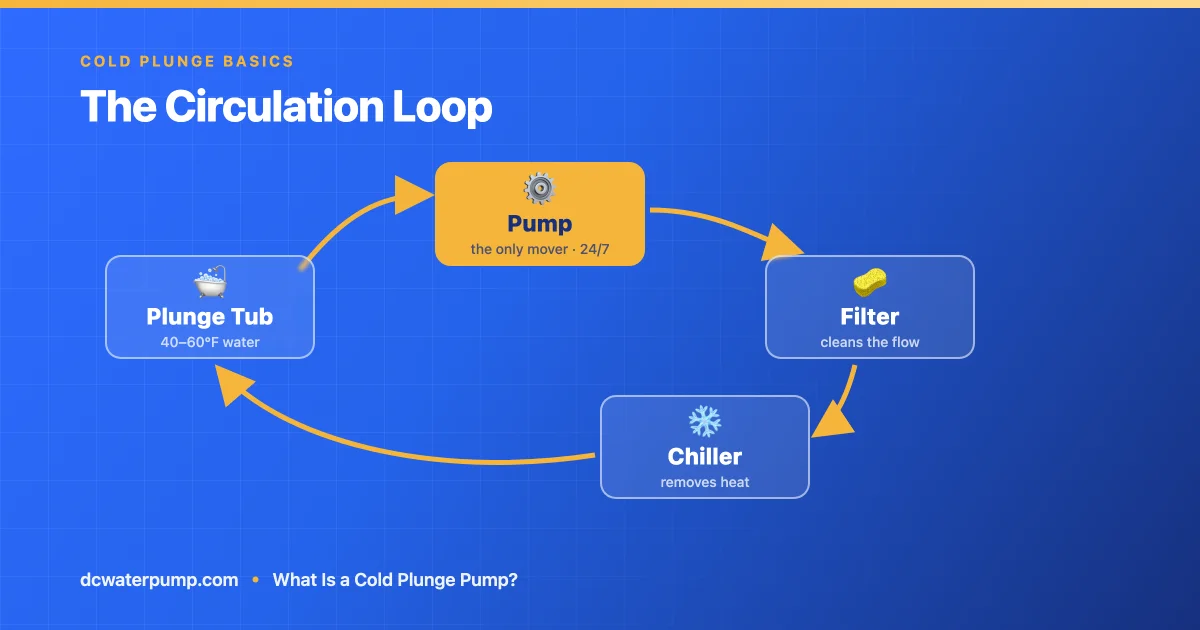
A cold plunge pump does four jobs at once, and losing any of them degrades the whole setup:
- Temperature circulation. Cold water is denser and sinks. Without flow, your tub stratifies — the thermometer says 45°F while the surface drifts several degrees warmer. The pump keeps the reading honest.
- Filtration transport. A filter only cleans the water that passes through it. The pump is what makes that happen; no flow means zero filtration, no matter how good the filter is.
- Chiller feeding. A water chiller needs water delivered at a flow rate inside its rated range. Too little flow and it short-cycles or ices up; the pump is the chiller’s supply line.
- Sanitizer and chemistry distribution. Circulation carries your sanitizer to every corner of the tub and keeps water chemistry uniform. It supports — but never replaces — proper water treatment, cleaning, and filter maintenance.
One detail beginners miss: these four jobs run continuously. A cold plunge pump is a 24/7 duty-cycle component, which is why motor technology and noise matter more here than in almost any other small-pump application.
How the circulation loop works — and why pumps must be primed
The loop is simple: tub → pump → filter → chiller → back to tub. The pump is the only component that moves the water — the chiller does its own hard work removing heat, and the filter catches debris, but neither can act on water that isn’t flowing.
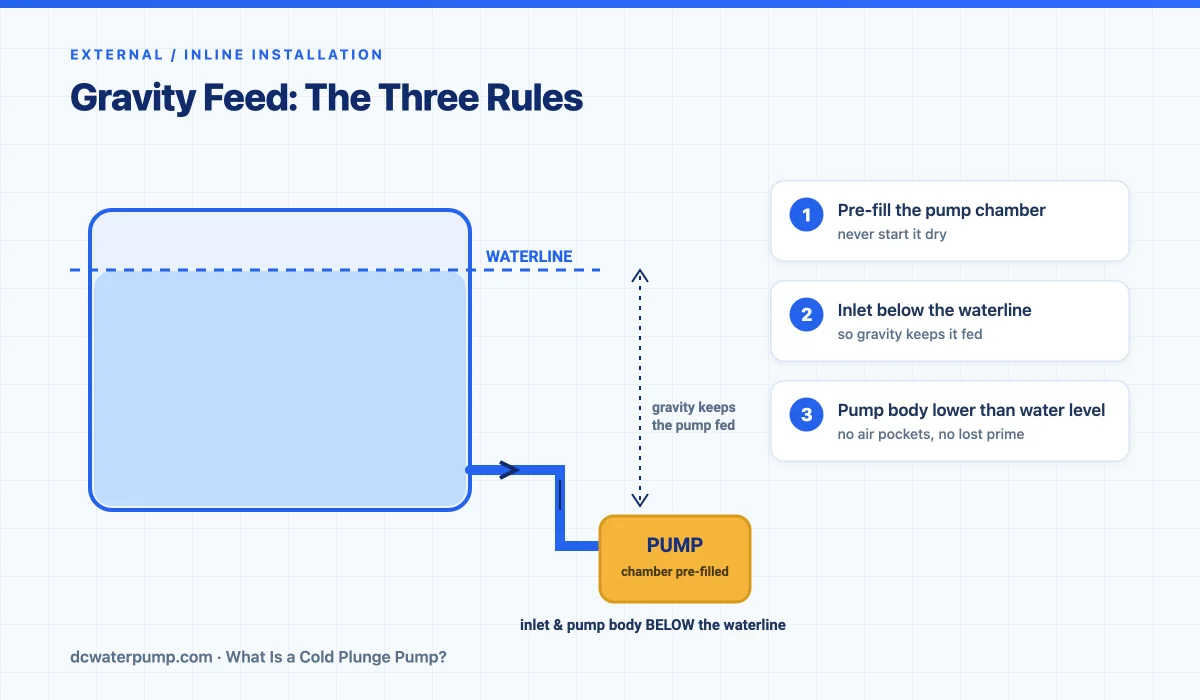
Here is the physics detail that explains half the “my pump stopped working” posts online: circulation pumps of this class — whether AC magnetic-drive or brushless DC — push water; they don’t pull it uphill from dry. They are gravity-fed devices with no dry self-priming ability. The pump chamber must be full of water before startup, and the inlet must sit below the tub’s water line so gravity keeps it fed. Mount the pump above the waterline, or let air into the line after cleaning, and it loses prime — the motor spins, nothing flows, and prolonged dry running will destroy the pump.
That’s not a defect; it’s how magnetic-drive circulation pumps are built, and it’s why installation geometry matters more than brand choice. (Fully sealed submersible pumps sidestep much of this by simply sitting flooded inside the tub — more on that below.)
The two numbers that size every cold plunge pump
Every pump on the market is specified by the same two numbers. Get them right and everything else is preference:
- Flow rate — how much water the pump moves, listed in GPH (gallons per hour) or L/min. You’ll also see GPM (gallons per minute) on larger pumps; divide GPH by 60 to compare.
- Head — how much vertical lift and plumbing resistance the pump can overcome, listed in feet or meters. Every elbow, filter, and chiller coil in your loop eats into it, which is why a pump’s real-world flow is always lower than the number on the box. (Head is the most misunderstood spec in small pumps — our explainer on how important the max head of a pump really is breaks it down.)
Two sizing rules cover nearly every setup:
- With a chiller: follow the chiller’s spec sheet, and aim mid-range. Your chiller’s manual specifies an acceptable flow range — that document is the primary authority. If it wants 800–1,600 GPH, pick a pump delivering roughly 1,000–1,200 GPH after head losses rather than chasing the maximum. Field experience agrees: as one builder on r/coldplunge put it, matching the chiller’s top figure “will put unnecessary strain on the chiller and the pump” once a filter joins the loop.
- Without a chiller: turn the tub over every 30 minutes. Plunge Junkies’ sizing guide recommends a pump “capable of circulating the entire volume of the tub at least every 30 minutes” — a 100-gallon tub therefore needs at least 200 GPH of delivered flow.
| Your setup | Sizing rule | Example |
|---|---|---|
| Tub + chiller (½ HP, 800–1,600 GPH) | Middle of chiller’s rated range | ≈1,000–1,200 GPH (63–76 L/min) |
| Tub only, 100 gal (380 L) | Full volume every 30 min | ≥200 GPH (≥12.6 L/min) |
| Tub only, 200 gal (760 L) | Full volume every 30 min | ≥400 GPH (≥25 L/min) |
Oversizing is a real failure mode, not a safety margin: an oversized pump adds turbulence, noise, and electricity cost while pushing the chiller outside its comfort zone. When you’re ready to turn these two rules into a specific pump pick, our five-step 12V pump sizing guide works the full calculation on a real 100-gallon build.
AC magnetic-drive vs. brushless DC: how the two motor types differ
Most pumps recommended for cold plunges today are AC magnetic-drive units — proven, affordable, and widely available. A newer class of brushless DC (BLDC) circulation pumps was engineered for continuous, quiet, low-voltage duty, and quality units differ from typical AC models in ways that matter for a tub you sit next to:
| Typical AC magnetic-drive pump | Quality BLDC circulation pump | |
|---|---|---|
| Speed | Fixed — one flow rate, always | Adjustable via PWM, 0–5V signal, or a simple potentiometer — trim flow to your chiller instead of buying a new pump |
| Noise | Line-frequency hum, tends to grow with age | No brushes or rubbing shaft seal to generate noise; well-built units run below 35 dB — about library-quiet |
| Power at the tub | Mains voltage (110/230V AC) | Low-voltage DC, typically 12/24V |
| Continuous duty | Yes, with wear on bearings and seals | Designed for continuous service with a rated design life around 30,000 hours; electronics fully isolated from the water path |
| Submersion | Model-dependent | IP68-sealed designs are built for continuous submersion |
The engineering behind the noise gap: a BLDC motor has no carbon brushes to spark or wear, and drives the impeller through a sealed magnetic coupling on a ceramic shaft — bearings remain the main wear surface, but there is far less mechanical contact to hum or degrade. The same epoxy-encapsulated, fully isolated construction is what makes IP68 sealing possible.
(Where these numbers come from: they are the published design specs of modern BLDC circulation pumps as built by manufacturers like BLDC PUMP, which has produced brushless DC pumps since 2009. If you’re an equipment builder rather than a DIYer, that page speaks your language.)
For a deeper technical primer on the motor difference, see our DC water pump comprehensive guide.
Submersible or inline: where should the pump live?
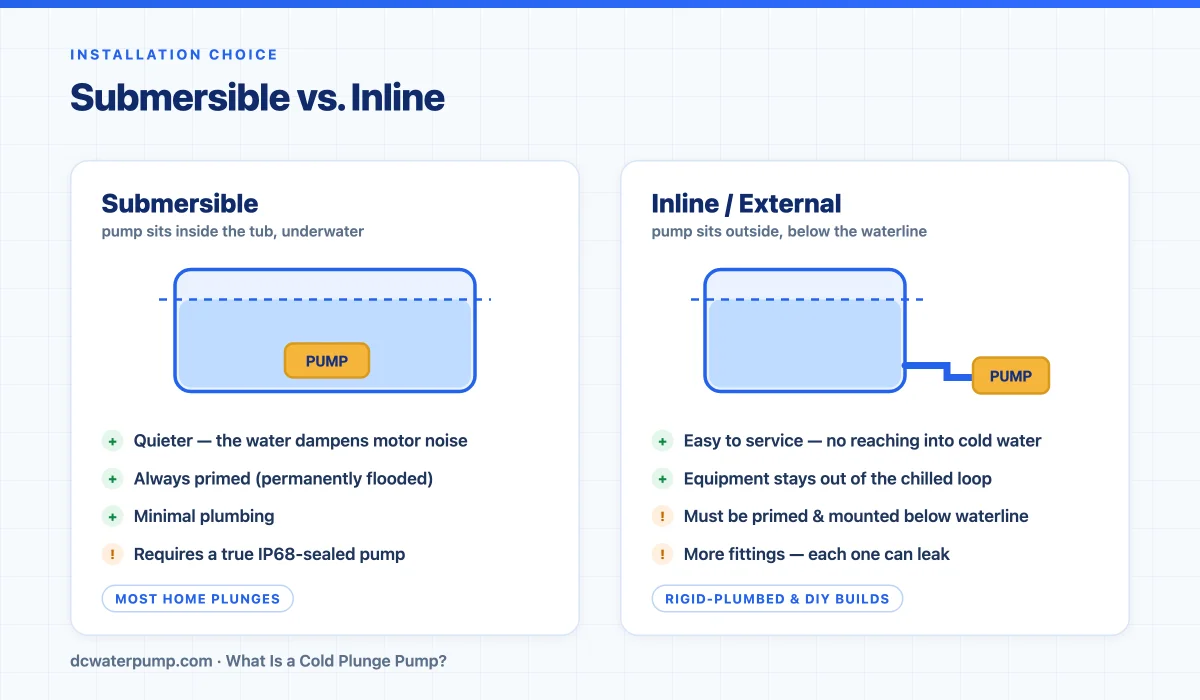
Both installations work; they trade different things.
- Submersible (pump sits inside the tub, underwater): the water itself dampens motor noise, plumbing is minimal, and priming is automatic — the pump is always flooded. Requires a true IP68 rating and a proper low-voltage supply.
- Inline / external (pump sits outside the tub): easier to service without reaching into cold water and keeps equipment out of the chilled loop, but it must follow the gravity-feed rules above: pre-fill the pump chamber, keep the inlet below the waterline, and mount the pump body lower than the water level.
For most home plunges, a quiet submersible unit is the simpler answer. Builders doing chest-freezer conversions or rigid-plumbed systems tend to go inline for serviceability.
Two symptoms that explain most pump problems
When a cold plunge pump misbehaves, its current draw usually tells you why — and both patterns typically trace back to installation, not a faulty pump:
- High current, low flow — something is fighting the impeller: an obstruction, a clogged filter, or more total head in the loop than the pump can handle.
- Low current, intermittent flow — the pump is moving air instead of water: an inlet above the waterline, an air pocket after refilling, or lost prime.
Fix the plumbing geometry and filter maintenance first; genuine motor failures are the rare case.
Frequently asked questions
Do I really need a pump for my cold plunge?
Yes. Without circulation the water stratifies into warm and cold layers, the filter and chiller stop doing anything useful, and sanitizer can’t reach the whole tub. The pump is what makes every other component work.
What size pump do I need?
Two rules cover almost everyone: with a chiller, follow its spec sheet and choose a pump in the middle of the rated GPH range; without one, choose a pump that turns your tub’s full volume over at least every 30 minutes — e.g., 200+ GPH for a 100-gallon tub.
Submersible or inline — which is better?
Submersible is quieter (the water absorbs motor noise) and stays primed by nature; inline is easier to service but must be mounted below the waterline and primed before startup. Home setups usually favor submersible.
Why does a pump need to be primed?
Circulation pumps in this class push water but can’t draw it up from dry. If the chamber contains air instead of water — after installation, cleaning, or a leak — the impeller spins uselessly and prolonged dry running can burn out the pump. Keeping the pump below the waterline lets gravity do the priming.
Can my circulation pump double as a wave maker?
Keep the jobs separate. The circulation pump should be sized to the chiller’s flow range; asking it to also generate surface agitation pushes it out of that range and strains both machines. If you want water movement for the plunge experience, add a dedicated wave-making unit.
How quiet should a cold plunge pump be?
For anything installed indoors or near a recovery space, under 35 dB is the threshold worth paying for — roughly library-quiet. Well-built brushless DC pumps reach this because they have no brushes or rubbing seals; an aging AC pump generally won’t.
Where to go next
You now know what a cold plunge pump does, how the loop works, and how to size the two numbers that matter. The next step is avoiding the purchasing mistakes that burn out chillers and budgets — our field guide covers them: Cold Plunge Pump Guide — How to Avoid Common Mistakes. Still weighing whether your setup even counts as a cold plunge — or whether a simple ice bath does the job? Our cold plunge vs. ice bath pump comparison sorts the three system types and the machine each one actually needs. Working on a hot tub rather than a plunge? The same compatibility logic — plus mains-powered jet pumps — is covered in our Hot Tub Pump Buying Guide.
Building cold plunge equipment commercially? BLDC PUMP supplies OEM brushless DC circulation pumps with adjustable speed, IP68 sealing, and sub-35 dB operation — with standard samples ready in 3–7 working days. Start at the cold plunge pump range.