
Cold Plunge vs Ice Bath: Does Pump Choice Really Matter?
TL;DR: An ice bath in the strict sense — a tub you cool by pouring in ice — doesn’t need a pump at all. A cold plunge — a system that holds the water at a set temperature with a chiller — can’t function without one. Most buyers live between those two definitions: they start with bags of ice, add a chiller within a season, and only then discover that pump choice decides whether the chiller performs or struggles. The rule that matters: keep the pump’s delivered flow inside your chiller’s specified range — and when the manual states a range with no preference, the middle is a safer default than the top.
The same tub, two different machines
The recovery-tub market has grown past the point where the vocabulary keeps up. Fortune Business Insights values the global cold plunge tub market at USD 362.96 million in 2025, projected to roughly double to USD 739.96 million by 2034 — yet “ice bath” and “cold plunge” are still used interchangeably by most of the people spending that money. They describe different machines:
- An ice bath is a container of water you cool manually — a stock tank, a chest freezer shell, even a bathtub — by adding ice until it lands somewhere in the 33–50°F (0.6–10°C) range, per iPHotTubs’ comparison guide. No machinery is required. The temperature drifts upward from the moment you stop adding ice.
- A cold plunge is a closed system: tub, chiller, filter, and a circulation pump holding the water at a set point you choose — commonly anywhere from the high 30s to 60°F (about 4–15.6°C) depending on the system and protocol — ready at any hour without a single bag of ice.
Note what the dividing line is not: temperature. Modern chiller systems reach well into ice-bath territory — several commercial plunges hold the water in the high 30s°F — so the ranges overlap. The real distinction is how cold is achieved and held: manually hauled ice that starts warming immediately, versus active control that holds a set point indefinitely. That distinction sounds academic until you’re standing in a pump aisle. The ice bath, strictly defined, has no place to put a pump. The cold plunge cannot exist without one — the chiller only cools water that flows through it, and the pump is the only thing making water flow.
Where the confusion starts costing money
Search results for “ice bath pump” are dominated by product listings that never explain any of the above, and buyers fill the gap with guesses. Three of those guesses fail in predictable ways:
Guess 1: “It’s just an ice bath — skip the pump entirely.” True for short, supervised sessions. But still water stratifies: cold sinks, the surface warms, and the thermometer reading stops describing what your body feels. Without flow there is also no filtration — whatever is in the tub stays in the tub between sessions. A pump doesn’t sanitize anything (that’s your water treatment’s job, which circulation supports but never replaces), but it’s what carries filtered, temperature-uniform water to every corner.
Guess 2: “Bigger pump, faster cooling.” This is the expensive one. A chiller’s cooling has a ceiling set by its refrigeration circuit — pushing water past the coil faster than the specified range buys, at best, marginal heat-transfer gains at sharply diminishing returns. What it reliably buys: more pressure drop, more noise, more wear across the loop, and operation outside the range the maker will stand behind. The r/coldplunge community has litigated this repeatedly — one owner asked whether a pump above his chiller’s specified 600–1,500 L/h range was a risk, and the thread’s practical consensus was to stay inside the spec; another reported that after throttling his pump down, his chiller cycled less often to hold temperature. A bigger pump is a bigger bill twice — at purchase and on every electricity reading — not a faster path to cold.
Guess 3: “Any pump this size will do.” The pump in a cold plunge runs continuously beside the space where you’re trying to recover, breathe, and (per every cold-exposure protocol) stay calm. An owner in the same thread put a number on the regret: his 1,000 GPH pump was loud enough that he now schedules the whole system around not hearing it. Noise is a spec, not a surprise — but only if you check it before buying.
Do I need a pump for an ice bath?
Not for a basic ice bath — manually adding ice to a stock tank works with no pump at all. But once you add a chiller to hold a consistent set temperature, a matched-flow circulation pump becomes essential: the chiller can only cool water the pump delivers to it.
The decision framework: match the pump to the system, not the tub
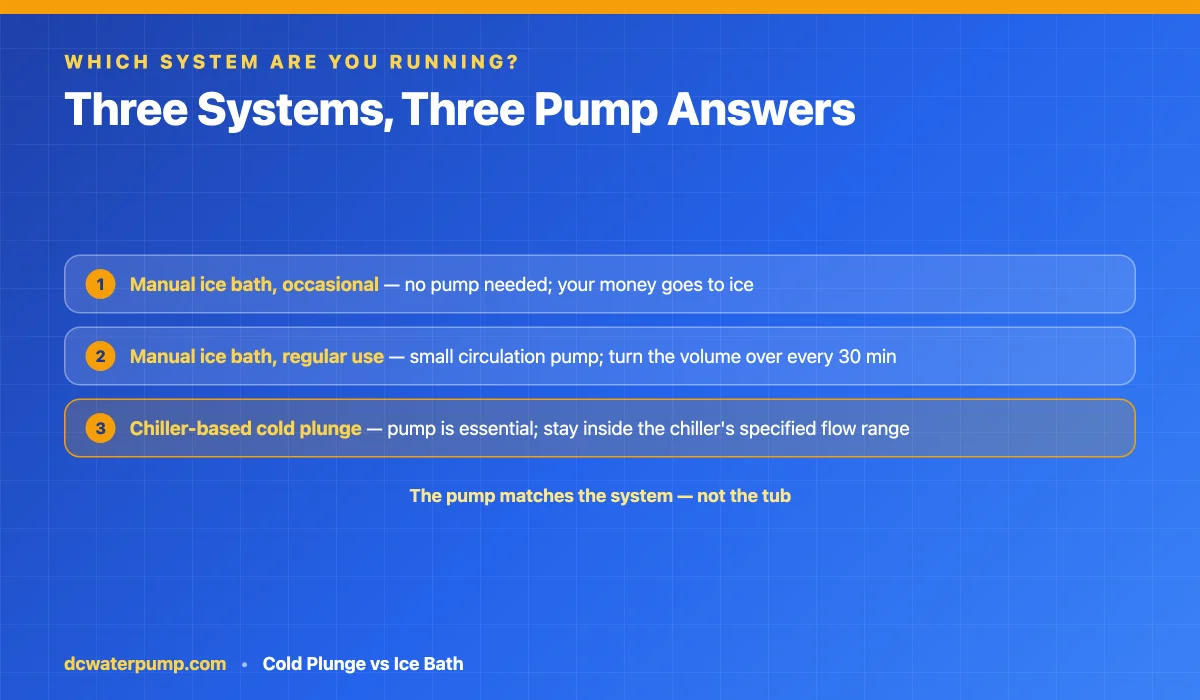
The useful question isn’t “cold plunge or ice bath?” — it’s “which of three systems am I running?”
System 1 — Manual ice bath, used occasionally. No pump needed. Your money goes to ice. If sessions are short and you drain the tub after, this is the honest budget option, and no pump marketing should talk you out of it.
System 2 — Manual ice bath, used regularly. Still no chiller, but stratification and standing water start to matter. A small circulation pump sized by tub volume fixes both. Plunge Junkies’ sizing guide recommends turning the tub’s full volume over at least every 30 minutes — a 100-gallon tub therefore wants a pump delivering at least 200 GPH after plumbing losses. (Why delivered flow is lower than the number on the box is a head-pressure story — our explainer on how important max head really is covers it.)
System 3 — Chiller-based cold plunge. Now the pump is load-bearing. Two numbers govern the choice:
- The chiller’s rated flow range is the authority. A typical spec reads 500–1,800 GPH; Plunge Junkies’ guidance — which matches what chiller manuals themselves ask for — is to pick a pump landing in the middle of the range, around 1,000–1,200 GPH for most setups, rather than chasing the maximum. Community experience with smaller 1/3 HP chillers converges on the same logic at lower numbers: owners report 500–700 GPH as the comfortable zone. (Delivered flow is what survives head losses — our max head vs. flow rate guide works a complete cold plunge TDH example.)
- Cooling is a rate, not an event. Hydro Systems’ install documentation for its own systems cites 4–8°F of cooling per hour, varying with ambient temperature and how far the chiller sits from the tub. Your equipment will publish its own figure — the point is to expect a pull-down measured in hours, and to give the chiller the flow its manual asks for while it works.
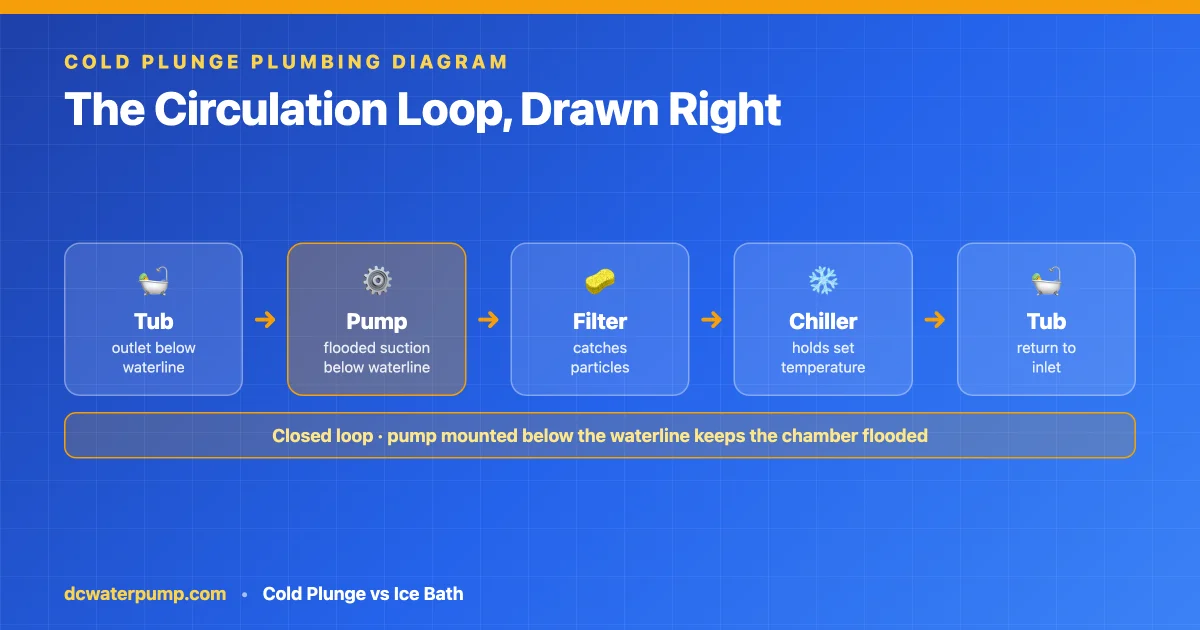
The loop itself is simple, and worth drawing before you buy a single fitting: tub outlet → pump → filter → chiller → back to the tub inlet, with the pump mounted below the waterline so its chamber stays flooded. The compact circulation pumps used in these builds push water; they don’t prime themselves from dry — a detail that explains a remarkable share of “my pump stopped working” posts.
Cold plunge vs ice bath: side-by-side
| Ice bath (strict) | Cold plunge | |
|---|---|---|
| Temperature | Wherever the ice takes it — typically 33–50°F (0.6–10°C) | A set point you choose — systems commonly hold high-30s to 60°F (≈4–15.6°C) |
| How it’s cooled | Ice, added manually | Chiller, automatic |
| Needs a pump | No (helpful if used often) | Yes — the loop can’t run without it |
| Needs a chiller | No | Yes |
| Filtration | None by default | Continuous, pump-driven |
| Ready when? | After you haul the ice | Any time, at set temperature |
The quiet detail nobody lists in the product photos
If your system runs a chiller, the pump runs around the clock — which makes duty rating and noise the two specs that decide whether you’ll like living with it. This is the niche where brushless DC (BLDC) circulation pumps were engineered: continuous duty with no brushes to wear (bearings remain the wear item), magnetic-drive isolation, low-voltage 12/24V DC supply, and quality units running below 35 dB with design lives around 30,000 hours. For a machine that sits a meter from your head during breathwork, the decibel line is not a luxury spec.
Honest scoping, as always: a BLDC circulation pump belongs in systems designed around it — DIY builds, new cold plunge equipment, off-grid setups — not as a casual swap into a mains-powered appliance’s existing controller. If you’re building recovery equipment commercially, BLDC PUMP’s cold plunge pump range covers the OEM side — the company has built brushless DC pumps since 2009, with standard samples in 3–7 working days.
Frequently asked questions
What’s the difference between a cold plunge and an ice bath?
Control, not temperature. An ice bath is manually cooled with ice and warms from the moment you stop adding it; a cold plunge uses a chiller and circulation pump to hold a chosen set point automatically — and modern systems can hold temperatures that overlap the ice-bath range. The equipment lists barely overlap: an ice bath needs a container; a cold plunge needs a tub, pump, filter, and chiller.
Will an oversized pump hurt my system?
It won’t meaningfully speed up cooling — the chiller’s refrigeration circuit sets the ceiling, and flow beyond the specified range delivers sharply diminishing heat-transfer returns — while costing you elsewhere: more pressure drop and noise, more wear, higher energy use, and operation outside the flow range your chiller’s maker specifies and supports. Stay inside the published range; with no stated preference, the middle is the safer default.
What flow rate matches a 1/3 HP chiller?
Community consensus from cold plunge owners lands at 500–700 GPH for 1/3 HP class chillers — but your chiller’s own label range is the authority. Pick the middle of whatever range it states.
How fast does a chiller cool the water?
One manufacturer’s install documentation cites 4–8°F per hour for its systems, varying with ambient temperature and how far the chiller sits from the tub. Your chiller’s own documentation is the authority — the practical takeaway is that pull-down takes hours, so systems are designed to hold temperature continuously rather than cool on demand.
Can I run a cold plunge without a chiller if I just add ice?
Yes — that’s a manual ice bath, and it’s a legitimate setup. If you use it regularly, a small circulation pump still earns its keep by preventing temperature stratification and moving water through a filter: size it to turn the tub’s volume over every 30 minutes.
Why does the pump need to sit below the waterline?
The compact circulation pumps typically used in plunge builds — AC or DC — are flooded-suction designs: they push water but can’t prime themselves from dry. (Self-priming pumps exist — pool-style centrifugals, for example — but they’re a different equipment class from the small circulation pumps this article covers.) Mounting below the waterline keeps the chamber full by gravity; mounted above it, this class of pump loses prime, and dry running will eventually destroy it.
Where to go next
If you’ve concluded you’re really building a cold plunge, start with the fundamentals in what a cold plunge pump actually does, then arm yourself against the classic purchasing traps in our cold plunge pump mistake guide. Ice-bath-first and upgrading later? Bookmark both — the plumbing loop you sketch today is the one you’ll build around a chiller next season.