
Fountain Pump Buying Mistakes: 7 Things First-Timers Get Wrong
TL;DR: Most fountain pump failures start at checkout, not in the water. First-time buyers read max head as spray height and max flow as delivered flow, pair the pump with tubing that’s too thin, set it on the basin floor where it eats debris, forget that a pump can run dry in an afternoon of summer evaporation, buy on GPH with no noise number, underestimate a 24/7 electricity bill, and have no winter plan. Below: each mistake as symptom → cause → fix, what the mistakes cost, and a 60-second checklist to run before you buy.
What is the most common fountain pump mistake?
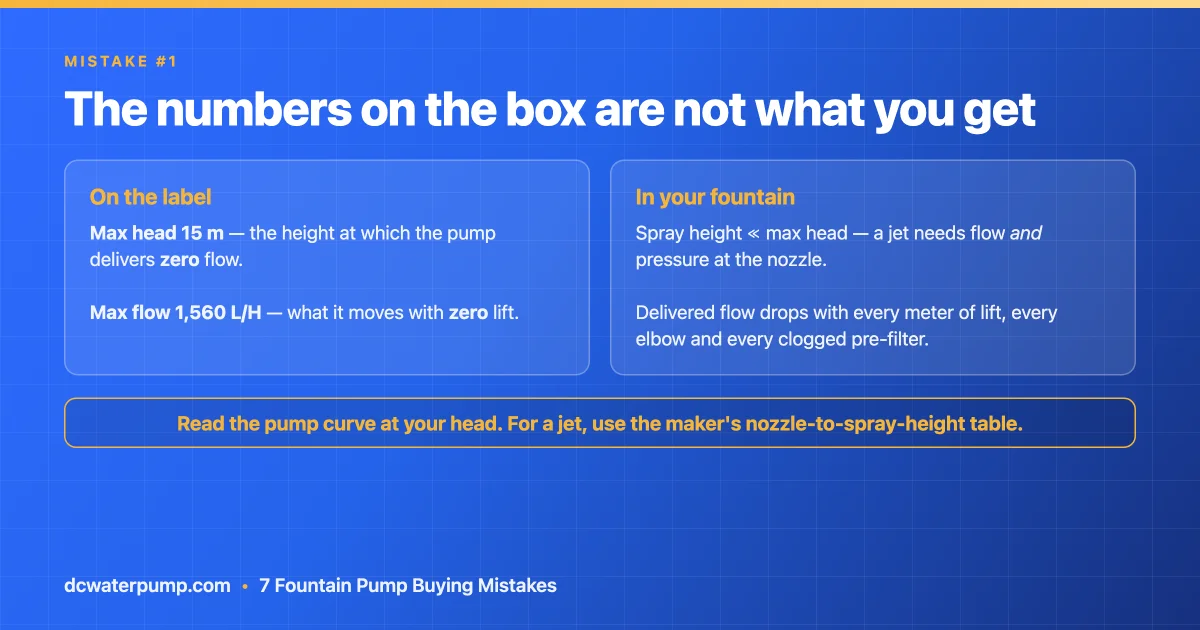
Treating the label’s two numbers as promises: max head is where the pump delivers zero flow; max flow is what it moves at zero lift. A jet needs pressure and flow at the nozzle, so real spray height sits well below max head.
Why first-time buyers get this wrong
Search “fountain pump” and half of what ranks is a calculator; the other half is a sizing guide. Both assume you already know what the specs mean. Nobody ranks for “here’s what people actually get wrong,” even though the failure pattern is consistent — we see the same misunderstandings in buyer inquiries, and the forums replay them weekly. A pump is the cheapest component in a water feature and the one that decides whether it works.
The seven mistakes below are ordered by how often they cause a return, a burned-out pump, or a fountain that quietly gets unplugged.
Mistake 1 — Reading max head as spray height (and max flow as real flow)
Symptom: You bought a pump rated “15 m max head” expecting a tall jet, and it produces a modest bubble; or you bought “1,500 GPH” and the top tier of a cascade barely wets.
Cause: Both figures are endpoints of the pump curve, not operating points. Our engineers spend a surprising amount of inquiry time on exactly this — as one put it to a customer: “…the 15 meters of the models are static head, in other words, the pressure at the outlet of the pump. At the 15 meters, there will be no water flow, you can check the performance curve.” Add pipe friction and fittings and the usable figure drops further: “generally there is head loss for the pumps due to working system pressure and inlet/outlet pipe resistance, so the actual max head must be lower than 15M.”
Fix: Ask for the pump curve and read flow at your head (vertical lift plus friction). For a jet, ignore max head entirely and use the manufacturer’s nozzle-to-spray-height table — spray height is a nozzle-and-flow question, not a max-head question. The primer on why max head matters more than max flow covers the physics; reading a pump curve shows the method on a real loop.
Evidence: Calculator sites offer a shortcut — SimplifyCalc suggests that “every 5 ft of head reduces pump output by roughly 10%.” Treat that as a rule of thumb for a first pass only; the derate varies by pump, and the curve is the authority.
Mistake 2 — Tubing that’s too thin for the flow
Symptom: The pump sounds busy, the outlet is weak, and a bigger pump helps less than expected.
Cause: Friction loss in undersized tubing eats head before the water reaches the fixture. A 600 GPH pump pushed through 3/8-inch line is fighting the hose, not gravity.
Fix: Size the tube to the flow, then pick the pump. SimplifyCalc’s guidance is a reasonable starting table: “Use 3/4-inch tubing up to about 600 GPH, 1-inch tubing for 600–1,500 GPH, and 1-1/4 inch or larger for higher flows.” In metric terms, that’s roughly 2,270 L/h and 5,680 L/h as the break points. Keep runs short, minimize elbows, and don’t neck the pump outlet down with adapters.
| Flow you need | Tubing (rule of thumb) | Metric |
|---|---|---|
| Up to ~600 GPH | 3/4 in | ≤ ~2,270 L/h · 19 mm |
| 600–1,500 GPH | 1 in | ~2,270–5,680 L/h · 25 mm |
| Above 1,500 GPH | 1-1/4 in or larger | > ~5,680 L/h · 32 mm+ |
(Table values are the calculator-site rule of thumb quoted above; confirm against the pump curve at your actual head.)
Mistake 3 — Setting the pump on the basin floor
Symptom: Flow fades over weeks; you clean the intake, it’s back in three days.
Cause: A pump sitting directly on the bottom sits in the layer where leaves, silt, and algae collect, and it pulls that layer straight into the impeller. Manufacturer maintenance guides consistently warn against the same two things — running dry and clogging — Fountain Tech’s maintenance guide puts it plainly: “Your pump must never run dry or be clogged with debris,” and the Design Cast maintenance packet warns that fountains under trees and plants collect organic debris that clogs the pump.
Fix: Elevate the pump on a brick or flat stone so the intake sits above the sediment layer, add a foam pre-filter sleeve on the intake, and clean the impeller cavity quarterly. Field confirmation: a homeowner on r/DIY reported weekly clogging until a nylon stocking over the intake plus an aquarium-sponge pre-filter turned it into a monthly job. The pumps we build carry the same warning in their usage precautions: keep particles, especially ceramic or magnetic ones, out of the pump.
Mistake 4 — Ignoring how easily a fountain runs dry
Symptom: The pump hums, no water moves, and the housing is warm. Often after a hot weekend.
Cause: Open fountains lose water to evaporation and splash; a shallow basin can drop below the intake in a day or two. A small centrifugal pump relies on the water it moves to stay cool and lubricated. Run it dry and the wear surfaces overheat quickly.
Fix: Keep the water level well above the intake and top up on a schedule; a float valve on a garden supply makes this automatic. Also install correctly in the first place — pumps in this class are not self-priming: the chamber must be full of water before startup, air must be bled out, and an externally mounted pump needs its inlet below the water line with positive pressure on the suction side.
If you want a safety net, choose a pump with dry run protection. Quality brushless DC (BLDC) fountain pumps, ours included, ship with a protection set that typically covers dry-run, stuck-impeller, over-voltage, low-voltage, overload, and reverse-polarity events; on ours, dry-run protection pulses the pump in short on/off cycles until water returns, then resets on its own. That protection is a backstop for a lapse, not a substitute for keeping the basin topped up.
Mistake 5 — Buying on GPH with no noise number
Symptom: The fountain sounds relaxing at the store display and like a refrigerator compressor in your bedroom at 2 a.m.
Cause: Listings publish flow and head; few publish a dB figure, and almost none say at what distance or condition it was measured. Motor hum and vibration through a hollow basin are the usual sources.
Fix: For anything indoors or near a patio seat, demand a noise spec with a method — dB at a stated distance (1 m is the convention), at the operating point you’ll actually run, in the mounting you’ll actually use. Then verify on arrival; our noise measurement method walks through a repeatable home test. Two installation fixes cost almost nothing: a rubber isolation pad under the pump, and keeping the pump body off the basin wall — a fix the fountain community rediscovers constantly, as in this maintenance write-up recommending “a rubber piece or Scotch Brite pad between the pump and basin.”
Motor technology matters too: quality BLDC circulation pumps, ours included, publish sub-35 dB figures for their quiet models — but that is a per-model spec to verify against a datasheet and your own meter, not a property of the letters “DC.”
Mistake 6 — Underestimating what 24/7 costs
Symptom: The electricity bill nudges up and nobody connects it to the fountain.
Cause: Fountain pumps run continuously by design, so watts matter more than they look. The formula is simple:
Monthly cost = pump watts × 24 h × 30 days ÷ 1,000 × your electricity rate.
Illustrative example at USD 0.13/kWh (the rate SimplifyCalc uses): a 60 W pump runs 43.2 kWh a month, “about $5.60 per month” in their worked example — roughly $67 a year. A 15 W pump moving similar water in a small feature runs 10.8 kWh, about $1.40. These are illustrative numbers; plug in your own rate and the wattage on the pump’s label, not a figure derived from volts × amps.
Fix: Compare pumps on watts at the flow you need, not on max GPH. Brushless DC motors are typically more efficient than brushed motors — published comparisons put BLDC in the 85–95% range against 75–85% for brushed DC (IJERA, DC Motor Efficiency) — which is one reason DC fountain pumps have become common in features that run around the clock. A timer for daylight-only operation is the other lever.
Mistake 7 — No winter plan
Symptom: Spring startup: cracked pump housing, snapped impeller, or split tubing.
Cause: Water left in the pump housing and tubing expands as it freezes and cracks them. Buyers assume a waterproof rating means weatherproof. It doesn’t. IP68 tells you the enclosure keeps water out under continuous submersion; it says nothing about ice pressure.
Fix: Wherever hard freezes occur, winterize before the first one. HiLine’s winterization guide lays out the routine: disconnect power, drain, clean, remove the pump, store it indoors, cover the fountain. Field practice on r/ponds is the same: shut down and pull the pump ahead of the first hard freeze unless a de-icer keeps the water above freezing. If you live in a mild climate and want to run through winter, that’s a design decision to make before buying — it changes what pump and basin you want.
What these mistakes actually cost
A mis-sized pump (Mistakes 1–2) gets returned or replaced; a floor-mounted, unprotected pump (3–4) burns out in a season; a pump bought without a dB number (5) gets unplugged; and the last two (6–7) turn a “cheap” pump into an annual expense. Almost none of this is a pump defect. It’s a specification and installation problem, which makes it preventable in about a minute.
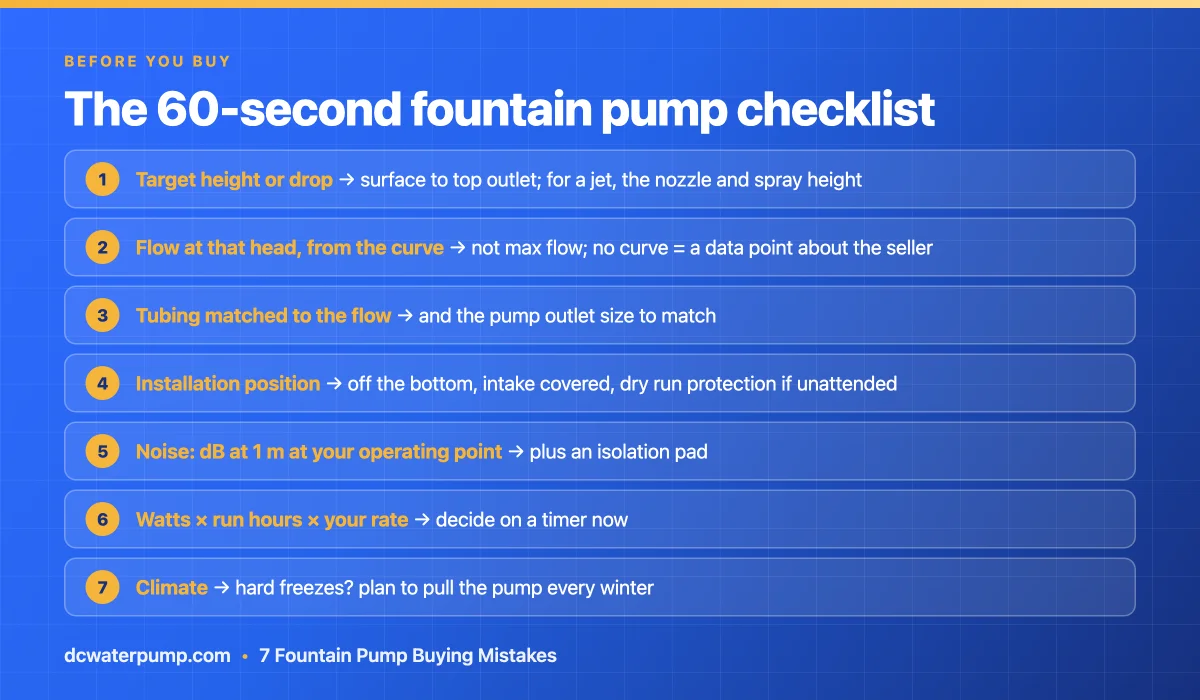
The 60-second pre-purchase checklist
Run this in order. If you can’t answer an item, don’t buy yet.
- Target height or drop. Vertical lift from water surface to the top outlet, in feet or meters. For a jet, the target spray height and the nozzle you’ll use.
- Flow at that head — from the curve. Not max flow. If there’s no curve and no nozzle chart, that absence is your data point. (For decorative features, calculator sites suggest turning the basin volume over roughly 0.5–1× per hour as a starting point; the nozzle or spillway sets the real number.)
- Tubing diameter matched to that flow (table above), and the pump outlet size to match.
- Installation position: elevated off the bottom, submerged with the intake covered, or externally mounted below the water line with a pre-filled chamber. Confirm the pump has dry run protection if the basin is shallow or unattended.
- Noise: dB at 1 m at your operating point, plus an isolation pad in the plan.
- Watts at operating point × your run hours × your rate. Decide on a timer now.
- Climate: does your site get hard freezes? If yes, plan to pull the pump every winter; if not, check the pump’s rated operating temperature range.
What the checklist does not cover: aesthetics, water treatment, and lighting. It covers only whether the pump will do what you expect — the part most first-timers skip.
Frequently asked questions
How do I calculate what fountain pump I need?
Measure the vertical lift from water surface to the outlet, add tubing friction, then read the pump’s flow at that total head on its curve. For a jet, pick the nozzle first and use the manufacturer’s nozzle-to-spray-height chart. Turnover rules are only a sanity check.
How high will a fountain pump spray?
Well below its max head. Max head is the zero-flow point; a jet needs flow at pressure, and the nozzle sets the trade-off. Only a nozzle chart or a test tells you the real height.
Why does my fountain pump hum but not pump water?
Usually air in the chamber, a water level below the intake, or a clogged impeller. Bleed the air, top up, clean the impeller cavity. If the pump has dry run protection it may be pulsing on and off on purpose until water returns.
How do I stop my fountain pump from clogging?
Elevate it off the bottom, add a foam pre-filter over the intake, keep it away from plant debris, and clean the impeller cavity quarterly. Field reports put that routine at monthly instead of weekly maintenance.
Can a fountain pump run 24/7?
Quality submersible fountain pumps are designed for continuous duty, provided the water level stays above the intake and the intake stays clear. Design life is a per-model spec — quality BLDC units, ours included, publish figures on the order of tens of thousands of hours — so check the datasheet.
Does a waterproof (IP68) pump survive winter outdoors?
No. IP68 describes protection against water ingress during continuous submersion; it does not protect against ice expansion. Wherever hard freezes occur, remove and store the pump before the first one.
Do fountain pumps use a lot of electricity?
Small ones don’t; large ones running continuously add up. Use watts × hours × rate. A 15 W pump is roughly 11 kWh a month; a 60 W pump about 43 kWh. Compare pumps on watts at the flow you need.
Where to go next
If the “max head vs. spray height” mistake was news, start with the fundamentals — why max head matters more than max flow — then read what a DC fountain pump is and how it differs from an AC pond pump. Together they answer the two questions this checklist assumes you can answer.
Building water features commercially? BLDC PUMP has made brushless DC pumps since 2009; our fountain range covers flows up to 13,000 L/h and heads up to 16 m, with dry run protection and IP68 sealing as standard, and custom samples typically shipping in 3–7 working days. The DC fountain pump range lists the models and offers matching nozzles with approximate spray heights.