
Silent Cold Plunge Pump: How Under-35 dB Changes Recovery Quality
TL;DR: The pump is the only component of a cold plunge that makes noise all day, every day — and in most builds it sits within arm’s reach of the person trying to down-regulate. Recovery spaces deserve the same noise budget as sleep spaces: the WHO’s night-noise guidance targets total bedroom levels around 30 dB — a budget the pump has to fit inside, not a product spec — and sub-35 dB at 1 m is the practical bar for a pump you share a room with. Getting there isn’t luck; it’s architecture — brushless DC motors, magnetic drive, decoupled mounting — plus one habit: never accept a “quiet” claim that doesn’t state decibels, at a distance, under a condition.
How many decibels is a silent water pump?
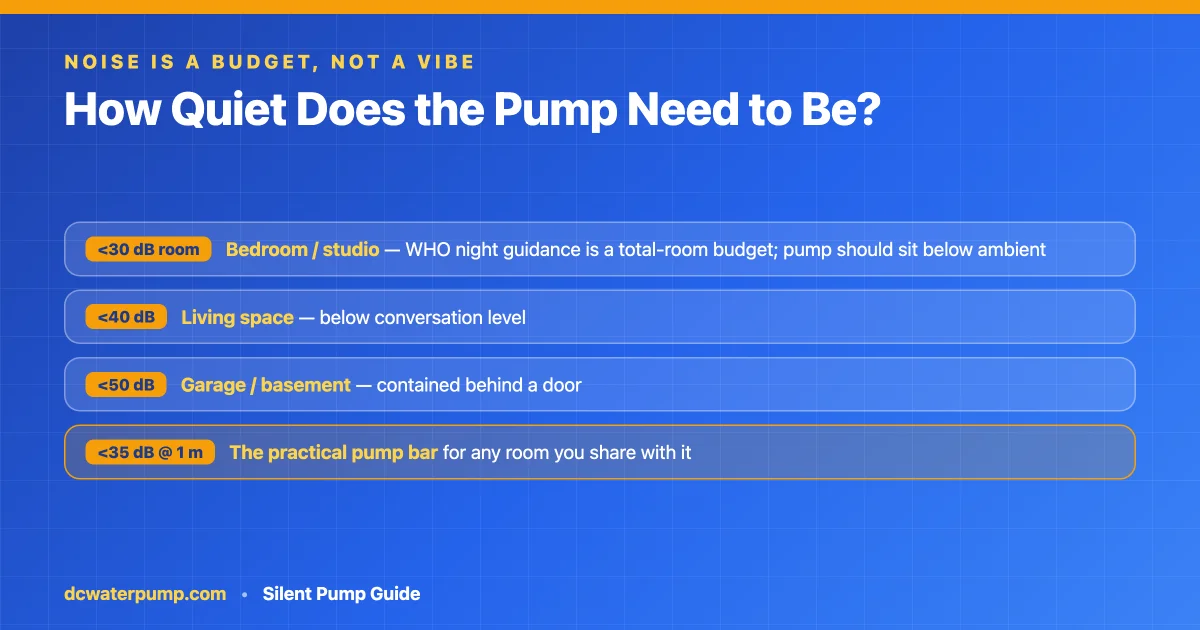
A practically silent water pump runs below 35 dB measured at one meter — between a whisper and quiet-room ambient. For bedrooms, note the WHO’s guidance targets total night-time room levels around 30 dB, so the pump’s contribution should sit below your room’s ambient. Quality brushless DC magnetic-drive circulation pumps publish specs at these levels.
The spec that’s everywhere in marketing and nowhere on the label
“Quiet,” “silent,” “whisper-quiet” — pump listings are full of adjectives and empty of method. A decibel figure without a distance is not a spec — sound level falls with distance (roughly 6 dB per doubling of distance in free field; indoor rooms with reflections behave less predictably), so the same pump is “30 dB” or “36 dB” depending on where you stood — and most listings don’t even offer the figure. Meanwhile the search results for quiet pumps are aquarium and PC-watercooling roundups; almost nothing addresses the cold plunge case, which is harder than both: more water than an aquarium loop, and unlike a PC, the machine runs beside deliberate stillness. You sit in cold water to trigger a calm-down response; a droning motor a meter from your head is the opposite input.
What “a little pump noise” actually costs
In recovery sessions: breathwork protocols are the standard companion to cold exposure, and they’re attention practices. Owners describe scheduling their whole system around the pump — running the chiller only when away, throttling flows — to avoid a hum they only discovered after installation. That’s a workaround for a spec that should have been checked at purchase. (To be precise about what’s claimed here: quiet changes the experience of a session — what’s documented is noise’s effect on sleep and annoyance, plus what owners consistently report. Whether a decibel threshold changes measurable recovery outcomes is not something pump specs can prove, and we won’t pretend otherwise.)
In sleep spaces: many home plunges live in basements, garages under bedrooms, or the bedroom itself. The WHO’s environmental noise guidance for restorative sleep points to total indoor night levels around 30 dB — a room budget, not a product spec, and the distinction matters: every noise source in the room shares that budget, so a pump audible at the pillow is spending it. Pool-class equipment, commonly reported by owners in the 50+ dB territory, doesn’t just spend the budget — it torches it.
The perception ladder — how these numbers feel — is remarkably consistent in enthusiast reports (r/watercooling has field-tested this for years): under ~30 dB is effectively inaudible in a quiet room; 30–35 dB is barely perceptible over ambient; 35–40 dB is noticeable up close but doesn’t break concentration; from ~45 dB the sound starts demanding attention. Independent pump testing lines up: Aquarium Extravaganza’s measurements put small 5W pumps around 20 dB, a 300 GPH class unit near 30 dB, and a 1,600 GPH brushless unit at 30–40 dB — evidence that even high-flow pumps can stay in the quiet band when the motor architecture is right. And Pump Critics’ roundup treats 35 dB as the bar that separates the genuinely quiet from the merely tolerable.
| Where the plunge lives | Practical noise budget (pump, at ~1 m) | Why |
|---|---|---|
| Bedroom / studio | Below room ambient (room total <30 dB per WHO) | The pump shares the room’s whole noise budget |
| Living space | < 40 dB | Below conversation level; unobtrusive |
| Garage / basement (door closed) | < 50 dB | Contained; won’t carry through the house |
| Outdoor | Neighbor-dependent | Distance is your ally |
| Commercial spa room | < 40–45 dB | Client experience; treatment-room ambience |
Where pump noise actually comes from
Four sources, each with a matching fix — this is the part a manufacturer can say with authority:
- Motor noise. Brushed motors add the friction and electrical noise of physical brush contact. Brushless DC (BLDC) motors eliminate the brushes entirely — no brush chatter, no brush wear turning into rattle over time. This is the single biggest architectural lever, which is why independent testers keep finding brushless units at the quiet end of their charts.
- Wet-end noise. An impeller spinning faster than the loop needs makes flow noise; running a pump at the ragged edge of its curve makes more. A pump sized to its operating point (see our sizing guide) runs quieter than an oversized one working badly.
- Bearing and seal wear. Mechanical shaft seals and plain bearings get louder as they age. Magnetic drive removes the shaft seal from the equation; ceramic shafts and quality bearings keep the wear curve — and therefore the noise curve — flat for longer. Brushless doesn’t mean wearless: bearings remain the wear item, which is exactly why bearing quality decides whether “quiet” lasts.
- Vibration transfer. A quiet pump bolted rigidly to a resonant surface becomes a loud system: the structure amplifies what the motor whispers. Rubber or silicone mounts and flexible hose sections decouple the pump from the tub and floor — enthusiasts treat mounting as equal in importance to the pump choice itself.
Two multipliers worth knowing. Submersion helps: water damps motor noise, one reason in-tub pumps sound quieter than the same pump in air. And speed control is a noise control: a PWM- or potentiometer-adjustable BLDC pump running at 60% duty to hit its flow target is quieter than the same pump at full tilt — you’re trading unneeded flow for silence, at zero cost.
Why brushless DC owns the quiet end
Put the four fixes together and you’ve described the architecture of a BLDC magnetic-drive circulation pump: no brushes, no shaft seal, electronically commutated speed, isolated wet end. The architecture removes noise sources; it doesn’t guarantee a number — build quality still decides the outcome, which is why the figures worth trusting are per-model specs: quality units in this class (ours included) publish sub-35 dB ratings with design lives around 30,000 hours. Demand the number on the datasheet; the “BLDC” label alone isn’t it.
For cold plunge duty specifically, the class brings two more fits: 12/24V DC supply — a statement about supply voltage only; whether a given pump, its connectors, and its power supply are rated for wet locations or submersion is a matter of that product’s specific ratings and certifications, which belong on the datasheet and in your verification, not in assumptions — and continuous-duty design matched to a loop that never stops. Scoping honesty as ever: these are design-in components for systems built around DC — not plug-swaps for an existing AC spa pack. If you’re building recovery equipment where sub-35 dB is a requirement rather than a wish, BLDC PUMP’s cold plunge range is built to that spec — manufacturing brushless DC pumps since 2009, standard samples in 3–7 working days.
How to verify a decibel claim (and measure your own)
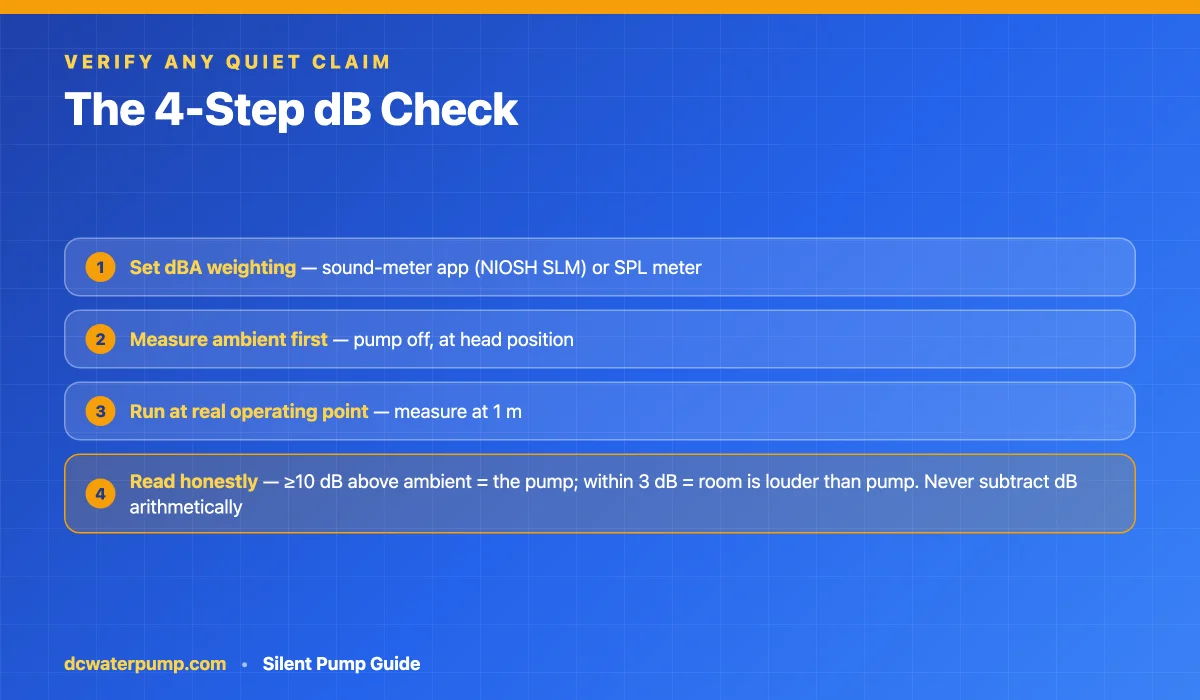
A usable quiet-pump spec reads: “X dB(A) at 1 m, pump running at stated flow, ambient/test setting noted.” The weighting (dBA is the human-hearing-weighted standard), the distance, the operating condition, and the test environment all move the number — a spec missing them is decoration. To check a pump you own:
- Use a sound meter app set to dBA weighting (NIOSH’s free SLM app is the reference-grade choice on iOS) or a basic SPL meter — phone mics are indicative, not lab instruments, but they’re honest enough for pass/fail.
- Measure ambient first, pump off, at the spot where your head will be.
- Run the pump at its real operating point for a few minutes, measure again at 1 m.
- Read the result honestly: if the pump-on reading is 10 dB or more above ambient, the reading is essentially the pump. If it’s within ~3 dB of ambient, your room is louder than the pump — which, for a recovery space, is the result you wanted. (Decibels are logarithmic; don’t subtract them arithmetically.)
- Repeat after mounting changes — the cheapest 5 minutes of the build is often discovering that a rubber pad, not a new pump, was the fix.
Frequently asked questions
What is the quietest type of water pump for a cold plunge?
Brushless DC (BLDC) magnetic-drive circulation pumps occupy the quiet end of independent tests — the architecture removes brush noise and shaft-seal wear from the equation, and quality units publish sub-35 dB (at 1 m) specs. Verify per model rather than trusting the label, and remember mounting matters as much as the pump: decouple it with rubber or silicone and keep it off resonant panels.
Is a 40 dB pump loud?
At 1 m, 40 dB sits below conversation level — unobtrusive in a living space. But note the WHO’s sleep guidance concerns total room levels around 30 dB, so a 40 dB source in a bedroom overspends that budget on its own. For a bedroom or studio plunge, aim for a pump below your room’s ambient; in a garage install, 40 dB disappears behind the chiller.
Are brushless water pumps quieter than brushed ones?
As a class, yes — removing brush contact removes a major mechanical and electrical noise source, and independent roundups consistently place brushless units at the quiet end of their measurements. Architecture isn’t everything, though: sizing, mounting, and bearing quality decide how much of the advantage you keep.
Why did my pump get louder over time?
Wear. Brush wear (in brushed motors), aging shaft seals, and tired bearings all convert time into noise. Designs without brushes or shaft seals — BLDC magnetic-drive — leave bearings as the main aging path, which is why they tend to hold their quiet longer. A pump that suddenly got loud may also be cavitating: check for airlocks and a starved suction line.
How can I make my existing pump quieter?
In order of cost: decouple it (rubber pad, flexible hose sections), stop over-driving it (reduce speed if adjustable, or fix the restriction making it work at the edge of its curve), submerge it if it’s rated for that, and only then replace it. Mounting fixes routinely deliver the largest improvement per dollar.
Do rubber mounts really matter?
Yes — a significant share of perceived pump noise is vibration re-radiated by the surface the pump is bolted to. Isolating the pump body from tub and floor removes that amplifier. It’s the standard first move in every quiet-build community for a reason.
Can a quiet pump still move enough water for a chiller?
Yes — quiet and capable aren’t opposites; independent testing has measured high-flow brushless units holding the 30–40 dB band. The route is architecture plus sizing: a BLDC pump selected by curve for your loop (per the five-step guide), running inside the chiller’s specified flow window, not thrashing at its limit.
Where to go next
The noise budget is one line of the spec sheet — the rest of the build lives in this cluster: start at what a cold plunge pump does, size it with the five-step guide, sort the pump-and-filter architecture, and if you’re still choosing between an ice bath and a plunge, that decision comes first.