
Cold Plunge Pump and Filter: Should You Combine Them or Keep Them Separate?
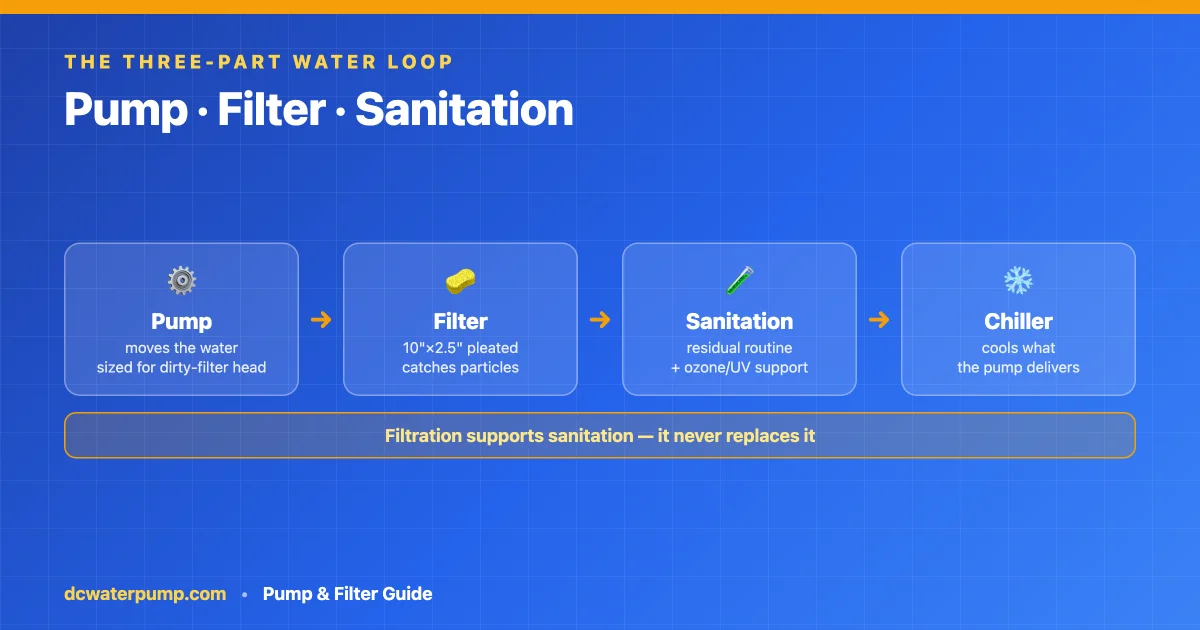
TL;DR: Every cold plunge that stays usable runs the same three-part water loop: a pump to move water, a filter to catch particles, and a sanitation program — a residual water-treatment routine, commonly supplemented by ozone or UV — to deal with what filters can’t. Your real decision is architectural: an integrated system (one sealed unit, minimal choices, premium price) or a separate loop (standard parts, full control, your labor). This guide compares the two honestly, then covers the cartridge standard, the micron trade-off, and the pump-matching detail most DIY builds miss — the filter’s head loss.
Do I need a pump and filter for a cold plunge?
Yes — a circulation pump moves water through a cartridge filter to remove skin oils, hair, and debris, and no filter means the tub collects everything you bring into it. But filtration only removes particles: it supports your sanitation routine (ozone, UV, or water treatment) and never replaces it.
The question the search results won’t answer together
Look up this topic and you’ll find cartridge product pages, filter-only guides, and DIY YouTube walkthroughs — each covering one component. What nobody puts side by side is the actual purchase decision: buy an integrated plunge with everything sealed inside, or build a separate pump-and-filter loop from standard parts? People end up buying a $60 filter housing before deciding the architecture it belongs to, which is backwards. The architecture decides the parts.
There’s a second gap, and it’s a health-relevant one: much of what’s written blurs the line between filtering and sanitizing. They are different jobs. A cartridge catches particles down to its micron rating. Bacteria and other pathogens are not managed by a particle filter — that’s the job of your water-treatment routine, a point Frigepath’s filter guide is unusually direct about. And one layer deeper, worth stating precisely: ozone and UV are supplemental treatments, not complete sanitation on their own — public-health guidance such as the CDC’s Model Aquatic Health Code positions them as secondary systems working alongside a maintained residual sanitizer and monitoring routine, not as replacements for one. A crystal-clear tub is not automatically a hygienic tub. Any filter advice that skips these sentences is selling clarity, not cleanliness.
What goes wrong when the loop is built badly
No filtration at all. Cold water slows biology but doesn’t stop it, and every session adds skin cells and oils. Without a filter loop, the only “maintenance” is full water changes — which, for a chilled 100-gallon tub, means paying to re-chill 100 gallons every time.
The wrong cartridge. The plunge-DIY community’s standing recommendation, from DIY Cold Plunge’s Filtration 101 and echoed across the million-view YouTube builds, is pleated polyester in the standard 10″ × 2.5″ format: rinseable pleats, predictable restriction, fits mainstream housings. Their experience base also warns against cheap unbranded spun-yarn cartridges (fiber shedding is the reported complaint) and against carbon blocks, which add restriction a plunge loop doesn’t need. To be fair to the category: reputable filtration makers do sell quality string-wound sediment cartridges for other applications — the community’s preference here is about washability and consistency in this loop, not a universal verdict on winding.
The filter-pump mismatch. A filter is a restriction, and it gets more restrictive as it loads. How much head it adds depends on the cartridge construction, the housing, and your flow — the honest number is the product’s own pressure-drop data, and it grows as the cartridge dirties. Ignore that allowance and a marginal pump’s delivered flow collapses — the loop “works” on day one and starves the chiller by week two. This is the sizing detail that connects this article to our five-step pump sizing guide: the pump must deliver its target GPM at the loop’s real head with a dirty filter, not at zero head with a clean one. The physics is in max head vs flow rate.
Treating the filter as the hygiene plan. Third time, because it’s the one that matters: particles are the filter’s job; pathogens are sanitation’s job. Plan both.
The real decision: integrated system vs separate loop
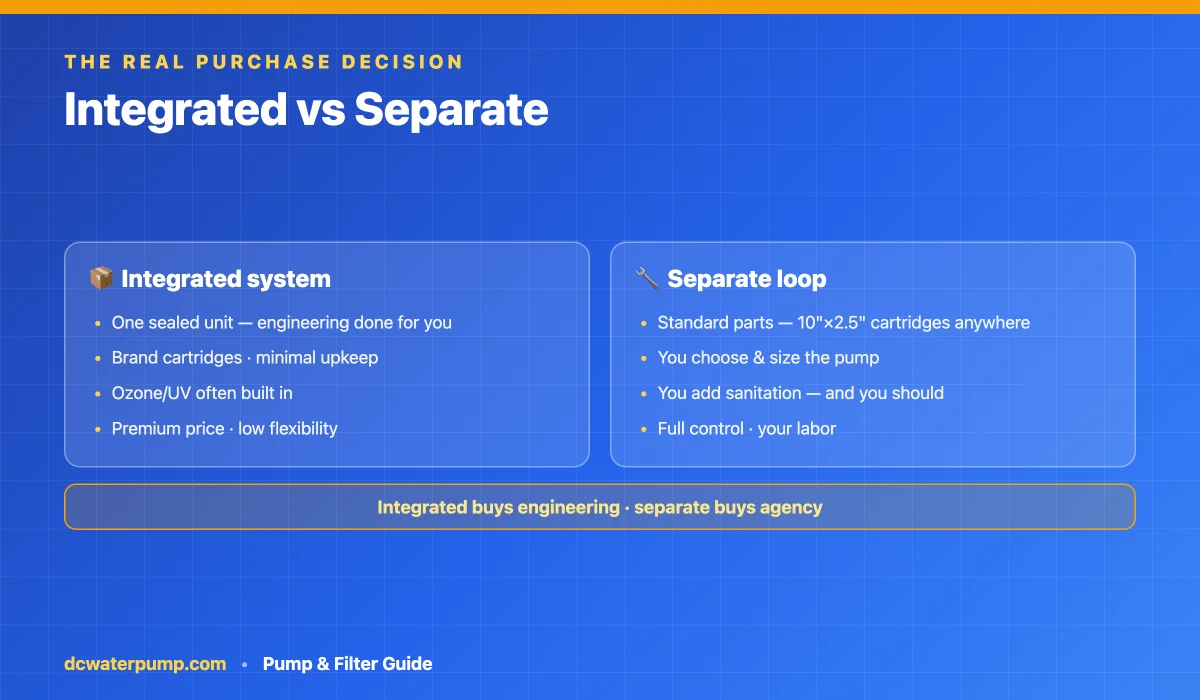
| Integrated system | Separate pump-and-filter loop | |
|---|---|---|
| What it is | One sealed product: tub + pump + filter + chiller (often + ozone/UV) | Your tub, plus standard parts: pump, filter housing, cartridge, chiller |
| Ballpark cost | Premium — commonly several thousand dollars for the finished unit | A fraction of that in parts, plus your build time |
| Pump | Built-in circulation pump, sized by the manufacturer | You choose — and you size it to the loop |
| Cartridge | Often brand-proprietary | Standard 10″×2.5″ pleated polyester, sourced anywhere |
| Sanitation | Ozone or UV frequently built in | You add it — and you should |
| Maintenance | Minimal: swap the cartridge on schedule | You own every fitting and o-ring |
| Flexibility | Low — it is what it shipped as | High — upgrade any component any time |
| Right for | Zero-hassle home or commercial use | DIY builders, studios, anyone who wants control |
The honest summary: integrated buys you engineering; separate buys you agency. Neither is wrong. What’s wrong is paying integrated prices and then wanting agency, or building separate and skipping the engineering — usually the sanitation step and the pump-filter match.
Choosing the cartridge: one standard, three decisions
The DIY ecosystem has effectively standardized the housing-and-cartridge format, which makes the choices short:
| Decision | Options | The standing pick |
|---|---|---|
| Size | 5″, 10″, 20″ × 2.5″ | 10″ × 2.5″ — the de facto DIY standard; fits mainstream housings |
| Material | Pleated polyester, carbon, polypropylene, spun yarn | Pleated polyester — the community standard for this loop (rinseable, consistent); carbon adds unneeded restriction; buy wound cartridges only from reputable makers |
| Micron | 5 / 20 / 50 | 20 micron for balance; 50 for longer life and coarser catch; 5 for the finest catch and the fastest clog |
The micron logic, as cartridge makers like iGlu Therapy state it: the lower the rating, the more it catches and the faster it clogs. Community rules of thumb for daily-use tubs run roughly: 50 micron ≈ 1–2 weeks per cartridge, 20 micron ≈ 5–10 days, 5 micron ≈ 3–5 days. Treat those as starting rhythms, not lab data — your bather load and whether you rinse cartridges weekly move the numbers. The unambiguous signal to change: delivered flow visibly drops.
The pump side: what the filter demands
For the separate-loop path, the pump spec follows from three requirements this cluster has already built:
- Flow: 4–6 tub turnovers per hour for a chilled loop, inside the chiller’s specified range — the full method is the five-step sizing guide.
- Head: the filter’s pressure drop (per its product data, growing as it loads) rides on top of the chiller’s restriction; read the pump’s curve at the loop’s total, dirty-filter head.
- Duty: this loop runs continuously. Magnetic-drive designs — no shaft seal to leak or wear — are the DIY community’s default for good reason, and it’s the same architecture brushless DC circulation pumps use: sealed magnetic drive, no brushes (bearings remain the wear item), quality units under 35 dB with ~30,000-hour design lives, on 12/24V DC with adjustable speed. (How to read dB claims — and verify them per model — is our silent pump guide.)
That last capability deserves a precise framing, because it’s easy to misuse: speed adjustment gives you margin between cartridge services, not a substitute for them. Industry practice keys cartridge cleaning and replacement to pressure rise and flow drop — the loading signal — and cranking the pump to chase a dirty cartridge masks that signal while driving pressure drop higher. The honest workflow: size the pump (with speed headroom) for dirty-filter head, and treat “I keep having to turn it up” as the change-the-cartridge alarm, not the fix. Equipment builders speccing this class can start at BLDC PUMP’s cold plunge range — brushless DC pumps built since 2009, standard samples in 3–7 working days.
Frequently asked questions
Do I need a separate pump for filtration, or does the chiller’s pump do both?
Depends on the architecture. Integrated systems typically run one built-in pump through filter and chiller in a single loop. Separate builds usually dedicate one pump to the whole loop as well — one properly sized pump through filter then chiller is the standard layout; a second pump only enters the picture in unusual split-loop designs.
What micron filter is best for a cold plunge?
20 micron pleated polyester is the balanced default: meaningful particle capture with a workable 5–10 day rhythm under daily use. Choose 50 micron for longer cartridge life and coarser filtering, 5 micron for the finest catch if you accept changing it every few days.
How often should I change the cartridge?
Community rules of thumb for daily use: 50 micron every 1–2 weeks, 20 micron every 5–10 days, 5 micron every 3–5 days — sooner if flow visibly drops. Rinsing pleated cartridges weekly stretches their life. Your usage moves these numbers; the flow drop is the honest signal.
Do cold plunge filters kill bacteria?
No. A particle filter removes debris above its micron rating; it does not disinfect. Sanitation is its own program: a maintained residual water-treatment routine first, commonly supplemented by ozone or UV — which public-health guidance (e.g., the CDC’s Model Aquatic Health Code) positions as secondary systems alongside a residual sanitizer, not replacements for one. Filtration supports that program; it never replaces it.
Can I use a pool filter for a cold plunge?
Hydraulically, an oversized cartridge filter isn’t harmful — more filter area generally means less pressure drop, not more. The problems are practical: pool-scale housings are bulky and costly for a plunge’s volume, and sand filters specifically require backwash flows sized far beyond what a plunge loop runs. The 10″×2.5″ inline cartridge format matched to a right-sized circulation pump is the proportionate answer.
What flow rate does a filter loop need?
Same as the plunge itself: commonly 4–6 tub volumes per hour, delivered at the loop’s real head and inside the chiller’s specified flow range. The filter doesn’t change the target — it changes the head the pump must overcome to hit it.
Does adding a filter reduce my pump’s flow?
Yes — every filter adds head, and a loading cartridge adds more. That’s expected; the design answer is to size the pump for dirty-filter head from day one. Speed-adjustable pumps add useful margin between services — but rising pressure and falling flow are the cartridge’s service signal, and the answer to a loaded cartridge is a fresh cartridge, not a faster pump.
Where to go next
Start the pump half of the decision at what a cold plunge pump does, size it with the five-step guide, and cross-check the whole build against the mistake guide before you spend.