
Submersible Fountain Pump vs External: Which Is Better for Your Build
TL;DR: For most fountains and water features up to a few hundred gallons, a submersible fountain pump is the better build: it installs by dropping it in, it stays primed because it is flooded, and the water around it damps motor noise. An external (inline) pump earns its place when the feature is large, when you need to service the pump without disturbing the water, or when winter makes pulling a submerged pump every year a chore. Below: the six points that actually separate the two, the three pain points that decide most cases, a scenario matrix, and the three installation rules that keep an external pump from destroying itself.
Submersible vs external fountain pump: which is better?
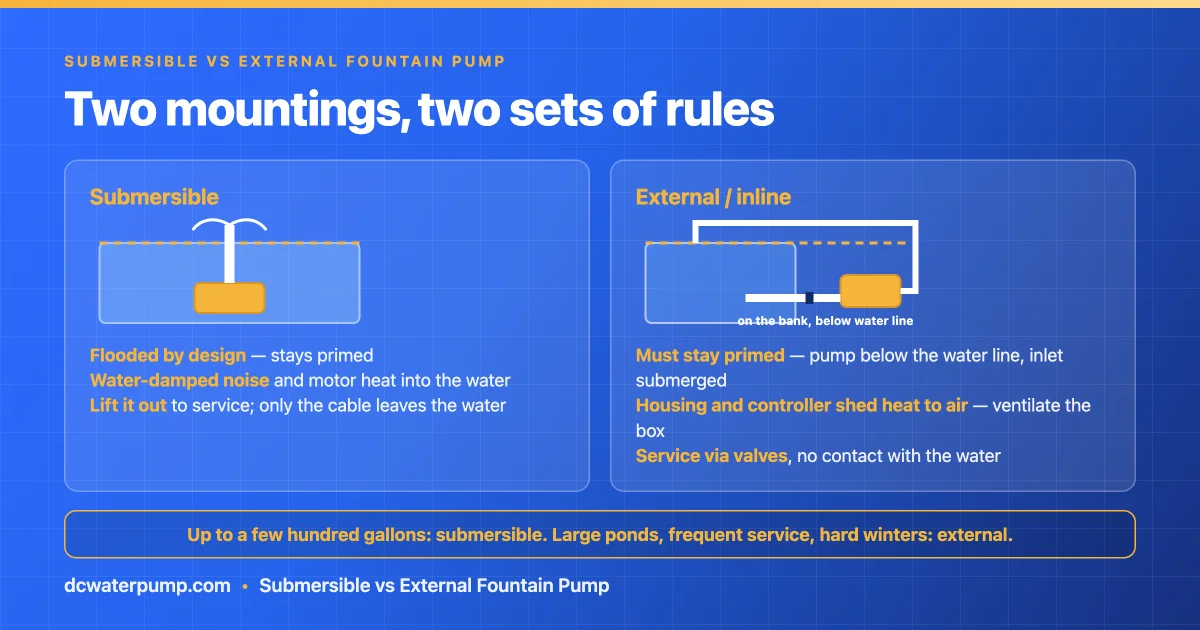
For water features up to a few hundred gallons, a submersible fountain pump is usually the better choice: simpler to install, flooded by design, and quieter because the water damps motor noise. External pumps earn their place on large ponds and cold-climate builds where servicing without draining matters more.
The problem: the mounting decision gets made after the pump is bought
Buyers pick a pump on flow and head, then decide where it will live. That order is backward, because the mounting position changes what the pump needs to survive. Three consequences follow from placement alone:
- Lost prime. Small centrifugal pumps push water; they do not draw it up. Our sales engineers answer this one regularly: “The pump cannot suck water; it must sit below the liquid level. The 13m is the ideal maximum head without pipe resistance, so the real lift will be lower and depends on the piping complexity.” An external pump mounted wrong does not fill, and a pump that runs on air runs dry.
- Wrong cooling. On a wet-rotor magnetic-drive pump the motor heat goes mostly into the pumped water in either mounting; what changes on the bank is where the controller and housing shed their heat. A closed, unventilated pump box runs hotter — a design question, not a defect.
- Wrong service plan. A submerged pump comes out of the water for every inspection; an external pump is serviced from dry ground. On a koi pond, that difference decides how often anyone actually cleans the impeller.
The Owner Builder Network makes the service point the same way: an external pump sits outside the water, so cleaning and repairs do not require lifting anything out of the pond or fountain. The flip side is ours to add — a submersible has less plumbing to leak, because there is no suction line at all.
Six points that separate submersible from external
The comparison below is deliberately qualitative: decibel figures, efficiency percentages and “years of life” vary by model far more than by mounting type, so the numbers belong to the datasheet of the pump you are considering.
| Dimension | Submersible | External (inline) |
|---|---|---|
| Installation & priming | Drop it in; the pump is flooded by design, so it stays primed | Must be mounted below the water line with a flooded inlet; loses prime if air gets in |
| Noise | The surrounding water damps motor sound and vibration | Motor vibration transmits through the housing and mounting surface; needs an isolation pad |
| Cooling & continuous duty | Motor heat goes into the pumped water; well suited to running around the clock | Motor still cooled by the pumped water; controller and housing shed heat to air, so an enclosed box needs ventilation |
| Service access | Lift the pump out; large features may need partial draining | Close valves, open the housing, no contact with the water |
| Winter | Comes out before a hard freeze unless it sits well below the freeze line and keeps running; ice expansion cracks housings that IP68 sealing does nothing to protect | Can live in an insulated or heated pump box; plumbing still needs draining |
| Cost & appearance | Lower installed cost; hidden in the basin | Adds valves, unions, fittings and a housing; visible unless boxed |
On noise, Water Features Adore states the physics the same way: submersible pumps are generally quieter because the surrounding water damps the sound, while inline pumps mounted outside the water can be quite loud. Quieter because the water absorbs it is the engineering — and the same water is the heat sink that makes continuous duty practical.
Plumbing Ways lists cooling method, placement, heat dissipation and noise among the differences between inline and submersible pumps. We would add the one that causes the most trouble in the field: priming. It is a failure mode, not a nuisance, and small brushless DC circulation pumps are not self-priming in either mounting, so an external install has to be flooded by geometry.
Where the pain actually shows up: three failure modes
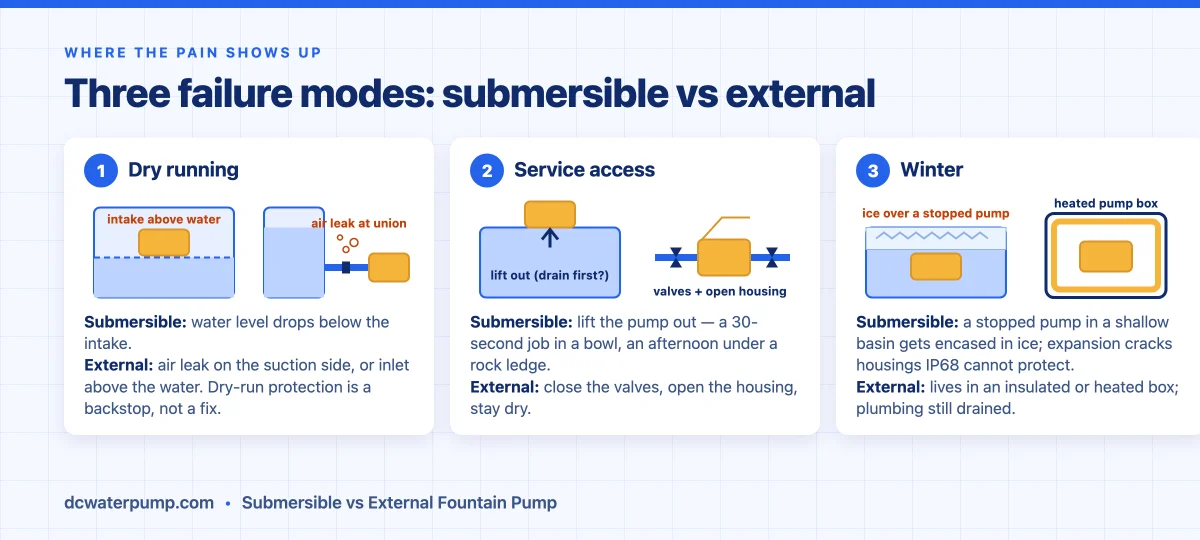
Dry running. The submersible’s advantage — it stays flooded — disappears the day the water level drops below the intake; a shallow basin can uncover the pump in a hot weekend. An external pump has the mirror-image problem: an air leak on the suction side, a loosened union, or a water level below the inlet pipe, and it loses prime while the motor keeps spinning. A field report on r/ponds captures the submersible version: a new owner traced weak flow to an algae-fouled impeller and noted that letting the water level fall below the intake had already killed a previous pump. Dry run protection on a quality brushless DC pump — ours pulses the pump in short on/off cycles until water returns, then resets — is a backstop for that lapse, not a substitute for keeping the level up. (Our seven buying mistakes covers the water-level habit in more detail.)
Maintenance access. A submersible pump in a tabletop basin is a thirty-second job to lift out. The same pump under a rock ledge in a 3,000-liter pond is an afternoon, sometimes with the water level lowered first. Pond keepers who switch say so: owners of larger koi ponds who move to an external pump commonly report that closing the valves and opening the housing is far easier than lifting a pump out — at the cost of noticeably more installation work. That is the whole trade in one sentence.
Winter. A submerged pump in a hard-freeze climate usually comes out every autumn: a stopped pump in a shallow basin can end up encased in ice, and ice expansion cracks housings that IP68 sealing does nothing to protect. An external pump can sit in an insulated or heated box year-round, which is why cold-climate koi keepers commonly lean external and treat the winter climate as a design input. Our outdoor fountain pump guide covers winterization for both cases.
The solution: choose by scenario, then install by the rules
Scenario decision matrix
The size bands below are our own illustrative starting line, not an industry threshold: 500 gallons is about 1,900 liters, and what actually moves a build between rows is how often you will need to touch the pump and whether you can reach it.
| Scenario | Recommended mounting | Why |
|---|---|---|
| Indoor tabletop or desktop feature | Submersible | Quiet, hidden, seconds to service; a sub-35 dB published spec (per model) matters most here |
| Small garden fountain, under roughly 1,900 L (500 gal) | Submersible | Lowest installed cost; the pump sits above the silt on a brick, under a pre-filter |
| Wall fountain or cascade | Submersible | Pump invisible in the sump; short vertical run |
| Koi or planted pond, roughly 1,900–6,000 L | Either | Submersible with a pre-filter if you can lift it easily; external if you will service it often or run external filtration |
| Large pond or display, above roughly 6,000 L | External | Serviceable without draining; plumbing sized for the flow; pump box protects it |
| Cold-climate feature you want to run through winter | External (heated box) | A submersible in a shallow basin comes out before a hard freeze |
| Solar-direct or battery feature | Submersible DC | Low-voltage pump stays flooded; supply stays on dry ground |
Three rules for mounting a pump outside the water
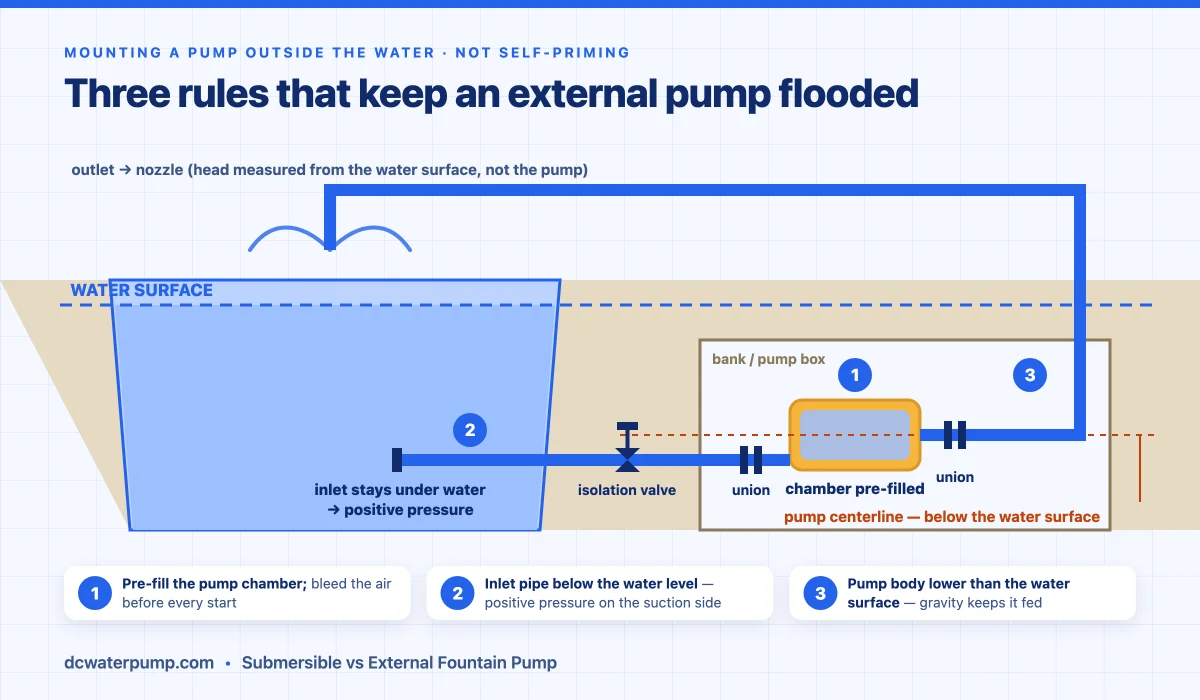
Pumps in this class — brushless DC centrifugal pumps, and AC magnetic-drive units of similar size — do not prime themselves, so an external installation has to be flooded by geometry. Our installation guidance reduces to three rules:
- Pre-fill the pump chamber. The pump must contain water before it is switched on; a chamber full of air spins uselessly and heats up.
- Keep the inlet pipe below the water level at all times. The suction side must stay under positive pressure from the water body; the moment the inlet breaks the surface, the pump loses prime.
- Mount the pump body lower than the water surface. With the pump’s centerline below the water line, gravity keeps the chamber fed and air pockets clear themselves.
Our engineers state the same thing in two lines when a customer asks about mounting orientation: “Our pumps have no special requirements for the installation angle and direction, you only need to pay attention to 2 points: the water pump needs to be exhausted before installation, and the inlet pipe needs to maintain positive pressure if the pump is not submersible.” Add a union on each side of the pump and an isolation valve on the inlet, and “service without draining” becomes real. Bleed air after every service; an air pocket after a filter clean is the usual way an external pump ends up running dry.
One point that confuses external installs: mounting the pump lower does not add lift. Static head is measured from the water surface to the outlet, not from the pump — the head and spray height explainer walks through why.
Submersible install checklist
- Sit the pump above the silt layer on a brick or flat stone, with a foam pre-filter over the intake; a pump on the basin floor inhales exactly the debris that clogs it.
- Keep the water level well above the pump body, and top up on a schedule — a float valve on a garden supply automates it.
- Confirm the pump is rated for continuous submersion. IP68 is the rating to look for; it describes protection against dust and water ingress under continuous immersion, and nothing else — not freeze resistance, not anything about the water being safe to touch.
- Keep the supply on dry ground. A low-voltage DC pump takes 12 or 24 V through a sealed cable; the adapter, battery or panel stays out of the water. Check your local code (NEC Article 680 in the US) for anything wired near a fountain — the mains side of the adapter is still mains.
- Bleed air after installing. Tilt the pump so the outlet points up until bubbles stop; a trapped pocket is the usual reason a new submersible hums without pumping.
Sizing the flow and head for either mounting is the same exercise; our small fountain pump sizing guide has the scenario matrix and curve-reading steps.
Where brushless DC pumps fit: both mountings, one design
A quality brushless DC fountain pump can be mounted either way because of construction, not marketing: the stator windings and control board are potted in epoxy, the rotor is driven through a magnetic coupling on a ceramic shaft, and there is no shaft seal between motor and water. As our engineer answers the “can it go underwater?” question: “Yes, submersible in water. Our pump is potted with epoxy resin, this is also the key technology of our pumps.” The same potting is what makes an IP68 rating possible on the pump body.
There are no brushes to wear; bearings remain the wear item, which is why our published design life of around 30,000 hours is a per-model spec tied to operating conditions, not a property of the letters “DC.” Submerged or on the bank, it assumes a flooded pump, reasonably clean water and a supply voltage within the pump’s range.
Two details matter when you choose the mounting on a DC pump:
- Where the controller lives. Many of our models come with the control board inside the pump or in a separate box on the cable. Asked which to specify for an underwater install, our engineer’s answer was: “Yes, DC80D works as a submersible pump. There are two options of DC80D, integrating the control box inside the pump or set it outside the pump, in our experience, a separated control box is better for waterproofing.” The separate box is rated to the same IP68 as the pump, and the cable between pump and box can be extended so the box sits on dry ground if you prefer — a common customization for OEM fountain builders, along with cable length, connector type and rated voltage.
- Dry run protection is not a mounting substitute. Built-in protection (dry-run, stuck impeller, over- and under-voltage, reverse polarity) will stop a pump that has lost prime from cooking itself, but it does not refill the chamber. Get the three rules right and the protection stays a backstop.
For anyone asking the customization question directly: both mountings can be specified for the same model, and a qualified B2B buyer can validate the choice with a sample order from a single unit before committing to volume.
Frequently asked questions
What is a submersible fountain pump?
A pump designed to run fully under water in the basin or pond. It is flooded by design, so it stays primed; the surrounding water carries away motor heat and damps noise; only the cable leaves the water.
Can a submersible fountain pump run continuously?
Yes, provided the water level stays above the pump body and the intake stays clear. Water cooling is what makes continuous duty practical; a pump uncovered by evaporation loses that cooling and runs dry. Quality brushless DC units, ours included, publish a design life on the order of tens of thousands of hours for continuous service — check the datasheet for the model.
Do submersible fountain pumps make noise?
Less than the same motor mounted in air, because the water absorbs vibration. Quality brushless DC pumps, ours included, publish sub-35 dB figures for their quiet models; verify it as a per-model spec, and add a rubber pad under the pump so it does not buzz against the basin.
How do you maintain a submersible fountain pump?
Keep it off the basin floor, keep a foam pre-filter over the intake, rinse the pre-filter monthly and clean the impeller cavity quarterly — more often in a pond under trees. Bleed the air after every service before restarting.
Can a submersible fountain pump freeze in winter?
Yes. IP68 protects against water getting in; it does nothing against ice expanding inside the housing. In climates with hard freezes, remove the pump before the first freeze and store it indoors, or plan the feature around an external pump in a heated box.
Is an external fountain pump self-priming?
Not in this pump class. Small brushless DC and AC magnetic-drive circulation pumps must be mounted below the water line with a pre-filled chamber and a submerged inlet under positive pressure. Some larger dedicated pond pumps are self-priming; check the datasheet.
Where to go next
If the answer for your build is “submersible” — for most features it is — the next decision is flow and head, which the small fountain pump sizing guide works through scenario by scenario; if you are still on fundamentals, start with what a DC fountain pump is. If the answer is “external,” follow the three rules and plan the winter box early.
If you design fountains or water features as a product, BLDC PUMP has built brushless DC pumps since 2009 that can be specified for either mounting — epoxy-potted, IP68-rated with an in-pump or separate controller, speed-controllable by PWM, 0–5 V or potentiometer — with standard samples ready in 3–7 working days. The DC fountain pump range lists the models and offers matching nozzles with approximate spray heights.