
Small Fountain Pump Sizing Guide: From Tabletop to Garden
TL;DR: A small fountain pump is sized by three numbers, not one: the flow your feature needs at the lift it has to overcome, the tubing that carries that flow, and the noise level you can live with. Tabletop features generally run on tens of gallons per hour; small garden and wall features on a few hundred. Below: a four-scenario starting matrix, a three-step method that turns it into a real operating point on the pump curve, the specs beyond GPH that decide whether the pump fits, and the two failure modes — clogging and running dry — that kill more small pumps than anything else.
What GPH do I need for a small fountain pump?
Most small fountains run on 30–200 GPH (about 110–760 L/h): tabletop features around 30–50 GPH, small outdoor features 80–200 GPH. Read the flow at your actual lift on the pump curve, not the max-flow label, and keep a common 20–30% margin in reserve.
Those ranges come from a pump retailer’s field guide rather than a standard, but they match what we see in inquiries — Fountain Tech Pumps: “Most small fountains need 30-200 GPH, with indoor tabletop fountains working well at 30-50 GPH.” … “Small outdoor fountains might need 80-200 GPH.” On power, the same guide notes that “Most use between 2-25 watts, which means lower electricity bills.” The rest of this guide turns a range like that into one pump you will not have to return.
New to the category? Start with what a DC fountain pump is.
The four-scenario starting matrix
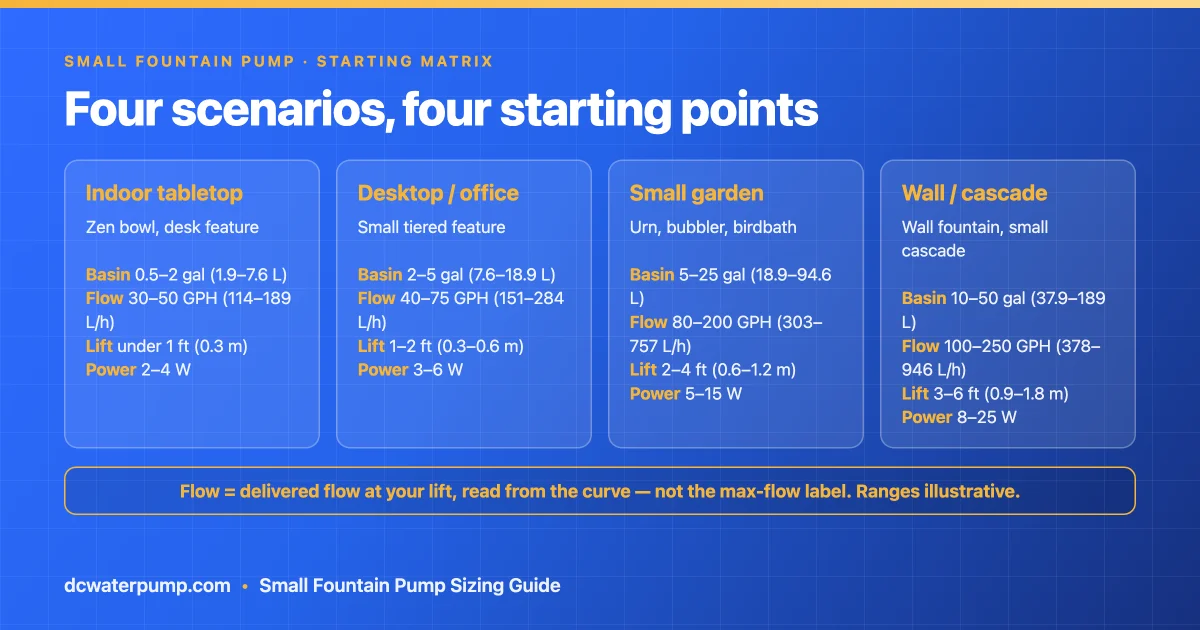
Small water features fall into four groups that behave differently enough to size separately. Fountain Tech gives 30–200 GPH overall (tabletop 30–50, small outdoor 80–200); the four-way split, lifts and wattages below are our own working ranges from inquiry experience — illustrative, not a standard.
| Scenario | Typical basin volume | Starting flow range | Typical lift (surface to outlet) | Typical power |
|---|---|---|---|---|
| Indoor tabletop (zen bowl, desk feature) | 0.5–2 gal (1.9–7.6 L) | 30–50 GPH (114–189 L/h) | under 1 ft (0.3 m) | 2–4 W |
| Desktop / office (small tiered feature) | 2–5 gal (7.6–18.9 L) | 40–75 GPH (151–284 L/h) | 1–2 ft (0.3–0.6 m) | 3–6 W |
| Small garden (urn, bubbler, birdbath) | 5–25 gal (18.9–94.6 L) | 80–200 GPH (303–757 L/h) | 2–4 ft (0.6–1.2 m) | 5–15 W |
| Wall fountain / small cascade | 10–50 gal (37.9–189 L) | 100–250 GPH (378–946 L/h) | 3–6 ft (0.9–1.8 m) | 8–25 W |
Two things before you pick a row. The flow ranges are delivered flow — what arrives at the top of the feature — which is lower than the number on the box. And the tiers overlap on purpose: a 40 GPH tabletop feature and a 40 GPH desktop feature differ mainly in lift, which is what the next section is about.
Three steps from the matrix to a real pump
The matrix gives you a starting flow. These three steps turn it into an operating point on a specific pump’s curve.
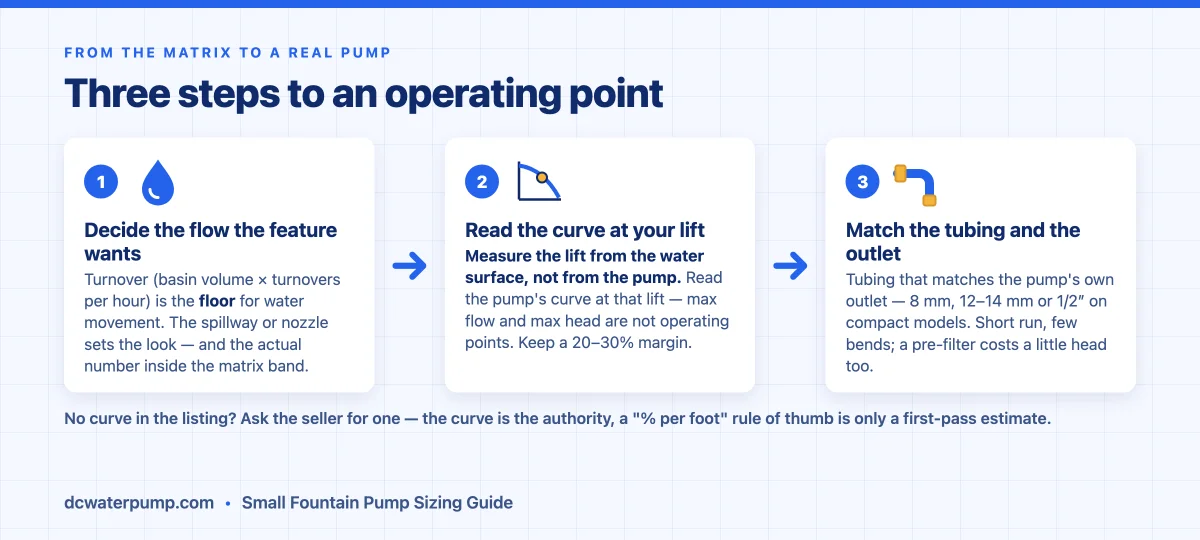
Step 1 — Decide the flow the feature wants
For a basin with fish or a filter, size by turnover. A common rule of thumb is basin volume × turnovers per hour: around 0.5–1× per hour for a purely decorative feature, 1–2× per hour where fish and filtration are involved. A 20-gallon (76 L) garden urn at 1× turnover therefore wants about 20 GPH of circulation — which is far less than the 80–200 GPH in the matrix.
That gap is the point: for a purely decorative feature, turnover is a floor for water movement, not the number that sets the look. The look is set by the spillway or nozzle — a sheet over a 6-inch (15 cm) lip, a gentle bubbler, and a small jet each need a different flow, and only the fixture’s own guidance or a test tells you which. Take turnover as the minimum, the matrix range as the realistic band, and let the fixture decide where in that band you land.
Step 2 — Find the flow the pump delivers at your lift
Every fountain pump is labeled with a max flow rate and a max head, and neither is an operating point. Our engineers explain this in almost every small-pump inquiry; one reply, verbatim, about a compact model: “Since the max water flow for model DC40M-1235PWM is 530L/H is the max water flow without lifting height, and doesn’t consider the system pressure and without pipe connecting.”
Measure the lift from the water surface to the highest outlet, not from the pump — a submersible pump sitting deeper does not have to lift the water above it — then read the pump’s curve at that lift. If the listing offers no curve, ask the seller for one; a calculator-site rule of thumb such as SimplifyCalc‘s “every 5 ft of head reduces pump output by roughly 10%” is only a first-pass shopping estimate, not physics: curve shapes differ from model to model, and a small pump with a low max head loses flow far faster per foot than that. The curve is the authority. Our max head vs flow rate walkthrough shows how to read one, and the fountain-specific head explainer covers why a jet needs pressure at the nozzle on top of the lift.
An illustrative example, all assumptions: a garden urn with the outlet 2 ft (0.6 m) above the water surface, a spillway that looks right at roughly 120 GPH (454 L/h), and 3 ft (0.9 m) of 1/2-inch tubing with one elbow. Add a 20–30% margin for friction and future clogging and you are shopping for a pump whose measured curve shows about 150 GPH (570 L/h) at 2 ft of lift. The example is not a formula; replace every number with your own.
Step 3 — Match the tubing and the outlet
Undersized tubing turns lift into friction. Small pumps ship with barbed outlets in a handful of sizes — 8 mm, 12–14 mm and 1/2-inch fittings are typical in our compact range — and the tubing should match the outlet rather than being necked down with adapters. Keep the run short, avoid sharp bends, and remember that an intake pre-filter also costs a little head. Tubing size versus flow is tabled in the buying-mistakes guide; at the flows in this article, tubing that matches the pump’s own outlet is usually sufficient.
Three specs beyond GPH that decide whether the pump fits
Once the operating point is settled, three practical specs separate a pump that works from one that goes back in the box.
- Flow at your head, not max flow. Ask for the curve; a seller who can offer only “max GPH” is telling you how the pump was specified.
- Cord and connector. Rule-of-thumb cord lengths are 6–8 ft (1.8–2.4 m) indoors and 15–25 ft (4.5–7.6 m) outdoors, so the power supply sits away from splash. On low-voltage DC pumps the adapter stays dry and only a thin two-conductor lead reaches the water; on ours, cable length and plug type are customization items.
- Physical size. Tabletop basins are shallow, and a pump has to sit fully submerged with water above the intake — the smallest pumps in our lineup are 51–57 mm long and about 0.1 kg for exactly that reason. Check basin depth against pump height plus a margin of water.
Two notes on the power supply. Match it to the pump’s rated voltage — 12 V or 24 V on our compact models — because an undersized adapter starves the pump; ours protect themselves outside the model’s input window (our 24 V models typically operate across about 10–30 V, model-dependent), but protection is a backstop, not a sizing method. And the smallest classes are not built to hang directly off a solar panel — as our sales engineer summarizes the range, “The advantages are long lifespan, no maintenance, higher efficiency, low noisy, could be connected to solar panel directly(except DC30, DC40). The shortages are no ability to suck water, could not afford particles in water.” For a solar garden feature, use a battery and controller, or a model designed for direct solar connection — see the outdoor fountain pump guide.
Clogging and running dry: the two things that actually kill small pumps
Those two “shortages” in the quote above are the whole maintenance story for small fountain pumps — not defects, but the physics of a small centrifugal pump that relies on the water it moves to stay cool and keep its impeller clear.
Why does my small fountain pump keep clogging?
Hair, algae, dust, and plant debris reach the impeller because the intake sits in the layer where they collect. The fix is a pre-filter on the intake, the pump lifted off the basin floor, and a periodic impeller cleaning — a routine that turns weekly clogs into a monthly job.
A homeowner on r/DIY whose pump jammed every few days fixed it with a nylon stocking over the intake and an aquarium sponge as a pre-filter, and went from weekly to monthly cleaning; a new pond owner on r/ponds reported low flow from a 300 GPH pump that turned out to be fouled with algae on the impeller. Manufacturer guidance says the same: Fountain Tech’s maintenance page states “Your pump must never run dry or be clogged with debris,” and Design Cast’s fountain maintenance packet adds that fountains placed around plants or under trees collect organic debris that can clog the pump.
A five-item routine that costs almost nothing:
- Lift the pump onto a flat stone or brick so the intake sits above the sediment layer.
- Sleeve the intake with foam or a nylon stocking; rinse weekly, replace when it stops springing back.
- Open the impeller cavity quarterly and rinse the rotor — algae on the impeller is the most common cause of “weak flow” reports.
- Keep the water level up. Two to three inches (5–8 cm) of water above the pump body is the habit that prevents both air intake and dry running.
- Use clean water for top-ups and change it on a schedule. A pre-filter supports, but does not replace, cleaning the basin and changing the water; it protects the pump, not the water quality.
One caution for magnetic-drive pumps like ours: keep hard particles, especially ceramic or magnetic grit, out of the pump entirely — the one thing a pre-filter must catch rather than merely slow.
Running dry
Open basins lose water to evaporation and splash; a tabletop bowl can drop below the intake in a warm weekend. A small submersible pump uses the water it moves for cooling, so running dry overheats the wear surfaces quickly. Dry run protection is the safety net worth paying for: on our pumps it triggers when fluid is short or air cannot clear the chamber, runs the pump in 3-second on/off cycles instead of continuously, and resets itself once water returns. It buys you the afternoon you forgot; it does not replace topping up.
The same physics is why pumps in this class must be installed flooded. They do not draw water up from dry — a submersible sitting in the basin is primed by nature, but an externally mounted pump needs its chamber pre-filled and its inlet below the water line.
Why small pumps should be judged on noise
A small fountain pump lives in a bedroom, an office, or beside a patio seat — closer to your ear than any other pump you own — and listings rarely give a decibel figure. Two things decide what you hear: the motor and the installation.
On the motor side, brushless DC pumps have no brushes and no line-frequency hum; quality units, ours included, publish sub-35 dB figures for their quiet models under a stated measurement method (ours: 1 m) — a per-model spec to verify against the datasheet and your own meter, not a property of “DC” as a category. Motor architecture matters within a range too; as our engineer told a customer comparing two compact series, “DC45D-1260 is a 3 phase pump, compared with 2 phase pump (DC40), the 3 Phase pumps are more efficient and quieter, and lower failure.” No brushes to wear; bearings remain the wear item.
On the installation side, a hollow ceramic base transmits vibration, a low water level pulls air into the impeller, and a pump touching the basin wall buzzes; a rubber pad and water well above the intake remove most of it. To check a pump against its spec, use a repeatable method — our noise measurement method covers distance, operating point, and mounting.
Scenario recommendations from our own lineup
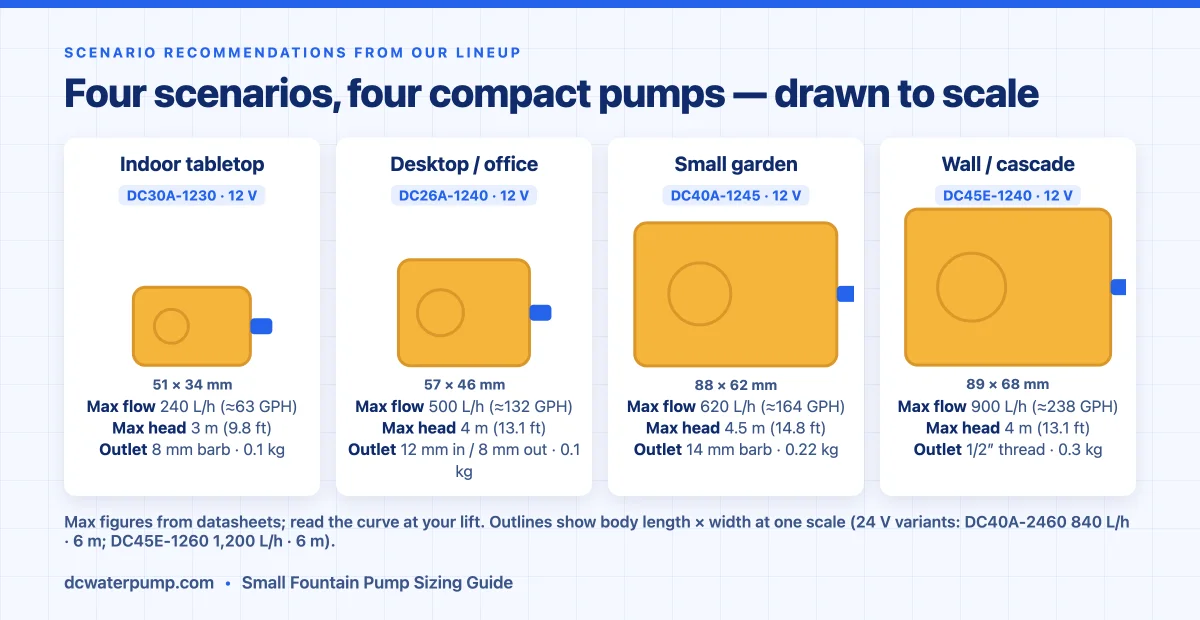
The table below maps the four scenarios to the smallest models in our range as illustrations of scale, not a prescription — your operating point, not the scenario name, picks the pump. Figures are datasheet max flow and max static head; delivered flow at your lift will be lower, so read the curve.
| Scenario | Illustrative model (12 V unless noted) | Max flow | Max static head | Size · weight | Outlet |
|---|---|---|---|---|---|
| Indoor tabletop | DC30A-1230 | 240 L/h (≈63 GPH) | 3 m (9.8 ft) | 51 × 34 × 43 mm · 0.1 kg | 8 mm barb |
| Desktop / office | DC26A-1240 | 500 L/h (≈132 GPH) | 4 m (13.1 ft) | 57 × 46 × 44 mm · 0.1 kg | 12 mm in / 8 mm out |
| Small garden | DC40A-1245 (24 V: DC40A-2460) | 620 L/h (≈164 GPH); 24 V: 840 L/h (≈222 GPH) | 4.5 m (14.8 ft); 24 V: 6 m (19.7 ft) | 88 × 62 × 44 mm · 0.22 kg | 14 mm barb |
| Wall fountain / small cascade | DC45E-1240 (or DC45E-1260) | 900 L/h (≈238 GPH); 1,200 L/h (≈317 GPH) | 4 m (13.1 ft); 6 m (19.7 ft) | 89 × 68 × 84 mm · 0.3 kg | 1/2″ thread |
Two facts to read the table with. The DC30 and base DC40 series are fixed-speed; other series in our range — including DC40M and the DC45 class — offer speed control by PWM signal, 0–5 V analog, or a potentiometer knob. For a wall fountain where the spill has to look exactly right, that knob is the simplest insurance: buy the curve above your estimate and turn it down. And adjacent scenarios overlap in pump size — which is why our lineup runs to 49 series and 141 models, and why a curve beats a category name.
Frequently asked questions
What GPH do I need for a small fountain?
Tabletop features typically 30–50 GPH (114–189 L/h), desktop features 40–75 GPH, small garden features 80–200 GPH, wall fountains 100–250 GPH — as delivered flow at your lift, with a common 20–30% margin in reserve. The spillway or nozzle sets the exact figure inside that band.
How high can a small fountain pump lift water?
Compact pumps in this class typically carry max static heads of 3–6 m (10–20 ft), but that is the zero-flow point. Usable lift at a decent flow is a fraction of it — read the curve at the lift you need, measured from the water surface, and add a margin.
Why does my small fountain pump keep clogging?
The intake sits in the debris layer. Lift the pump off the floor, sleeve the intake with foam or a nylon stocking, rinse it weekly, and open the impeller cavity quarterly. Keep hard grit out entirely.
Can a small fountain pump run continuously?
Quality submersible pumps are designed for continuous duty as long as they stay submerged and the intake stays clear. Design life is a per-model spec: ours publish around 30,000 hours, model-dependent.
What size tubing do I need for a small fountain pump?
Match the pump’s own outlet — 8 mm, 12–14 mm or 1/2-inch on compact models — and keep the run short with few bends. Necking the outlet down with adapters costs flow you paid for.
How much electricity does a small fountain pump use?
Small pumps draw roughly 2–25 W. Monthly cost is watts × 24 h × 30 days ÷ 1,000 × your rate; a 5 W pump is about 3.6 kWh a month. Compare pumps on watts at the flow you need, not on max GPH.
Are BLDC fountain pumps worth it for a small feature?
They cost more than a bargain pump, and the case for them is noise, continuous-duty design, and protections such as dry run protection — not flow. Within earshot or unattended, those are the specs that decide whether the feature stays plugged in.
Where to go next
You have a starting flow for your scenario, a way to find the delivered flow at your lift, and the two habits that keep a small pump alive. Outdoors, the outdoor fountain pump guide covers IP ratings, weather, and winter; if the “max head” label still looks like a spray height, the head pressure explainer fixes that in five minutes; the max head fundamentals are the short version.
If you build small water features as a product, the sizing logic is the same and sourcing is simpler than most buyers expect. BLDC PUMP has made brushless DC pumps since 2009; for qualified B2B buyers we accept sample orders from a single unit — customized samples included — with standard batches typically 100 units, mixed models welcome, and samples usually shipping in 3–7 working days. The compact models above, with curves and outlet options, are on the DC fountain pumps page.