
Cold Plunge Pump for OEM Builders: A Sourcing Checklist
TL;DR: If you’re building cold plunge products — tubs, chillers, all-in-one recovery systems — the circulation pump is a component you’ll specify once and answer for across thousands of units. This checklist covers what a complete pump spec sheet must contain (curve, duty, noise with method, sealing scope), the supplier questions that separate manufacturers from resellers, how to run a sample validation that actually validates, and the commercial terms — MOQ flexibility, customization scope, payment structure — worth negotiating before the first PI is issued.
What should OEM buyers check when sourcing a cold plunge pump?
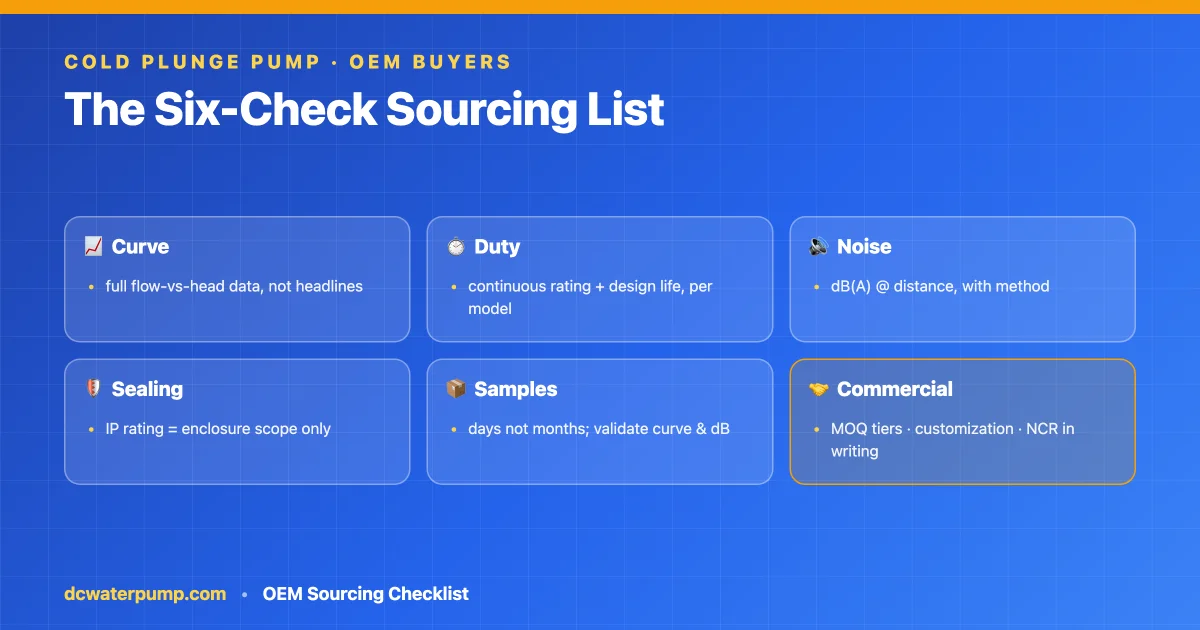
Six things: a full performance curve (not headline numbers); a continuous-duty rating with design life; noise specified in dB at a stated distance and condition; sealing and materials scope; sample availability with realistic lead times; and commercial flexibility — MOQ tiers, customization dimensions, and defect-handling process in writing.
Why the pump spec deserves procurement-grade attention
Two market facts frame the sourcing problem. The cold plunge category is compounding fast — Grand View Research projects the tub market nearly doubling by 2033 — and per Persistence Market Research, above-ground units hold about 60% of revenue: the portable, home-placed form factor where noise, energy, and reliability complaints land directly on your brand’s reviews. The pump inside your product is invisible until it’s the reason for a one-star review — or a warranty season.
This checklist is written from the manufacturer’s side of the table. Use it on every supplier you evaluate — including us.
Check 1 — The spec sheet: complete or disqualified
A cold plunge pump spec sheet that supports OEM integration contains, at minimum:
| Item | What “complete” looks like | Red flag |
|---|---|---|
| Performance | Full flow-vs-head curve, not just max flow / max head | Two headline numbers only |
| Duty | Continuous-duty rating + design life, stated per model with its conditions (quality BLDC units commonly publish figures on the order of tens of thousands of hours) | “Long life” with no number |
| Noise | dB at stated distance and operating condition (e.g., <35 dB @ 1 m at rated flow) | “Ultra quiet” with no method |
| Electrical | Voltage (12/24V DC), current at operating points, control interface | Voltage only |
| Sealing | IP rating with scope stated — an IP rating describes enclosure protection against dust and water ingress, nothing more | IP number used as a safety claim |
| Materials | Wetted materials list (housing, impeller, shaft, o-rings) | Unspecified plastics |
| Priming | Flooded-suction stated plainly, mounting constraints documented | Silence on priming |
Why the curve is non-negotiable: your product has a specific loop — chiller, filter, plumbing — and the pump will live at one operating point on that curve. Integration engineering happens on the curve (our max head explainer covers the physics; the five-step sizing method turns it into procedure). A supplier who won’t publish curves is asking your engineers to work blind.
Check 2 — Control and integration
Cold plunge systems increasingly ship with app control, schedules, and eco modes — all of which terminate at the pump’s control interface. Confirm:
- Speed control method: PWM signal, 0–5V analog, or onboard potentiometer — and which your controller speaks. Adjustable speed is also your manufacturing tolerance absorber: units can be trimmed to spec at end-of-line instead of binned.
- Behavior at power events: restart behavior after outage, soft-start current draw (matters for battery and solar-fed portables).
- Connector and cable options: specified now, not discovered at DFM review.
Check 3 — Compliance, honestly
Your target markets define the compliance list (household appliance directives, electrical safety, materials). The sourcing move is simple: request the supplier’s certificate list for your specific markets and product category, and verify the documents — numbers, dates, issuing bodies. Be wary of any supplier whose answer to every compliance question is “yes” before hearing which market you sell into; the honest answer to some questions is “that certification applies to the end product, not the component,” and a supplier who knows the difference is telling you they’ve shipped into regulated channels before.
Check 4 — Sample validation that actually validates
Standard samples in this category should be available fast — ours ship in 3–7 working days — and the validation plan matters more than the sample:
- Curve verification: measure delivered flow at two or three head points on your actual loop; compare against the published curve. A sample that matches its curve passes the first test — it validates that sample. Production consistency is the second, separate question: ask how end-of-line testing, sampling plans, and process controls keep every batch on that same curve, and get the answer in writing.
- Noise verification: dB at 1 m, at your operating point, mounted the way your product mounts it (see the measurement method). Marketing adjectives don’t survive this test; real specs do.
- Duty soak: run the sample continuously for weeks, not minutes, at operating conditions — temperature, duty, and wear behaviors only show up over time.
- Integration dry-run: control interface, connectors, mounting, service access — the boring items that dominate warranty economics.
Check 5 — Commercial terms worth negotiating
The four friction points that stall most first orders, and what reasonable looks like. One framing note first: the numbers below are reference points from our own commercial practice, offered so you have a concrete baseline to negotiate against — terms vary widely by model, customization depth, supplier capacity, and relationship, so treat every figure as an RFQ starting point, not an industry constant.
- MOQ. In our practice, standard MOQ for BLDC pump series runs 100–500 pcs depending on model — and validation orders are a recognized stage: pilot quantities of 10–50 pcs on stocked models are negotiable with manufacturers who want the design win (the trade-off is per-unit price without the volume tier). Custom versions typically need volume to justify tooling. Whatever a given supplier’s numbers are, a flat “no” to any pilot pathway tells you how the relationship will run.
- Lead time. Get sample lead time (days), pilot lead time, and volume lead time as three separate numbers in writing, plus the standard-vs-custom split. Stocked standard models should quote fast. A long sample lead time isn’t a verdict by itself — build-to-order production, material cycles, and testing queues are legitimate reasons — but it always deserves the follow-up question; the red flag is a long lead time without a clear explanation.
- Customization. Scope it across four dimensions: performance re-tuning (voltage, flow, head), mechanical (ports, mounting), electrical (connector, cable, control signal), and branding (color, silk-screen). Parameter re-tuning of an existing platform generally costs engineering time; new molds are where the big tooling charges live. In between sits real gray area — even a connector or cable change can legitimately involve crimp tooling, fixtures, and validation runs. The test isn’t whether a one-time charge exists; it’s whether the supplier can itemize what the charge buys. An unexplainable tooling line is the red flag, not the line itself.
- Payment and quality process. Common first-order terms in this trade (ours included) run 30% deposit with balance before shipment, with LC, D/P, or escrow available as trust builds — negotiate per supplier. On quality: ask for the end-of-line test list (a complete one covers leak, current, flow, head, and noise on 100% of units) and the NCR process with timelines — documentation window, failure-analysis turnaround, replacement path. Suppliers who own failure analysis in writing behave differently from suppliers who hope.
The questions that expose a weak supplier
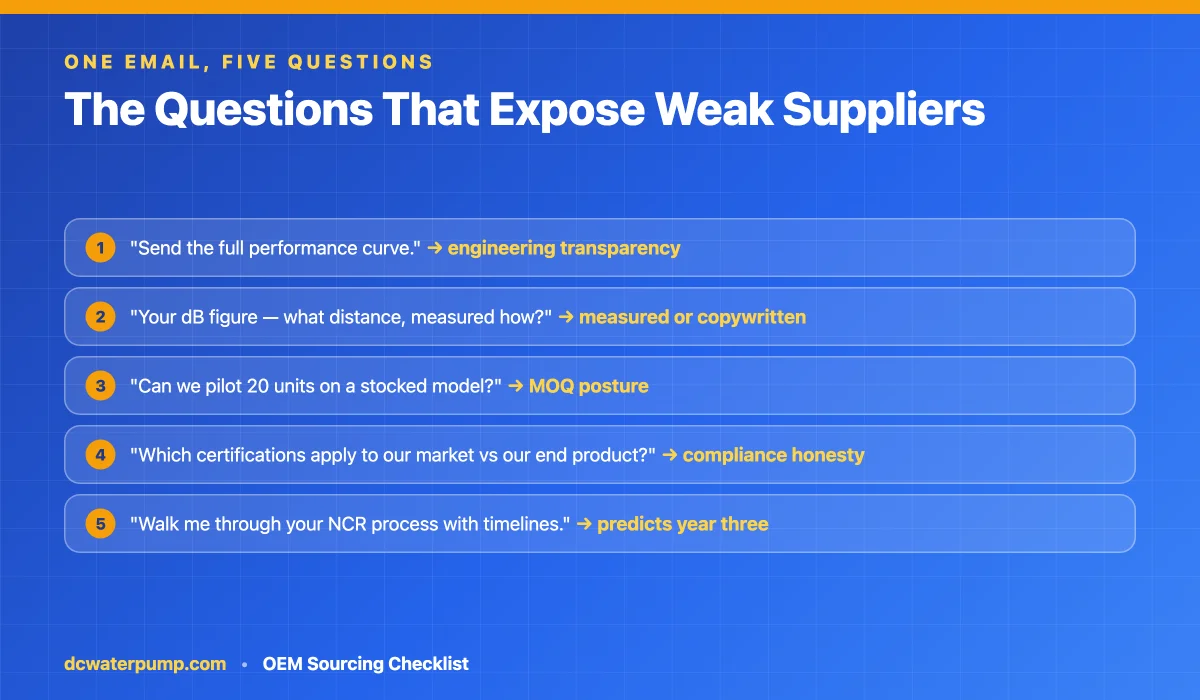
Five questions, askable in one email, whose answers tell you most of what the checklist would:
- “Send the full performance curve for model X.” (Tests: engineering transparency.)
- “What’s your dB figure, at what distance, measured how?” (Tests: whether specs are measured or copywritten.)
- “Can we start with a 20-unit pilot on a stocked model?” (Tests: MOQ posture.)
- “Which of your certifications apply to our target market, and which would apply to our end product instead?” (Tests: compliance honesty.)
- “Walk me through your NCR process with timelines.” (Tests: what happens when something goes wrong — the only question that predicts year three.)
We built BLDC PUMP’s cold plunge pump range to pass this checklist — published curves, continuous-duty BLDC designs under 35 dB, speed control across PWM/0–5V/potentiometer, 100% end-of-line testing, samples in 3–7 working days, and pilot-friendly MOQ terms — manufacturing brushless DC pumps since 2009. Send the five questions; we answer them for a living.
Frequently asked questions
What MOQ should I expect for OEM cold plunge pumps?
It varies by model, customization, and supplier — get quotes and compare. As a concrete reference point from our own practice: standard series run 100–500 pcs depending on model, pilot orders of 10–50 pcs on stocked models are negotiable at per-unit pricing, and custom versions need enough volume to justify tooling. Use figures like these as your negotiation baseline, not as a universal standard.
How fast should samples arrive?
Standard, stocked models should ship in days, not months — we ship ours in 3–7 working days, which is a fair benchmark to hold stocked models to. A longer sample lead time isn’t automatically damning (build-to-order production and testing queues are legitimate reasons) — but it always warrants the follow-up question, and an unexplained long lead time is the actual red flag.
What’s the single most important item on the spec sheet?
The performance curve. Every integration decision — chiller matching, filter allowance, control range — happens at an operating point on that curve. Suppliers who publish only max flow and max head are asking you to engineer blind.
How do I verify a noise claim before committing?
Demand the number with its method (dB at stated distance and condition), then reproduce it on the sample: 1 m, your operating point, your mounting. Noise is a per-model spec, not a technology-class guarantee — quality BLDC circulation pumps (ours included) publish sub-35 dB figures, and the datasheet plus your own measurement is what makes any such figure real.
What customization is reasonable to ask for?
Four dimensions are standard: performance re-tuning (voltage/flow/head on an existing platform), mechanical (ports, mounting), electrical (connectors, cable, control signal), and branding. Re-tuning and connector changes should cost engineering time and, where connectors are involved, possibly itemized tooling; genuine mold charges belong to new molds. The red flag is a charge the supplier can’t itemize.
Is 12V or 24V better for an OEM cold plunge product?
Both are standard in the class; the choice usually follows your system architecture — battery and solar-adjacent designs often favor 12V ecosystems, while 24V halves current for the same power (thinner cables, easier long runs). Specify the operating point either way and let the curve decide the model.
Where to go next
The engineering behind this checklist lives in the cluster: the five-step sizing method for the operating point, the noise verification method for the dB line, and the five failure modes your end users will hit if the spec is wrong.