
Cold Plunge Pump Reviews: What Buyers Are Really Asking in 2026
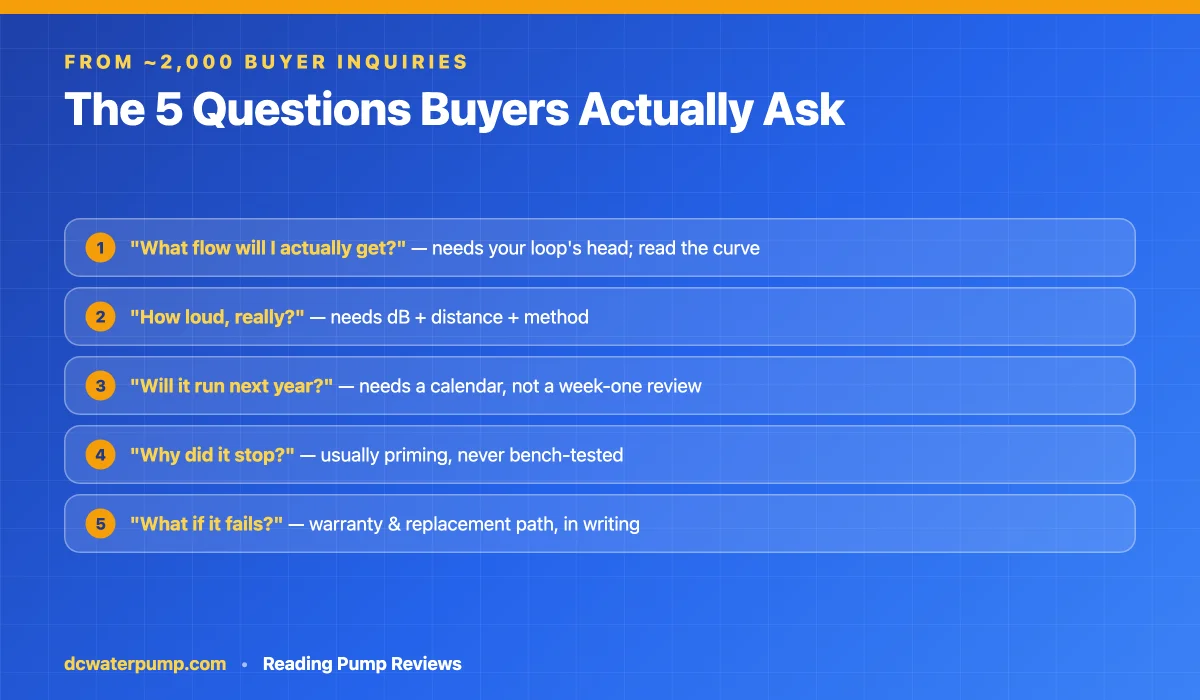
TL;DR: Cold plunge pump reviews mostly answer the questions that are easy to test in an afternoon — flow on a bench, price, unboxing impressions. But the questions buyers actually ask before purchase are different, and we can say that with unusual confidence: as a pump manufacturer, we’ve analyzed the patterns in nearly 2,000 buyer inquiries received since 2021. What buyers really probe: delivered flow in a real loop, noise they can verify, whether the pump survives year one, why pumps “stop working” (usually priming), and what happens when something fails. Here’s each question answered — and a skeptic’s checklist for reading any review.
How should you read cold plunge pump reviews?
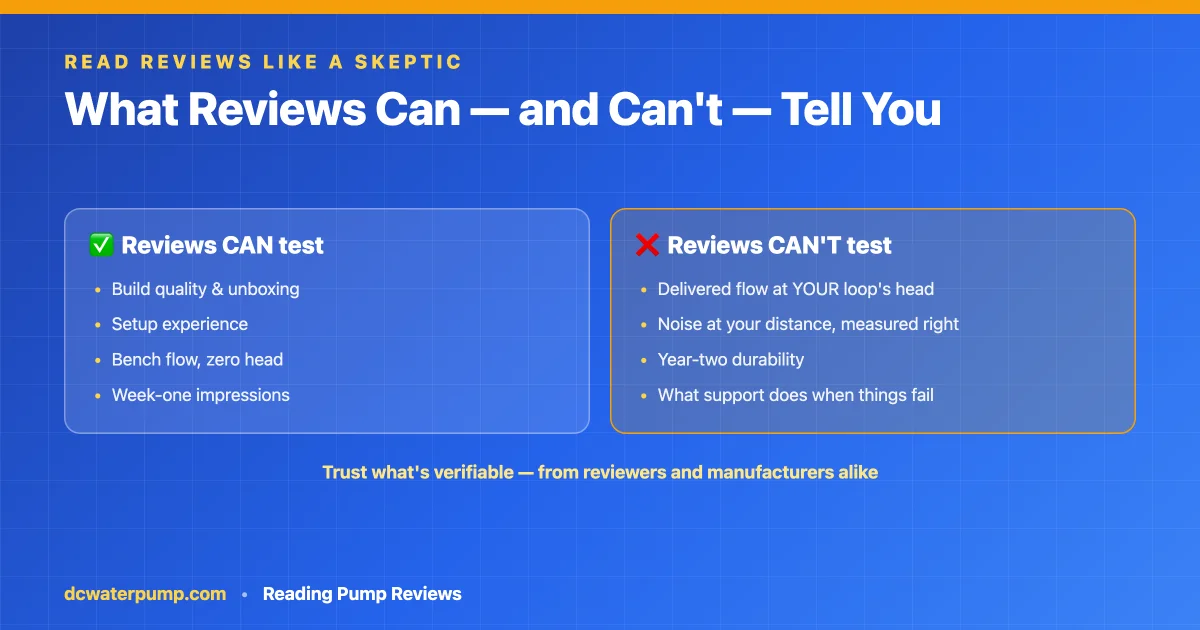
Read them for what they can test (build quality, setup experience, bench flow) and distrust them on what they can’t: delivered flow at your loop’s head, noise at your distance measured properly, and longevity — most reviews are written in week one of a pump that’s supposed to run for years.
The review landscape has a structural problem
Search “cold plunge pump reviews” and the results rotate the same handful of retail AC pumps through affiliate listicles, scored on specs transcribed from listings. Nothing wrong with honest listicles — but the format can’t answer the questions that decide satisfaction, because those questions need either a loaded loop, a sound meter and method, or a calendar. Meanwhile the category keeps growing — Grand View Research projects the tub market nearly doubling by 2033 — which means more first-time buyers reading week-one reviews to make three-year decisions.
We sit on an unusual dataset for this topic: the inquiry log of a pump manufacturer. Since 2021 we’ve received and categorized nearly 2,000 buyer inquiries — DIY builders, studio owners, OEM engineers — grouped by our sales team into recurring question and objection themes. Honest framing before we use it: this is directional data from one manufacturer’s funnel, not a market survey — buyers who contact a DC pump maker skew technical, and we can’t publish the raw log. What it’s good for is exactly this article’s question: the pattern of what people ask before money moves, which barely overlaps with what reviews cover. The five questions below are the recurring ones.
Question 1 — “What flow will I actually get?” (not “what’s the max flow?”)
The single most common technical thread in our inquiries is some version of: my loop has a chiller and a filter — what will this pump really deliver? Buyers have learned, often the hard way, that headline GPH evaporates against real head. Reviews rarely test this because it requires a plumbed loop per pump.
How to get the answer anyway: ignore review flow numbers; pull the pump’s published curve and read it at your loop’s head (the five-step method walks it). If neither the review nor the manufacturer offers a curve, that silence is your data point. Community guidance like Plunge Junkies’ GPH tiers is a sanity check, not a substitute for the curve.
Question 2 — “How loud is it, really?”
Noise questions run through our inquiry log with a telling detail: buyers don’t ask “is it quiet” — they ask for the number, because they’ve been burned by adjectives. Reviews usually report an impression (“barely noticeable”) from a garage, which transfers poorly to your bedroom-adjacent install.
How to get the answer: demand dB at a stated distance and condition, then verify on arrival with the measurement method — 1 m, your operating point, your mounting. Noise is a per-model spec: quality BLDC circulation pumps (ours included) publish sub-35 dB figures, and it’s the datasheet number plus your own measurement — not the technology label — that makes a claim real. Anything without a method attached is copywriting.
Question 3 — “Will it still be running next year?”
Reviews are structurally silent here — they’re published in week one. Our inquiry data fills in what happens later: the durability questions buyers ask cluster around continuous duty (“can it really run 24/7?”), wear (“what fails first?”), and the honest answer involves architecture: brushless designs remove brush wear from the equation entirely, magnetic drive removes the shaft seal, and bearings remain the long-term wear item — which is why design life is a per-model spec tied to operating conditions (quality BLDC units, ours included, publish figures on the order of tens of thousands of hours, model-dependent) and why bearing quality is the spec that decides whether “quiet in the review” stays quiet in year two.
Question 4 — “Why did my pump stop working?” (the priming question)
Here’s the statistic reviews never surface: priming-related issues account for roughly 12% of the pre-sale objections in our 2021–2026 inquiry dataset — the single largest “will something go wrong with this pump” theme buyers raise before purchase. And the community’s post-mortems on this pump class point the same direction: for flooded-suction circulation pumps, lost prime and mounting errors dominate the reported causes of “pump stopped working” — the pump spins without moving water after being mounted above the waterline or airlocked at a filter change. (Self-priming designs and pumps with dry-run protection fail differently; this is a flooded-suction story.) Reviews conducted on a bench with a bucket never encounter it; owners encounter it constantly.
How to get ahead of it: before buying, check that the listing states mounting constraints plainly (a spec sheet that explains flooded suction is a supplier who understands their product); after buying, pump below the waterline, bleed air after service. The primer covers the physics; the five-mistakes guide covers what happens to the chiller when flow silently stops.
Question 5 — “What happens if it fails?”
The quiet giant of our inquiry log: warranty terms, replacement process, spare availability, lead time on a replacement. Reviews score the product; buyers increasingly evaluate the relationship — and they’re right to, for a component that runs continuously under a tub they use daily. A useful review would test the support channel; almost none do.
How to get the answer: ask the seller two questions before purchase — warranty terms in writing, and the concrete replacement path with timelines. (OEM buyers: this scales into the full sourcing checklist, NCR process included.)
The skeptic’s checklist for any pump review
| Review claim | Trust it if… | Discount it if… |
|---|---|---|
| Flow | Measured on a loop with stated head, or curve cited | Transcribed from the listing |
| Noise | dB + distance + condition given | “Whisper quiet” and vibes |
| Durability | Long-term follow-up or fleet data | Week-one impressions |
| “Best for cold plunge” | Tested with chiller and filter inline | Tested in a bucket |
| Value | Energy use and lifespan in the math | Purchase price only |
Where we stand in this conversation: we make the pumps, so we don’t publish “reviews” — we publish curves, dB figures with method, duty ratings, and the sourcing questions we invite buyers to test us with. That’s the standard we think buyers should hold everyone to, us included: BLDC PUMP’s cold plunge range — brushless DC, magnetic drive, published specs, built since 2009, samples in 3–7 working days.
Frequently asked questions
What is the best cold plunge pump in 2026?
The one whose published curve delivers your loop’s target flow at its real head, inside your chiller’s specified range, with a verifiable noise figure and a duty rating that matches 24/7 use. That’s a specification, not a brand — and it’s why “best pump” lists that skip your loop’s numbers can’t actually answer the question.
Are expensive cold plunge pumps worth it?
Price correlates loosely with what matters. The premiums most likely to earn their keep: brushless architecture (noise and wear), magnetic drive (no shaft seal), published curves (engineering trust), and speed control (one pump fits changing conditions). Whether they actually pay back depends on your duty hours, energy prices, and how long you keep the system — run that arithmetic for your build. A high price without those features, though, is just a high price.
Why do so many cold plunge pump reviews recommend the same pumps?
The practical mechanism is structural: review sites can only test and link what’s available through retail channels, and affiliate programs exist mostly around those same retail products. DC and OEM-class options sit largely outside retail distribution, so they appear less often — a coverage gap that follows from how the channel works, not necessarily a judgment on any pump’s merits.
What do buyers worry about most before buying?
In our pre-sale inquiry patterns: priming and installation questions lead (roughly one in eight objections in our dataset relate to priming), noise concerns second, and delivered-flow doubts third. Community reports after purchase echo the same three themes — and all three are addressable at selection time with a curve, a dB method, and honest head math. (Our data covers the pre-sale side; we don’t have equivalent statistics on post-purchase complaints and won’t pretend to.)
Should I trust manufacturer specs over reviews?
Trust verifiable claims from either source: a manufacturer’s curve and dB-with-method are testable on the sample; a reviewer’s loaded-loop measurement is real evidence. Distrust unverifiable claims from both — adjectives in listings and impressions in reviews are the same genre.
Is a BLDC pump worth it for a cold plunge?
If your build values quiet (sub-35 dB class), continuous duty (tens-of-thousands-of-hours design lives), low-voltage supply, or speed adjustability — the four themes that dominate real buyer questions — then yes, that’s precisely the case BLDC architecture was built for. For a garage build around retail AC parts with same-week replacement as the priority, the AC path remains legitimate.
Where to go next
Turn the questions into decisions: scenario first (cold plunge vs ice bath), then the five-step sizing method, the noise verification method, and the five mistakes that turn good purchases into dead chillers.